

Drawings and documents
National Archives restored drawings: drawing
Stacy Costell's Patent Drawing for a Steam Engine

National Archives, Restored Patent Drawings (Record Group 241) · Full-size scan at the National Archives · Catalog record
Show the text on the drawing Hide (138 words)
Words on the drawing as machine-read by the National Archives; not checked. Useful mainly for searching.
121, STEAM. / As / I. ENGINES / [150] Oscillating. / CLASSINICATION / 6939 / / DIVISION. / $3. / Stacy Costell's / Steam Engine / Patented:Febr20:1332. / Fig1. / HC / GC / On / ELL / Fig2. / Fig 3. / Figh / Fig5 / Fight / Figh. / Figs / Fig9. / References. / A, Stands. / B, Fig 1, 586 Vibrating cylinders / c, Fig: 1, 2, Stationary raive, prevented from vibrating by the / stop K, (Fig.2, Face, Fig 3, Section shewing the channels, Fig 4, / back view shewing the opening. for induction and eduction.) / D, Valme seats with openings into the cylinder. / E, Piston rod, one end attached to the crank L, on the shaft of flywheele / F, Stuffing box / G, F'ollowerofthe stuffing box forming a stide for the peston rod. / H, Journals / 1, Figat,138, Bar attached to the journals whichs holds the valve to its / seats, (Fight, Front Fig:8 Edge.) / F. Benne del
USPTO scan
The patent as scanned by the USPTO
-
 Page 1
-
 Page 2
-
 Page 3


U.S. Patent and Trademark Office · Google Patents
Show the transcription Hide (473 words)
Machine transcription (LightOnOCR) of the pages as scanned by the USPTO, most of them the handwritten copies made when the records were restored after the 1836 fire. Not checked; it can misread handwriting, so compare it with the scan.
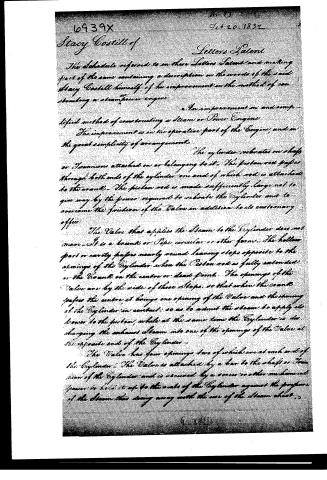
Page 1.
6939X
S. Costell,
Oscillating Steam Engine.
Patented Feb. 20, 1832.

Page 2.
16939X
Stacy Costill of
Letters Patent
The Schedule referred to in these Letters Patent and making part of the same, containing a description in the words of the said Stacy Costill himself, of his improvement in the method of constructing a steam power engine.
An improvement in, and simplified method of constructing a Steam or Power Engine.
The improvement is in the operative part of the Engine, and in the great simplicity of arrangement.
The cylinder vibrates on shafts or Journals attached on or belonging to it. The piston rod passes through both ends of the cylinder one end of which rod is attached to the crank. The piston rod is made sufficiently large not to give way by the power required to vibrate the Cylinder and to overcome the friction of the Valve in addition to its customary office.
The Valve that applies the Steam to the Cylinder does not move. It is a brunt or Pipe circular or other form. The hollow part or cavity passes nearly round leaving stops opposite to the openings of the Cylinder when the Piston rod is fully extended or the brunt on the centre or dead point. The openings of the Valve are by the side of these Stops, so that when the crank passes the centre, it brings one opening of the Valve and the opening of the Cylinder in contact, so as to admit the steam to apply its power to the piston, while at the same time the Cylinder is discharging the exhaust Steam into one of the openings of the Valve at the opposite end of the Cylinder.
The Valve has four openings, two of which are at each end of the Cylinder. The Valve is attached by a bar to the shaft or Journal of the Cylinder and is secured by a screw or other mechanical power to hold it up to the ends of the Cylinder against the pressure of the steam, this being away with the use of the steam chest.
G. W. H.
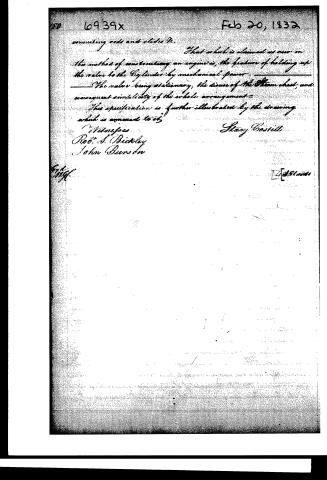
Page 3.
connecting rods and slides &c.
That which is claimed as new in the method of constructing an engine is, the feature of holding up the valve to the Cylinder by mechanical power. The valve being stationary, the issue of the Steam chest, and consequent simplicity of the whole arrangement.
This specification is further illustrated by the drawing which is annexed to it.
Stacy Bastill
Witnesses
Robt. S. Bickley
John Burns
Filed
Published accounts: journal notice
Notice in the monthly list of patents, with remarks
Journal of the Franklin Institute, new ser., vol. 10 (1832), p. 90 · View the page
21. For an improvement in the mode of constructing the Steam Engine; Stacy Costil, city of Philadelphia, February 20.
Remarks. The cylinder of this engine is to vibrate on trunnions at its centre, and the piston rod is to be passed through a stuffing box at each of its ends. There are openings for the admission and discharge of steam, at each end of the cylinder, and faced plates forming the valve seats, which are in the same vertical plane with a cross section of one of the trunnions. There are no steam ways cast on the cylinder, the steam being let on and off directly through these openings on the faced plate. The stationary valve against which the faced plates vibrate, is a flat hoop, concentric with the trunnions, and sufficiently large in diameter to extend from end to end of the cylinder, and to cover the valve seats. This flat hoop is cast hollow, for steam ways, each hollow forming nearly a semicircle, but with stops between them to prevent their communicating with each other. On that face of the hoop which fits on to the fore plates there are four openings, two to each face plate, serving to let the steam on and off at each vibration. Steam, and eduction pipes, enter at the other, or outer side, of the hoop. This hoop is held up against the valve seats by a bar of iron which crosses it, and which is borne up by a screw. The claim is to the "holding the valve against the cylinder by mechanical power, the valve being stationary, the disuse of the steam chest, and the consequent simplicity of the whole arrangement." There is no small resemblance between the action of this valve and that described by Mr. Halloway at p. 43, under the name of the wing gudgeon valve. In that, the openings are near to the trunnions, in this, the fore valve is extended so as to carry the openings to the ends of the cylinder: and what is a little singular, both these patentees make one of their claims to consist in "the simplicity of the whole," which simplicity is rather an unpatentable article.
About this record
- Patentee
- DATAMP
- Date
- the Name and Date index of patents, DATAMP, USPTO records
- Invention
- DATAMP
- Listed in
- the Name and Date index of patents, DATAMP, USPTO records, Jim Shaw's X-patent list, the Journal of the Franklin Institute, Burke's List of Patents (1847)
- The Franklin Institute's journal spells the name differently.
- Burke's 1847 Patent Office list gives the same patent.