

Drawings and documents
National Archives restored drawings: drawing
Roger N. Lambert's Patent Drawing for a Cane Rifle

National Archives, Restored Patent Drawings (Record Group 241) · Full-size scan at the National Archives · Catalog record
Show the text on the drawing Hide (183 words)
Words on the drawing as machine-read by the National Archives; not checked. Useful mainly for searching.
63 FIRE-ARMS. / Cane-Guns, / Родеч A. Lambert / Vol. 14 pg 213 / Patented Febryth 1832. / Game Prifle. / CLASSIFICATION / 6945X / DIV ISION. / Top view of the cane / 69457 / Section of barrel Lock / cockseenfrombolow / Patent affice 31 July 1841 / section of the came & ferrule / made under the disection of Commissioner I Patents / in conformity with actaf's march 1837. / MLSUMOSTH / of Patents / Head of care / Viewof the / eh L. Heischmana he / View of the Prifle Cane / Preferences. a the barrel b head of the cane C cylindrical metal plate 02 slide plate. ddthe slit e pirot pin e' bruch pm f corefor persuaren cap. g.g side plate of the lock, h the mainspring i the cock / K small dog l its spring m the Trigger. m the inner forule at the muzzle. n the can 0 the spiral spring p exterior ferule q capaf the ferul 2 the sightpin. t slit on the cock for aiming / u inner ferule V.D slides in the barrel w the Ring X the bilt for securing the head. y notch in the stide plate
USPTO scan
The patent as scanned by the USPTO
-
 Page 1
-
 Page 2
-
 Page 3
-
 Page 4
-
 Page 5
-
 Page 6
-
 Page 7


U.S. Patent and Trademark Office · Google Patents
Show the transcription Hide (1,689 words)
Machine transcription (LightOnOCR) of the pages as scanned by the USPTO, most of them the handwritten copies made when the records were restored after the 1836 fire. Not checked; it can misread handwriting, so compare it with the scan.
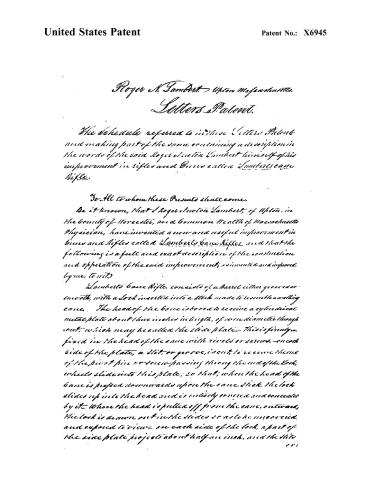
Page 2.
United States Patent
Patent No.: X6945
Roger N. Lambert, Upton Massachusetts.
Letters Patent.
The Schedule referred to in these Letters Patent and making part of the same containing a description in the words of the said Roger Norton Lambert himself of his improvement in rifles and Guns called Lambert's cane Rifle.
To All to whom these Presents shall come,
Be it known, that I Roger Norton Lambert, of Upton, in the County of Worcester, and Common Wealth of Massachusetts Physician, have invented a new and useful improvement in Guns and Rifles called Lambert's Cane Rifle and that the following is a full and exact description of the construction and operation of the said improvement, as invented and improved by me, to wit:
Lambert's Cane Rifle consists of a barrel either grooved or smooth, with a lock inserted into a stock made to resemble a walking cane. The head of the cane is bored to receive a cylindrical metal plate about three inches in length, of one diameter throughout, which may be called the slide plate. This is firmly fixed in the head of the cane with rivets or screws. On each side of the plate, a slit, or groove, is cut, to receive the end of the pivot pin or screw passing through the end of the lock, which slides into this plate, so that, when the head of the cane is pushed downwards upon the cane stick, the lock slides up into the head and is entirely enclosed and concealed by it. When the head is pulled off from the cane, outward, the lock is drawn out in the slides so as to be uncovered and exposed to view. On each side of the lock, a part of the slide plate projects about half an inch, and the slit
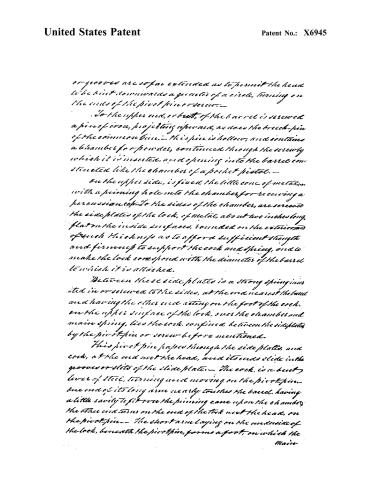
Page 3.
United States Patent
Patent No.: X6945
or grooves are so far extended as to permit the head to be bent downwards a quarter of a circle, turning on the axis of the pivot pin or screw.
To the upper end, or butt, of the barrel is screwed a pin of iron, projecting upwards, as does the breech-pin of the common gun. This pin is hollow, and contains a chamber for powder, continued through the screw by which it is inserted, and opening into the barrel constructed like the chamber of a pocket pistol.
On the upper side, is fixed the little cone of metal, with a priming hole into the chamber, for receiving a percussion cap. To the sides of the chamber, are screwed the side plates of the lock, of metal, about two inches long, flat on the inside surfaces, rounded on the exterior, and of such thickness as to afford sufficient strength and firmness to support the cock and spring, and to make the lock correspond with the diameter of the barrel to which it is attached.
Between these side plates is a strong spring inserted in or screwed to the sides, at the end nearest the butt and having the other end acting on the foot of the cock. On the upper surface of the lock, over the chamber and main spring, lies the cock, confined between the side plates by the pivot pin or screw before mentioned.
This pivot pin passes through the side plates, and cock, at the end near the head, and its ends slide in the grooves or slots of the slide plate. The cock, is a bent lever of steel, turning and moving on the pivot pin. One end of its long arm nearly touches the barrel, having a little cavity left over the priming cone upon the chamber; the other end turns on the end of the lock near the head, on the pivot pin. The short arm laying on the underside of the lock, beneath the pivot pin, forms a foot, on which the
Main
Page 4.
United States Patent
Patent No.: X6945
main spring rests and acts, either directly or by a stirrup pressing the end of the long arm down on the priming cane, a small dog of steel having a notch or tooth on its surface on which the edge of the slide plate in the head, catches, when the head of the cane is bent down, is let into the lower outer edge of the foot of the cock and moves with it. This dog, rests on a spring, also let into the foot of the cock which keeps it out so far beyond the surface of the lock, as to catch the edge of the slide plate when the head is bent down. — The trigger lays in the plate which covers the lower side of the lock. When the cock is down, the trigger is level with the surface. — When the cock is elevated, it is started out and rests against the dog let into the foot of the cock. Being pulled, it depresses the dog, and disengages the cock from the edge of the slide plate. The cock is then thrown down by the action of the main spring on the priming cane.
To the end of the barrel at the muzzle an inner female of metal is closely fitted. — The barrel slides within the stick, or cane, about half an inch. — A spiral spring is wound round it, one end of which rests on and acts against the inner female at the muzzle; and the other is drawn and acts against the end of the cane or stick, keeping the barrel out so far as it is permitted to slide. — Over this, is an exterior female, fastened with screws or rivets to the cane, carrying the spiral spring and resembling in appearance the inner female of a common walking cane.
When the barrel is pulled so as to slide into the cane, the extremity or cap of the female, which is hung by a stay of metal in the side of the female with a hinge or pivot at their extremity, falls off by its own weight. — The spiral spring causes the barrel to start out, thus preventing the cap from being replaced until the barrel is again drawn in, a small screw or pin, on this female, answers the purpose of a sight for
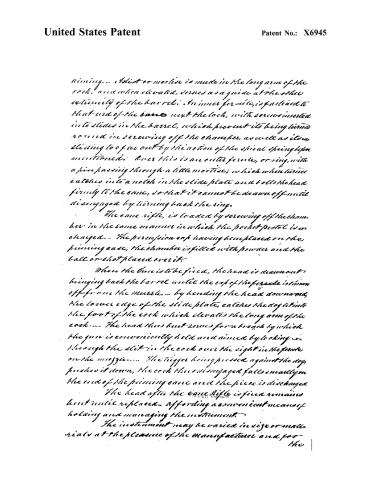
Page 5.
United States Patent
Patent No.: X6945
aiming... A slit or mortise is made in the long arm of the cock, and when elevated, serves as a guide at the other extremity of the barrel. An inner female, is fastened to that end of the same next the cock, with screws inserted into slides in the barrel, which prevent its being turned round in screwing off the chamber, as well as its sliding too far out by the action of the spiral spring before mentioned. Over this is an outer female, or ring, with a pin passing through a little mortise; which when turned catches into a notch in the slide plate and holds the head firmly to the case, so that it cannot be drawn off until disengaged by turning back the ring.
The same rifle, is loaded by screwing off the chamber in the same manner in which the pocket pistol is uncharged. The percussion cap having been placed on the priming case, the chamber is filled with powder and the ball or shot placed over it.
When the gun is to be fired, the head is drawn out, bringing back the barrel until the end of the female is thrown off from the muzzle. By bending the head downward, the lower edge of the slide plate, catches the dog into the foot of the cock which elevates the long arm of the cock. The head thus bent serves for a breach by which the gun is conveniently held and aimed by looking through the slit in the cock over the sight in the female on the muzzle. The trigger being pressed against the dog, pushes it down, the cock thus disengaged falls smartly on the end of the priming case and the piece is discharged.
The head after the same rifle is fired remains bent until replaced, affording a convenient means of holding and managing the instrument.
The instrument may be varied in size or materials at the pleasure of the manufacturer and for the
Page 6.
United States Patent
Patent No.: X6945
the purpose of adapting it to the different uses of which it is susceptible.
The instrument, when closed, so entirely resembles a common walking cane, and the brace and apparatus are so perfectly connected in the stick, that it would require very careful examination by those not acquainted with its construction, to discover the uses for which it is designed, as an efficient weapon of offense or defense, and for the purposes of the marksmen and Hunter.
Your petitioners particularly claims as his invention in the Rifle-cane above specified, and described.
1st—The sliding of the brace in the cane so as to remove the cap over the muzzle.
2nd—The movement and apparatus by which the cap is thrown off and replaced, in its application to the cane rifle.
3rd—The motion of the head, at the same time elevating the cock and furnishing a brace to hold and manage the instrument, and a guide to aim the rifle.
In Testimony that the above is a true specification of my said improvement as above described, I have hereunto set my hand and seal the second day of February in the year of our Lord eighteen hundred and thirty-two.
Witnesses
William Lincoln
William S. Lincoln
Rogers & Burton Vanders
Ex.
C.K.W.
1650 ndr.
Page 7.
United States Patent
Patent No.: X6945
R. H. LAMBERT
Humble-Loading Fire-Arm.
Patented Feb. 27, 1882.

Top view of the Gun & Lock
Section of Gun & Lock
Section of the Gun & Barrel
View of the cap & Gun
View of the Rifle Case
Published accounts: journal notice
Notice in the monthly list of patents
Journal of the Franklin Institute, new ser., vol. 10 (1832), p. 92 · View the page
25. For a Cane Rifle; being an improvement on rifles and guns; Roger Newton Lambert, Repton, Worcester county, Massachusetts, February 27.
About this record
- Patentee
- DATAMP
- Date
- the Name and Date index of patents, DATAMP, USPTO records
- Invention
- DATAMP
- Listed in
- the Name and Date index of patents, DATAMP, USPTO records, Jim Shaw's X-patent list, the Journal of the Franklin Institute, Burke's List of Patents (1847)
- Burke's 1847 Patent Office list gives the same patent.