

Drawings and documents
National Archives restored drawings: drawing
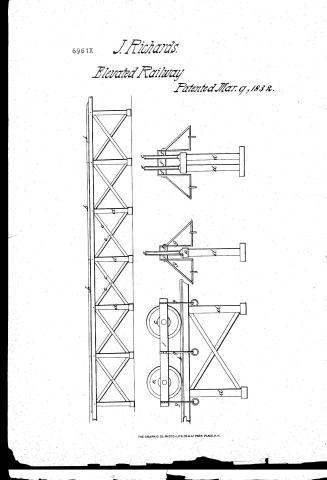
Jedediah Richards' Patent Drawing for a Railway and Cars

National Archives, Restored Patent Drawings (Record Group 241) · Full-size scan at the National Archives · Catalog record
Show the text on the drawing Hide (115 words)
Words on the drawing as machine-read by the National Archives; not checked. Useful mainly for searching.
RAIL WAIS. / "The Way." / [120] Elevated. / # 696/x / CLASSIFICATION / Sedediah Prichards / 6961 X / DIVISION. / Railway &. Cars. / Vol th. pg. 445. / Patented Narch g. 1832. / Patented march 9.1832. / single Railway a. / Tide view of the car KRailway / Front of f Railway & Car. / Double Prailway. / Preferences. a.a. single Prailway. b.b ron zib. ce.e.e No. Diagonal braces. dd. supports. / e.e wheels of the car If the frame. g.y.g armsto suspend the burdens. / Patent affice December 7.1841. the / made under the dir cetion of the Commifriener of / Patents in conformity with act of , ad March 1857. / Com misiconer of Patints.
USPTO scan
The patent as scanned by the USPTO
-
 Page 1
-
 Page 2
-
 Page 3


U.S. Patent and Trademark Office · Google Patents
Show the transcription Hide (607 words)
Machine transcription (LightOnOCR) of the pages as scanned by the USPTO, most of them the handwritten copies made when the records were restored after the 1836 fire. Not checked; it can misread handwriting, so compare it with the scan.
Page 1.
6961X J. Richards.
Elevated Railway
Patented Mar. 9, 1832.
THE GRAPHIC CO. PHOTO-LITH. 39 & 41 PARK PLACE, N.Y.
Page 2.
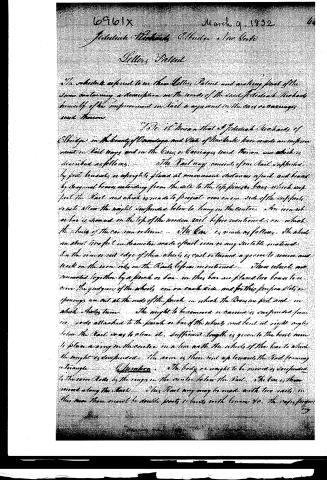
March 9, 1832
Jedediah Richards, Eldridge, New York
Letters Patent
The schedule referred to in these Letters Patent and making part of the same containing a description in the words of the said Jedediah Richards himself of his improvement in Rail ways and in the cars or carriages used thereon.
To all to whom this shall come, Jedediah Richards of Eldridge in the county of Orange and State of New York have made an improvement in Rail ways and in the cars or carriages used thereon which is described as follows. The Rail way consists of one Rail supported by post braces or uprights placed at convenient distances apart and braced by diagonal braces extending from the side to the top piece or bar which support the Rail and which is made to project over one side of the supports so as to allow the weight suspended below to hang in the center. An iron bar or bar is secured on the top of the wooden rail before mentioned on which the wheels of the car run outwards. The Car is made as follows. The wheels are about two feet in diameter made of cast iron or any suitable material. In the inner or set edge of these wheels is cast or turned a groove to receive and work on the iron side on the Rails before mentioned. These wheels are connected together by a fork or bar, in this bar are placed two boxes to receive the gutters of the wheels, one on each side and for this purpose slots or openings are cut at the ends of the fork in which the Boxes are put and in which they turn. The weight to be removed or carried is suspended from iron rods attached to the fork or bar of the wheels and lead at right angles below the Rail so as to clear it. Sufficient length is given to the boxes to place a string or the centre in a line with the wheels of the bar to which the weight is suspended. The car is then run up towards the Rail forming a triangle. Otherwise, the body or weight to be moved is suspended to the iron sides by the rings in the centre below the Rail. The bar is then moved along the Rail. This Rail way may be made with two rails, in this case there must be double posts or braced with braces etc. The car is formed by
Page 3.
Mar 9, 1832
over on each side sufficiently far to let the load pass the wheels being sufficiently strong for the purpose. This rail way and cars is calculated to unload, travel, and remove heavy weights, also for travelling when and for this purpose the carriage is to be filled up for accommodating any convenient number of passengers and suspended below the wheels and rail.
What I claim as my invention and desire to secure by Letters Patent is the before described improvement in rail ways and in the cars or carriages used thereon. For further illustration of my invention I refer to the model and drawing of the same deposited on the Patent Office.
In testimony whereof I have hereunto subscribed my name this 7th day of March 1832.
Federal Sturtevant
Witnesses:
Wm. William Elliott
Samuel P. Walker
(600 words)
Published accounts: journal notice
Notice in the monthly list of patents, with remarks
Journal of the Franklin Institute, new ser., vol. 10 (1832), p. 159 · View the page
11. For Rail-ways and Cars used thereon; Jedediah Richards, Elbridge, Onondaga county, New York, March 9.
Remarks. The rail-way is to be a single rail, sustained by suitable supports. Two wheels, in a frame made for the purpose, are to run on this rail, the car being suspended under it by iron rods attached to the frame of the wheels. The claim is " to the before described improvements in rail-ways, and in the cars or carriages used thereon." Single suspension rails were patented in England by Mr. H. R. Palmer, six or seven years ago, and are described in this journal for April, 1828; they, however, have never been brought into practical use. There is but little difference between the present plan and that proposed by Mr. Palmer; the principle of both is the same, and we do not think that Mr. Richards has made any improvement on that first suggested, nor has he alluded to it, but has taken his patent as though single rails were absolutely new.
About this record
- Patentee
- DATAMP
- Date
- the Name and Date index of patents, DATAMP, USPTO records
- Invention
- DATAMP
- Listed in
- the Name and Date index of patents, DATAMP, USPTO records, Jim Shaw's X-patent list, the Journal of the Franklin Institute, Burke's List of Patents (1847)
- Burke's 1847 Patent Office list gives the same patent.