

Drawings and documents
USPTO scan
The patent as scanned by the USPTO
-
 Page 1
-
 Page 2
-
 Page 3


U.S. Patent and Trademark Office · Google Patents
Show the transcription Hide (872 words)
Machine transcription (LightOnOCR) of the pages as scanned by the USPTO, most of them the handwritten copies made when the records were restored after the 1836 fire. Not checked; it can misread handwriting, so compare it with the scan.
Page 1.
UNITED STATES PATENT OFFICE
PTO – BOYERS, PA DUTY STATION
PAGE NOT AVAILABLE
PATENT NUMBER X6989 FOR THE ISSUE DATE 4/6/1832 HAS BEEN SCANNED/LOADED, BUT WITH MISSING PAGE(S). UPON RECEIPT OF THE MISSING PAGE(S), THE ENTIRE DOCUMENT WILL BE RESCANNED. THIS NOTICE IS FOR THE MISSING PAGE CONTAINING:
Missing All Drawings
DATA CONVERSION OPERATION
BOYERS, PA
Page 2.
XL989
4-6-1832 417
Josiah Pratt Junr.
Letters Patent
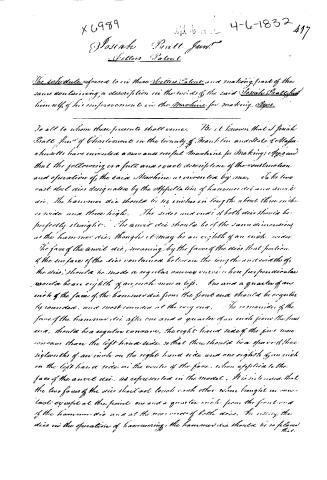
The schedule referred to in these Letters Patent and making part of the same containing a description in the words of the said Josiah Pratt Junr. himself of his improvement in the Machine for making Paper.
To all to whom these presents shall come. Be it known that I Josiah Pratt Junr. of Charleston in the county of Franklin and State of Massachusetts have invented a new and useful Machine for Making Paper and that the following is a full and exact description of the construction and operation of the said Machine as invented by me. To the two cast steel dies designated by the Appellation of hammer die and anvil die. The hammer die should be six inches in length about three inches wide and three high. The sides and ends of both dies should be perfectly straight. The anvil die should be of the same dimension as the hammer die, though it may be an eighth of an inch wider. The face of the anvil die, meaning by the face of the dies that portion of the surface of the dies contained between the long side and width of the dies, should be made a regular concave curve whose perpendicular would be an eighth of an inch more or less. One and a quarter of an inch of the face of the hammer die from the front end should be regularly rounded, and most rounded at the very end. The remainder of the face of the hammer die after one and a quarter of an inch from the front end, should be a regular concave, the right hand side of the face more concave than the left hand side, so that there should be a space of three eighths of an inch on the right hand side and one eighth of an inch on the left hand side in the centre of the face, when applied to the face of the anvil die, as represented in the model. It is intended that the two faces of the dies shall not touch each other when brought in contact except at the point one and a quarter inch from the front end of the hammer die and at the rear ends of both dies. In using the dies in the operation of hammering, the hammer die should be so placed that
Page 3.
418 X 6989
4-6-1832
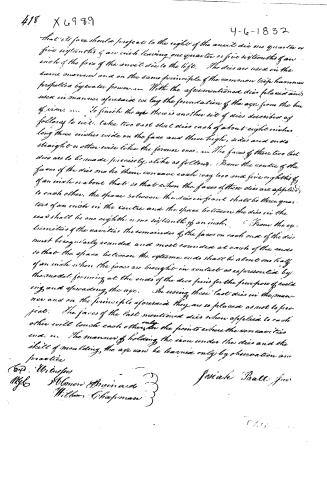
that its face should project to the right of the annul die one quarter or five sixteenths of an inch. Leaving one quarter or five sixteenths of an inch of the face of the annul die to the left. The dies are used in the same manner and on the same principle of the common life hammer propelled by water power. With the aforementioned dies placed and used in manner aforesaid we lay the foundation of the axe from the bar of iron. To finish the axe there is another set of dies described as follows to wit. Take two cast steel dies each of about eight inches long three inches wide on the face and three high, sides and ends straight or other wise like the former ones. The faces of these two last dies are to be made precisely alike as follows. From the centre of the faces of the dies make them concave each way two and five eighths of an inch or about that so that when the faces of these dies are applied to each other, the space between the dies in front shall be three quarters of an inch in the centre and the space between the dies in the rear shall be one eighth or one sixteenth of an inch. From the extremities of the cavities the remainder of the faces on each end of the dies must be regularly rounded and most rounded at each of the ends so that the space between the extreme ends shall be about one half of an inch when the faces are brought in contact as represented by the model forming at the ends of the dies pins for the purpose of welding and spreading the axe. In using these last dies in the manner and on the principle aforesaid they are so placed as not to project. The faces of the last mentioned dies when applied to each other will touch each other only the points where the concavities end. The manner of holding the iron under the dies and the skill of moulding the axe can be learned only by observation and practice.
Josiah Pratt, Jr.
Wm. H. Winters
Wm. H. Winters & Thainards
William Chapman
(13)
Published accounts: journal notice
Notice in the monthly list of patents, with remarks
Journal of the Franklin Institute, new ser., vol. 10 (1832), p. 234 · View the page
(See description among the specifications.) 12. For a Machine for making Axes; Josiah Pratt, jr., Claremont, Franklin county, Massachusetts, April 6.
Remarks. This machinery consists of what the patentee denominates hammer and anvil dies; the first kind are to be worked like a trip hammer, the last, as the name indicates, forming the anvil, or bed. A particular description of the curvature of the faces of these dies, and of their size, is given in the specification. The foundation of the axe from the bar of iron, is laid with one pair of dies, and another set is used for finishing. There is no claim made; reliance being placed on the entire novelty of the whole plan. "The manner of holding the iron under the dies, and the skill of moulding the axe,” we are told, can be learnt only by observation' and practice."
About this record
- Patentee
- DATAMP
- Date
- the Name and Date index of patents, DATAMP, USPTO records
- Invention
- DATAMP
- Listed in
- the Name and Date index of patents, DATAMP, USPTO records, Jim Shaw's X-patent list, the Journal of the Franklin Institute, Burke's List of Patents (1847)
- Burke's 1847 Patent Office list gives the same patent.