

Drawings and documents
National Archives restored drawings: drawing
George A. Madeira's Patent Drawing for Machinery for Holding and Guiding Edge Tools, When Grinding

National Archives, Restored Patent Drawings (Record Group 241) · Full-size scan at the National Archives · Catalog record
Show the text on the drawing Hide (122 words)
Words on the drawing as machine-read by the National Archives; not checked. Useful mainly for searching.
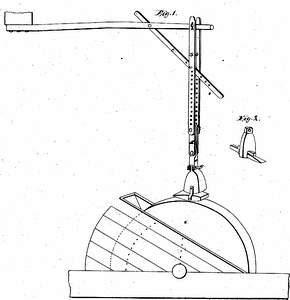
1. GRINDING & POLISHING, / thing limidul Pole / Bibb / Clap / metal, / Edge Tools. / CLASS $150 MON / George A Madira / 7010-x / Machinerey for holding and guiding Edge Tools, whengrinding / DIVISION. / no HP@ / Volin pg. 181. / Patented apt 19. 1832. / Preferences. / a the spring pole. / b.b. the hanger / C diagonal brace / Jig.2 / d the continuation of the hanger. / e the movemble piece to which the blockisfastened / of the block. and Tig.2 for different tools. / g the joint pin upon which it moves sidewards. / h an are / i the grind stone. / Patent Offier De / made under the direction of the Commissions / of Patents in conformity with act of March / nd sumorth / Commisions of Patents.
USPTO scan
The patent as scanned by the USPTO
-
 Page 1
-
 Page 2
-
 Page 3


U.S. Patent and Trademark Office · Google Patents
Show the transcription Hide (694 words)
Machine transcription (LightOnOCR) of the pages as scanned by the USPTO, most of them the handwritten copies made when the records were restored after the 1836 fire. Not checked; it can misread handwriting, so compare it with the scan.
Page 1.
7010X
G. A. Madeira,
Edge-Tool Grinder.
Patented Apr. 19, 1832.

Page 2.
7010X
Apr 19, 1832
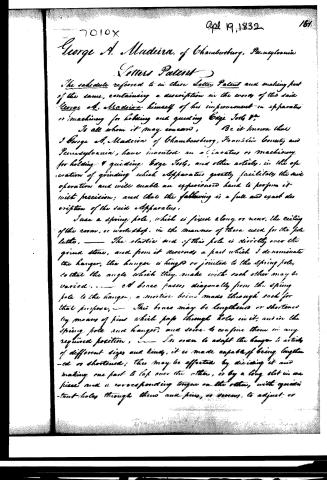
George A. Madeira, of Chambersburg, Pennsylvania
Letters Patent
The schedule referred to in these Letters Patent and making part of the same, containing a description in the words of the said George A. Madeira himself of his improvement in apparatus or machinery for holding and guiding Edge Tools &c.
To all whom it may concern, Be it known that I George A. Madeira of Chambersburg, Franklin County and Pennsylvania, have invented an apparatus or machinery for holding & guiding Edge Tools, and other articles, in the operation of grinding which apparatus greatly facilitates the said operation and will enable an experienced hand to perform it with precision; and that the following is a full and exact description of the said apparatus.
I use a spring pole, which is fixed along or near, the ceiling of the room, or workshop, in the manner of those used for the pole laths. — The slanting arm of this pole is directly over the grind stone, and from it descends a part which I denominate the hanger, the hanger is hinged or jointed to the spring pole, so that the angle which they make with each other may be varied. — A brace passes diagonally from the spring pole to the hanger, a mortise being made through each for that purpose. — This brace may be lengthened or shortened by means of pins which pass through holes in it, and in the spring pole and hanger, and serve to confine them in any required position. — In order to adapt the hanger to articles of different sizes and kinds, it is made capable of being lengthened or shortened; this may be effected by dividing it and making one part to lap over the other, or by a long slot in one piece and a corresponding tongue on the other, with quadrant holes through them and pins, or screws, to adjust or
Page 3.
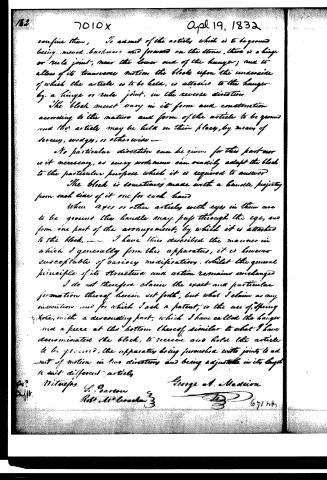
confine them. To admit of the articles which is to be ground being moved backwards and forwards on the stone, there is a hinge or rule joint, near the lower end of the hanger, and to allow of its transverse motion the block upon the underside of which the article is to be held, is attached to the hanger by a hinge or rule joint, in the reverse direction.
The block must vary in its form and construction according to the nature and form of the article to be ground and the article may be held in their place, by means of screws, wedges, or otherwise.
No particular direction can be given for this part nor is it necessary, as every workman can readily adapt the block to the particular purpose which it is required to answer.
The block is sometimes made with a handle projecting from each side of it one for each hand.
When eyes or other articles with eyes in them are to be ground the handle may pass through the eye, and form one part of the arrangement, by which it is attached to the block. I have thus described the manner in which I generally form this apparatus, it is however susceptible of various modifications, whilst the general principle of its structure and action remains unchanged.
I do not therefore claim the exact and particular formation thereof herein set forth, but what I claim as my invention and for which I ask a patent, is the use of spring hole, with a descending part, which I have called the hanger and a piece at the bottom thereof similar to what I have denominated the block, to receive and hold the article to be ground, the apparatus being furnished with joints to admit of motion in two directions and being adjustable in its length to suit different articles.
Witness
George A. Madeira
Published accounts: specification
Specification printed in the Journal of the Franklin Institute
Journal of the Franklin Institute, new ser., vol. 10 (1832), p. 256 · View the page
Text of the specification as printed in the Journal, from OCR; not proofread.
Specification of a patent for an apparatus for Holding and Guiding Edge Tools in the operation of Grinding. Granted to GEORGE A. MADEIRA, Chambersburg, Franklin county, Pennsylvania, April 19, 1832, To all whom it may concern, be it known, that I, George A. Madeira, of Chambersburg, Franklin county, Pennsylvania, have invented an apparatus, or machinery, for holding and guiding edge tools, and other articles in the operation of grinding, which apparatus greatly facilitates the said operation, and will enable an inexperienced hand to perform it with precision; and that the following is a full and exact description of the said apparatus. I use a spring pole, which is fixed along or near to the ceiling of the room or workshop, in the manner of those used for the pole lathe. The elastic end of this pole is directly over the grindstone, and from it descends a part which I denominate the hanger; the hanger is hinged or jointed to the spring pole, so that the angle which they make with each other may be varied. A brace passes diagonally from the spring pole to the hanger, a mortise being made through each for that purpose. This brace may be lengthened or shortened by means of pins, which pass through holes in it, and in the spring pole and hanger, and serve to confine them in any required position. In order to adapt the hanger to articles of different sizes and kinds, it is made capable of being lengthened or shortened; this may be effected by dividing it and making one part to lap over the other, or by a long slot in one piece, and a corresponding tongue on the other, with equidistant holes through them, and pins or screws to adjust or confine them. To admit of the article which is to be ground being moved backward and forward on the stone, there is a hinge, or rule joint, near the lower end of the hanger; and to allow of its transverse motion, the block upon the under side of which the article is to be held, is attached to the hanger by a hinge, or rule joint, in the reverse direction. The block must vary in its form and construction according to the nature and form of the article to be ground; and the articles may α e b 0 be held in their places by means of screws, wedges, or otherwise. No particular directions can be given for this part, nor is it necessary, as every workman can readily adapt the block to the particular purpose which it is required to answer. The block, is sometimes made with a handle projecting from each side of it, one for each hand. When axes, or other articles with eyes in them, are to be ground, the handle may pass through @ the eye, and form one part of the arrangement by which it is attached to the block. 0 0 SHULTZE'S mode of Bleaching Yellow Wax. I have thus described the manner in which I ordinarily form this apparatus; it, however, is susceptible of various modifications, whilst the general principle of its structure and action remains unchanged. I do not, therefore, claim the exact and particular formation thereof as herein set forth, but what I claim as my invention, and for which I ask a patent, is the use of a spring pole, with a descending part, which I have called the hanger, and a piece at the bottom thereof, similar to what I have denominated the block, to receive and hold the article to be ground; the apparatus being furnished with joints to admit of motion in two directions, and being adjustible in its length, to suit different articles. GEORGE A. MADEIRA. Patent for an improvement in the mode of Bleaching Yellow Bees-wax. Granted to JOHN N. SHULTZE, Chemist, city of New York, April 30, 1832. Four vats are to be prepared which may each be about four feet long, three wide, and three deep; these are to be placed side by side, to facilitate their use. They may be numbered 1, 2, 3 and 4. Into No. 1, 200 lbs. oxymuriate [chloride) of lime, and 125 gallons of water are to be put; the mixture is to be well stirred, and the impurities allowed to settle. 500 lbs. of yellow wax are to be put into No. 2, and heat applied, either by steam or otherwise, sufficient to melt the wax, which is allowed to remain at rest, that its impurities may settle. The clear melted wax, and portions of the solution of oxymuriate of lime, are to be laded into vat No. 3, heat being applied to keep the wax melted, which, however, is not to exceed 160°. Nearly all the solution of oxymuriate will in general be used in this first process, which, however, will in general but partially bleach the wax. The mixture is to be constantly stirred for about an hour, in which time this first operation will be completed. A mixture, consisting of twenty pounds of sulphuric acid, diluted with thirty of water, is then added, and agitation kept up for half an hour. The acid, combining with the lime, sinks it to the bottom, and leaves the bleached wax floating above it; this settling is effected in about half an hour. The process has sometimes to be repeated a second or third time, depending upon the portion of colouring matter in the wax. When the wax has been thus sufficiently bleached, it is put into vat No. 4, and as it still contains some water, this is to be separated from it. To effect this, thirty pounds of common salt are added, which being soluble in, unites with, the water, and the weight of this solution causes it to separate from, and descend below, the wax, which thus acquires a clear and transparent appearance. To improve the white appearance of the wax, an ounce of pulverized Antwerp blue, previously mixed with a quart of the melted wax, is poured into vat No. 4, when the whole is deposited in proper vessels. VOL. X.-No. 4. - OCTOBER, 1832. 33 ENGLISH PATENTS.
Published accounts: journal notice
Notice in the monthly list of patents, with remarks
Journal of the Franklin Institute, new ser., vol. 10 (1832), p. 241 · View the page
32. For apparatus or machinery for Holding and Guiding Edge Tools in the operation of Grinding; George A. Madeira, Chambersburg, Franklin county, Pennsylvania, April 19.
Remarks. (See the specification.)
DATAMP: illustration
Illustrations from DATAMP

DATAMP (Directory of American Tool and Machinery Patents), via the Internet Archive · Archived DATAMP page
About this record
- Patentee
- DATAMP
- Date
- the Name and Date index of patents, DATAMP, USPTO records
- Invention
- DATAMP
- Listed in
- the Name and Date index of patents, DATAMP, USPTO records, Jim Shaw's X-patent list, the Journal of the Franklin Institute, Burke's List of Patents (1847)
- Burke's 1847 Patent Office list gives the same patent.