

Drawings and documents
USPTO scan
The patent as scanned by the USPTO
-
 Page 1
-
 Page 2
-
 Page 3
-
 Page 4


U.S. Patent and Trademark Office · Google Patents
Show the transcription Hide (967 words)
Machine transcription (LightOnOCR) of the pages as scanned by the USPTO, most of them the handwritten copies made when the records were restored after the 1836 fire. Not checked; it can misread handwriting, so compare it with the scan.
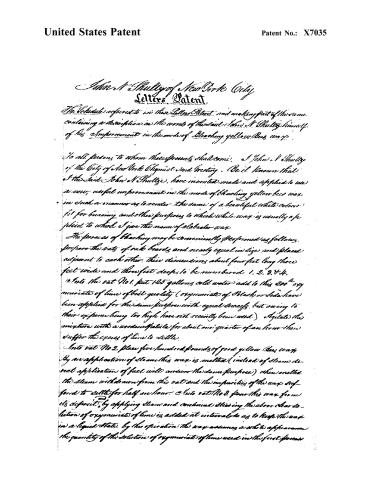
Page 2.
United States Patent
Patent No.: X7035
John M. Shultz of New York City
Letters Patent
The Schedule referred to in these Letters Patent and making part of this same, containing a description in the words of the said John M. Shultz himself of his Improvement in the mode of Bleaching yellow bees wax.
To all persons to whom these presents shall come, I John M. Shultz of the City of New York Citizen and Inhabitant, Be it known that I the said John M. Shultz, have invented, made and applied to wax a new, useful improvement in the mode of bleaching yellow bees wax, in such a manner as to render the same of a beautiful white colour fit for burning and other purposes to which white wax is usually applied, to which I give the name of alabaster wax.
The process of bleaching may be conveniently performed as follows:
Prepare the vats of oak boards and nearly equal in size and placed adjacent to each other. Their dimensions about four feet long, three feet wide and three feet deep, to be numbered 1, 2, 3, & 4.
Into the vat No 1, put 125 gallons cold water, add to this 200 lbs. oxymuriate of lime of best quality (oxymuriate of Bichloride or Soda have been applied for the same purpose with equal success, but owing to their expense being too high have not recently been used). Agitate this mixture with a wooden spatula for about one quarter of an hour, then suffer the excess of lime to settle.
Into vat No 2, place five hundred pounds of good yellow bees wax. By an application of steam this wax is melted (instead of steam, direct application of fuel will answer the same purpose). When melted, the steam withdrawn from this vat and the impurities of the wax are forced to settle for half an hour. Into vat No 3, pour this wax from its deposit, by applying steam and continuing stirring the above clear solution of oxymuriate of lime is added at intervals so as to keep the wax in a liquid state. By this operation the wax assumes a white appearance. The quantity of the solution of oxymuriate of lime used in the first process
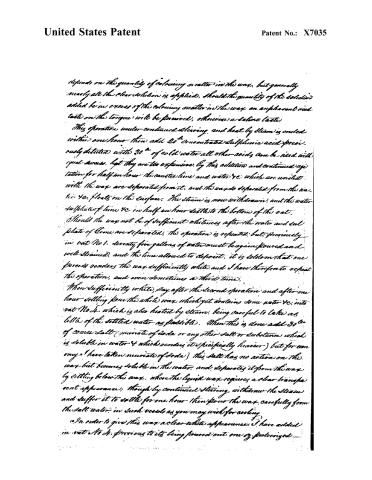
Page 3.
United States Patent
Patent No.: X7035
depends on the quantity of colouring matter in the wax, but generally nearly all the clear solution is applied. Should the quantity of the solution added be in excess of the colouring matter in the wax, an unpleasant acid taste on the tongue will be perceived, otherwise a saline taste.
This operation, under continued stirring, and heat by steam is ended within one hour; then add 20° concentrated sulphuric acid (previously diluted with 30° of cold water) all other acids can be used with equal success, but they are too expensive. By this addition and continued agitation for half an hour the acetic lime and water, which are united with the wax are separated from it, and the wax is separated from the water. The steam is now withdrawn, and the water sulphate of lime &c. in half an hour settles to the bottom of the vat.
Should the wax not be of sufficient whiteness after the water and sulphate of lime are separated, the operation is repeated, but previously in vat No. 1. Twenty-five gallons of water must be again poured and well stirred, and the time allowed to deposit. It is seldom that one process renders the wax sufficiently white and I have therefore to repeat the operation, and even sometimes a third time.
When sufficiently white, say after the second operation and after one hour settling from the white wax which yet contains some water &c. into vat No. 4, which is also heated by steam, being careful to take as little of the settled water as possible. When this is done add 30° of coarse salt (muriate of soda or any other salt or substance which is soluble in water & which renders it specifically heavier) but for economy I have taken muriate of soda. This salt has no action on the wax but becomes soluble in the water, and separates it from the wax by settling below the wax, where the liquid wax acquires a clear transparent appearance; though by continued stirring, withdraw the steam and suffer it to settle for one hour then pour the wax carefully from the salt water in such vessels as you may wish for cooling.
In order to give this wax a clear white appearance, I have added in vat No. 4, previous to its being poured out, one oz. pulverized—
Page 4.
United States Patent
Patent No.: X7035
Antwerp blue previously mixed with one quart of this melted wax.
N.B. Should the oxymuriate of lime in vat No 3. be in excess by the addition of sulphuric acid a very offensive smell will ensue for about ten minutes, which is also unhealthy, being oxymuriatic Gas. & therefore care should be taken not to inhale it.
The heat applied to wax in this process, should not at any time exceed 100 degrees — The size & figure of the vats may of course be varied according to the quantity of wax to be whitened and application of heat may be direct to the materials instead of by steam. I do testify that the above is a true specification of my said improvement as above described. I have hereunto set my hand this 18th day of April in the year of our Lord one thousand eight hundred and thirty two.
Witnesses
Elisha H. Willey
H. Pelliman
John N. Shultze.
(Patented 30 April 1832)
(962)
Published accounts: journal notice
Notice in the monthly list of patents
Journal of the Franklin Institute, new ser., vol. 10 (1832), p. 250 · View the page
57. For a mode of Bleaching Yellow Wax; John N. Shultze, chemist, city of New York, April 30.
Published accounts: journal notice
Notice in the monthly list of patents
Journal of the Franklin Institute, new ser., vol. 10 (1832), p. 257 · View the page
I do not, therefore, claim the exact and particular formation thereof as herein set forth, but what I claim as my invention, and for which I ask a patent, is the use of a spring pole, with a descending part, which I have called the hanger, and a piece at the bottom thereof, similar to what I have denominated the block, to receive and hold the article to be ground; the apparatus being furnished with joints to admit of motion in two directions, and being adjustible in its length, to suit different articles. GEORGE A. MADEIRA. Patent for an improvement in the mode of Bleaching Yellow Bees-wax. Granted to JOHN N. SHULTZE, Chemist, city of New York, April 30, 1832.
About this record
- Patentee
- DATAMP
- Date
- the Name and Date index of patents, DATAMP, USPTO records
- Invention
- DATAMP
- Listed in
- the Name and Date index of patents, DATAMP, USPTO records, Jim Shaw's X-patent list, the Journal of the Franklin Institute, Burke's List of Patents (1847)
- The Franklin Institute's journal spells the name differently.
- Burke's 1847 Patent Office list gives the same patent.