

Drawings and documents
USPTO scan
The patent as scanned by the USPTO
-
 Page 1
-
 Page 2
-
 Page 3
-
 Page 4


U.S. Patent and Trademark Office · Google Patents
Show the transcription Hide (1,062 words)
Machine transcription (LightOnOCR) of the pages as scanned by the USPTO, most of them the handwritten copies made when the records were restored after the 1836 fire. Not checked; it can misread handwriting, so compare it with the scan.
Page 2.
United States Patent
Patent No.: X7056
Robert Dale
The schedule referred to in the Letters Patent for making part of the same containing a description in the name of the said Robert Dale himself of his improvement in carriages, by which the horses may be instantly disengaged when running away, or whenever required, to be detached from the carriage quickly, called the safety carriage.
Be it known, that Robert Dale of the city of Washington in the District of Columbia, have made an improvement in carriages, by which the horses may instantly disengage when running away, or whenever required, to be detached from the carriage quickly, called the safety carriage, which is described as follows:
The straight bar is attached to the cross bar by an iron fixture called a jointed clasp, found thus: [Diagram: A jointed clasp fixture] the lower part marked A resting against the back of the cross bar. This jointed clasp is held up against the under side of the cross bar by an iron shank or hinged clasp found thus: [Diagram: Hinged clasp fixture] turning on a joint or hinge secured to the under side of the cross bar. To the end of the hinged clasp is attached an iron rod or bolt, B, with an eye at its end. This rod or bolt passes into an opening in the cross bar (and has an opening) key inserted into the eye resting on the upper side of the bar, which is which secures the jointed clasp from dropping. So the rod may be forced permanently to the cross bar projecting far enough below it to pass through a slot or mortice in the end of the hinged clasp, with a spring key inserted through the end of the rod or bolt to prevent the hinged clasp falling. To the end of the spring key is attached a cord which leads inside of the carriage where it hangs loosely. Should the horse take fright and become unmanageable, then the cord is to be pulled suddenly which will draw the spring key from the eye of the rod or bolt, let fall the hinge clasp, and with it the jointed clasp attached to the straight bar, and will disengage the horse from the carriage.
The legs are open in front thus: [Diagram: Open legs] to allow the breacher to step off easily. The is breacher is made from a single strap of leather, with rings secured to the ends to hook over the legs.
The shutter or hinge clasp may have its ends turned up at right angles and formed like a catch or hook, and secured by a spring fastened to the side of the cross bar; the cord being attached to the end of the spring. The shutter may instead be held up in a great variety of modes but the before
Drawing
Page 3.
United States Patent
Patent No.: X7056
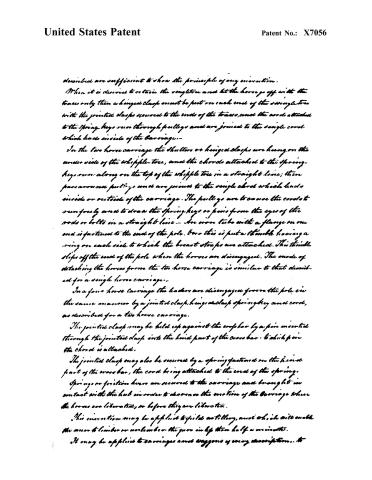
described are sufficient to show the principle of my invention.
When it is desired to retain the single tree and let the horse go off with the traces only, then a hinged clasp must be put on each end of the single tree with the jointed clasp secured to the ends of the traces, and the cords attached to the spring keys run through pulleys and are joined to the single cord which leads inside of the carriage.
In the two horse carriage the shutters or hinged clasps are hung on the under side of the whistle-tree, and the chords attached to the spring- keys run along on the top of the whistle tree in a straight line; then pass around a pulley and are joined to the single chord which leads inside or outside of the carriage. The pulleys are to cause the cords to run freely and to draw the spring keys or pins from the eyes of the rods or bolts in a straight line — An iron tube with a flange on one end is fastened to the end of the pole. Over this is put a thimble having a ring on each side to which the breast straps are attached. This thimble slips off the end of the pole when the horses are disengaged. The mode of detaching the horses from the two horse carriage is similar to that described for a single horse carriage.
In a four horse carriage the leaders are disengaged from the pole in the same manner by a jointed clasp, hinged clasp spring key and cord, as described for a two horse carriage.
The jointed clasp may be held up against the crossbar by a pin inserted through the jointed clasp into the hind part of the cross bar to which pin the chord is attached.
The jointed clasp may also be secured by a spring fastened on the hind part of the cross bar, the cord being attached to the end of the spring.
Springs or friction keys are secured to the carriage and brought in contact with the hub in order to decrease the motion of the carriage when the horses are liberated, or before they are liberated.
This invention may be applied to field artillery, and which will enable the men to limber or unlimber the gun in less than half a minute.
It may be applied to carriages and wagons of every description.
Page 4.
United States Patent
Patent No.: X7056
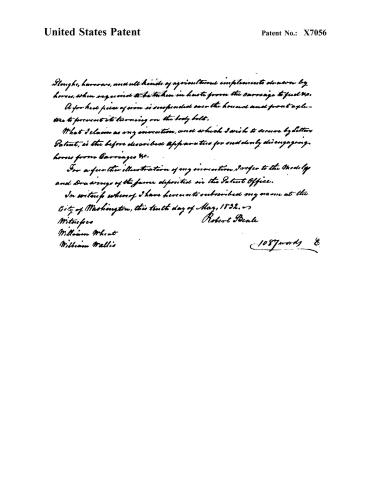
Ploughs, harrows, and all kinds of agricultural implements drawn by horses, when required to be taken in haste from the carriage to field &c.
A for head piece of iron is suspended over the harness and front axle-tree to prevent its turning on the body bolt.
What I claim as my invention, and which I wish to secure by Letters Patent, is the before described Apparatus for suddenly disengaging horses from Carriages &c.
For a further illustration of my invention, I refer to the Model & Drawings of the same deposited in the Patent Office.
In witness whereof I have hereunto subscribed my name at the City of Washington, this tenth day of May, 1832.
Robert Beale
Witnesses
William Wheat
William Wallis
1087 words &
Published accounts: journal notice
Notice in the monthly list of patents, with remarks
Journal of the Franklin Institute, new ser., vol. 10 (1832), p. 326 · View the page
A screw is made to force a follower down between the cheeks of a press: upon the follower are two pieces of plank which are forced down upon the crimp. The claim is to "the application of the screw;" and the whole description does not occupy double the space of our notice of it. 20. For a " Safety Carriage;" Robert Beale, city of Washington, District of Columbia, May 12.
Remarks. (See the specification.)
Published accounts: journal notice
Notice in the monthly list of patents
Journal of the Franklin Institute, new ser., vol. 10 (1832), p. 334 · View the page
All that is necessary is then to pass the pipe through the melted tin, which, when the pieces are not of considerable length, may be easily managed by hand; or when of considerable length and weight, a rope and pulley, or any other suitable mechanical contrivance which the workman may prefer, may be resorted to. I am aware that the coating of lead pipes with tin, simply, is not new, the same having been heretofore done, but in a manner less perfect than that which I have just described. The lead has been tinned in sheets, and afterwards made into pipes, or the pipes have been made and tinned, and afterwards drawn to the intended size. By neither of these processes, however, is the intended security obtained with the same certainty as by my process of tinning the pipes after they are otherwise finished. The coating of tin is thus rendered more perfect, and those fissures are avoided which the former processes can scarcely fail to produce. I do not, therefore, claim as my invention the mere tinning of pipes made out of lead, but what I do claim is the tinning such pipes after they have been drawn to the proper size, as is hereinbefore set forth. THOMAS EWBANK. Specification of a patent for a mode of detaching horses from a carriage, either when running away, or whenever it may be desirable to effect that object, rapidly. Granted to ROBERT BEALE, city of Washington, District of Columbia, May 12, 1832.
Published accounts: specification
Specification printed in the Journal of the Franklin Institute
Journal of the Franklin Institute, new ser., vol. 10 (1832), p. 334 · View the page
Text of the specification as printed in the Journal, from OCR; not proofread.
Specification of a patent for a mode of detaching horses from a carriage, either when running away, or whenever it may be desirable to effect that object, rapidly. Granted to ROBERT BEALE, city of Washington, District of Columbia, May 12, 1832. Be it known, that I, Robert Beale, of the city of Washington, in the District of Columbia, have made an improvement in carriages, by which the horses may be suddenly disengaged when running away, or whenever required to be detached from the carriage quickly; called the safety carriage; which is described as follows. The swingletree is attached to the cross bar by an iron fixture called a jointed clasp, formed as in the annexed figure; the knee part, marked A, resting against LA the back of the cross bar. This jointed clasp is held up against the underside of the cross bar by an iron shutter, or hinged clasp, formed thus, turning on a joint, or hinge, secured to the underside of the cross bar. To B the end of the hinged clasp is attached an iron rod, or bolt, B, with an eye at its end. This rod, or bolt, passes through an opening in the cross bar, and has an iron spring key inserted through the eye, resting on the upper side of the bar, which secures Detaching Horses from Carriages. the jointed clasp from dropping; or the rod may be fixed permanently to the cross bar, projecting far enough below it to pass through a slot or mortise in the end of the hinged clasp, with a spring key inserted through the end of the rod, or bolt, to prevent the hinged clasp falling. To the end of the spring key is attached a cord which leads inside of the carriage, where it hangs loosely. Should the horses take fright, and become unmanageable, the cord is then to be pulled suddenly, which will draw the spring key from the eye of the rod, or bolt, let the hinged clasp fall, and with it the jointed clasp attached to the swingletree, and will disengage the horse from the carriage. The tugs are open in front, thus, to allow the breeching to slip off freely. This breeching is made from a single strap of leather, with rings sewed to the ends, to hook over the tugs. The shutter, or hinged clasp, may have its end turned up at right angles, and formed like a catch, or hook, and secured by a spring, fastened to the side of the cross bar, the cords being attached to the end of the spring. The shutter may, indeed, be held up in a great variety of modes, but the before described are sufficient to show the principles of my invention. When it is desired to retain the swingletree, and let the horse go off with traces only, then a hinged clasp must be put on each end of the swingletree, with the jointed clasps secured to the ends of the traces, and the cords attached to the spring keys run through pulleys and are joined to the cord which leads inside of the carriage. In the two-horse carriage, the shutters, on hinged clasps, are hung on the under side of the wheppletree, and the cords attached to the spring keys run along on the top of the wheppletree in a straight line, then pass around pulleys, and are joined to the single cord which leads inside, or outside, of the carriage. The pulleys are to cause the cords to run freely, and to draw the spring keys, or pins, from the eyes of the rods, or bolts, in a straight line. An iron tube, with a flanch on one end, is fastened to the end of the pole. Over this is put a thimble, having a ring on each side, to which the breast straps are attached. This thimble slips off the end of the pole, when the horses are disengaged. The mode of detaching the horses from the two-horse carriage is similar to that described for a single horse carriage. In a four-horse carriage the leaders are disengaged from the pole in the same manner, by a jointed clasp, hinged clasp, spring key, and cord, as described for a two-horse carriage. The jointed clasp may be held up against the cross bar by a pin inserted through the jointed clasp into the hind part of the cross bar, to which pin the cord is attached. The jointed clasp may also be secured by a spring fastened on the hind part of the cross bar, the cord being attached to the end of the spring. Springs, or friction levers, are secured to the carriage, and brought in contact with the hub in order to decrease the motion of the carriage when the horses are liberated, or before they are liberated. 1 Manufacture of Gas for Illumination. This invention may be applied to field artillery, and it will enable the men to limber or unlimber the gun in less than half a minute. It may also be applied to wagons of every description, to ploughs, and harrows, and all kinds of agricultural implements drawn by horses, when required to be taken in haste from the carriage to feed, &c. A forked piece of iron is suspended over the hound and front axletree to prevent its turning on the body bolt. What I claim as my invention, and which I wish to secure by letters patent, is the before described apparatus for suddenly disengaging horses from carriages. For a further illustration of my invention I would refer to the models and drawings of the same deposited in the patent office. ROBERT BEALE. ENGLISH PATENTS.
About this record
- Patentee
- DATAMP
- Date
- the Name and Date index of patents, DATAMP, USPTO records
- Invention
- DATAMP
- Listed in
- the Name and Date index of patents, DATAMP, USPTO records, Jim Shaw's X-patent list, the Journal of the Franklin Institute, Burke's List of Patents (1847), the Journal of the Franklin Institute, Journal
- Burke's 1847 Patent Office list gives the same patent.