

Drawings and documents
USPTO scan
The patent as scanned by the USPTO
-
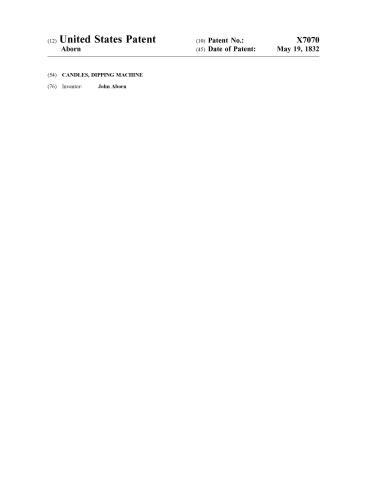 Page 1
-
 Page 2
-
 Page 3
-
 Page 4


U.S. Patent and Trademark Office · Google Patents
Show the transcription Hide (1,072 words)
Machine transcription (LightOnOCR) of the pages as scanned by the USPTO, most of them the handwritten copies made when the records were restored after the 1836 fire. Not checked; it can misread handwriting, so compare it with the scan.
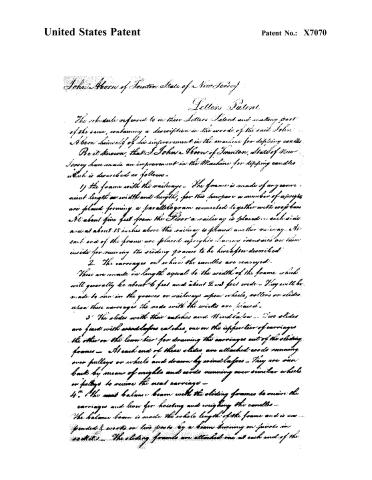
Page 2.
United States Patent
Patent No.: X7070
John Aborn of Trenton State of New Jersey
Letters Patent
The schedule referred to in these Letters Patent and making part of the same, containing a description in the words of the said John Aborn himself of his improvement in the machine for dipping candles.
Be it known, that I John Aborn of Trenton, State of New Jersey have made an improvement in the Machine for dipping candles which is described as follows—
1. The frame with the railways — The frame is made of any convenient length or width and height, for this purpose a number of uprights are placed forming a parallelogram connected together with cross bars. At about five feet from the Floor a railway is placed on each side and at about 18 inches above this railway is placed another railway. At each end of the frame are placed uprights having iron rails on them inside for receiving the sliding frames to be hereafter described.
2. The carriages on which the candles are conveyed — These are made in length equal to the width of the frame which will generally be about 6 feet and about 2 and 3 feet wide. They will be made to run in the grooves or railways upon wheels, rollers or slides when these carriages the rods with the wicks are placed.
3. The slides with their catches and Windlasses — Two slides are fixed with windlasses catches, one on the upper tier of carriages the other on the lower tier for drawing the carriages out of the sliding frames — At each end of these slides are attached cords running over pulleys or wheels and drawn by windlasses — They are run back by means of weights and cords running over similar wheels or pulleys to receive the next carriage —
4. The next balance beam with the sliding frames to receive the carriages and lever for hoisting and weighing the candles — The balance beam is made the whole length of the frame and is suspended & works on two parts by a beam turning on pivots in sockets — The sliding frames are attached one at each end of the
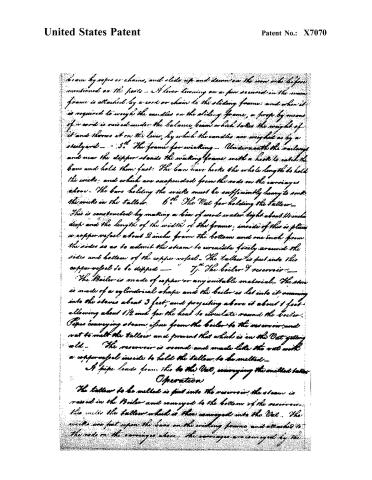
Page 3.
United States Patent
Patent No.: X7070
beam by ropes or chains, and slide up and down on the iron rods before mentioned on the floats. A lever turning on a pin secured in the main frame is attached by a cord or chain to the sliding frame: and when it is required to weigh the candles on the sliding frame, a prop by means of a cord is raised under the balance beam which takes the weight of it and throws it on the lever, by which the candles are weighed as by a steelyard.
5th. The frame for wicking. Underneath the railways and near the dipper stands the wicking frame with a hook to catch the bars and hold them fast. The bars have hooks the whole length to hold the wicks, and which are suspended from the rods on the carriages above. The bars holding the wicks must be sufficiently heavy to sink the wicks in the tallow.
6th. The Vat for holding the tallow. This is constructed by making a box of wood water tight about 18 inches deep and the length of the width of the frame; inside of this is placed a copper vessel about 2 inches from the bottom and one inch from the sides so as to admit the steam to circulate freely around the sides and bottom of the copper vessel. The tallow is put into this copper vessel to be dipped.
7th. The Boiler & reservoir. The Boiler is made of copper or any suitable material. The stove is made of a cylindrical shape and the boiler is let into it running into the stove about 3 feet, and projecting above it about 1 foot, allowing about 1½ inch for the heat to circulate round the boiler. Pipes conveying steam issue from the boiler to the reservoir, and not to melt the tallow and prevent that which is in the Vat getting cold. The reservoir is round and made like the vat with a copper vessel inside to hold the tallow to be melted. A pipe leads from this to the Vat, conveying the melted tallow.
Operation
The tallow to be melted is put into the reservoir; the steam is raised in the Boiler and conveyed to the bottom of the reservoir; this melts the tallow which is then conveyed into the Vat. The wicks are put upon the bars on the wicking frame, and attached to the rods on the carriages above; the carriages are conveyed by the
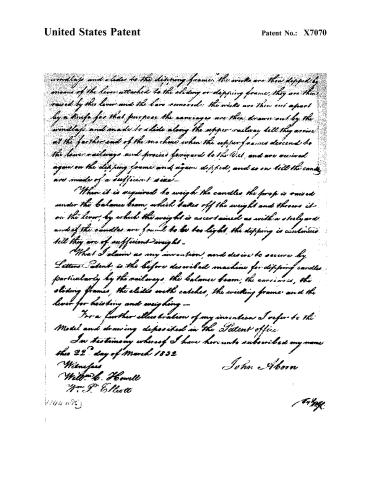
Page 4.
United States Patent
Patent No.: X7070
windlass and slides to the dipping frame. The wicks are then dipped by means of the lever attached to the sliding or dipping frame, they are then raised by this lever and the bars removed. The wicks are then cut apart by a knife for that purpose. The canvases are then drawn out by the windlass and made to slide along the upper railway till they arrive at the farther end of the machine when the upper frames descend to the lower railways and proceed forward to the V.I. and are received again on the dipping frame and again dipped, and so on till the candles are made of a sufficient size.
When it is required to weigh the candles, the prop is raised under the balance beam, which takes off the weight and throws it on the lever, by which the weight is ascertained as with a scale yard and if the candles are found to be too light, the dipping is continued till they are of sufficient weight.
What I claim as my invention, and desire to secure by Letters Patent, is the before described machine for dipping candles particularly by the railways, the balance beam, the canvases, the sliding frames, the slides with catches, the wicking frame and the lever for hoisting and weighing.
For a further illustration of my invention I refer to the Model and drawing deposited in the Patent office.
In testimony whereof I have hereunto subscribed my name this 22nd day of March 1832
Witnesses
William B. Howell
Wm. F. Elliott
John Aborn
Published accounts: journal notice
Notice in the monthly list of patents, with remarks
Journal of the Franklin Institute, new ser., vol. 10 (1832), p. 332 · View the page
35. For a Machine for Dipping Candles; John Aborn, city of Trenton, New Jersey, May 19.
Remarks. A vat is prepared for holding the tallow into which the wicks are to be dipped; it may be made of copper, and of such dimensions as are required in the operation; it is surrounded by a tight wooden box, between which and the vat, steam from a boiler is to circulate, for the purpose of heating it. A reservoir for supplying the vat is constructed, and heated upon similar principles. The main part of the apparatus, however, consists of a frame of any convenient length, and wide enough between its sides to admit the sticks upon which Coating Lead Pipes with Tin. the candles are arranged, and the carriages which support them; the dipping vat stands at one end of this frame. A double rail-way, one placed above the other, extends along the frame; and by means of a windlass, the connected carriages, each supporting a row of sticks, are advanced towards the vat, when they arrive there, the candles are dipped, and placed upon the lower rail-way, and carried back, to be again returned. There is a contrivance for weighing the candles, which consists of a long lever extending from front to back, along the upper part of the frame, and supported on fulcra like a scale beam; several other matters of detail are also noticed by the patentee, as a wicking frame, &c.; in point of detail, however, the description is defective, leaving too much to be re-invented by any one who should attempt to construct the machine with no other aid than that which is afforded by the specification. The claim is to the before described machine, and particularly to the rail-ways, the balance beam, the carriages, the sliding frames, the slides with catches, the wicking frame, and the lever for hoisting and weighing.
About this record
- Patentee
- DATAMP
- Date
- the Name and Date index of patents, DATAMP, USPTO records
- Invention
- DATAMP
- Listed in
- the Name and Date index of patents, DATAMP, USPTO records, Jim Shaw's X-patent list, the Journal of the Franklin Institute, Burke's List of Patents (1847)
- Burke's 1847 Patent Office list gives the same patent.