

Drawings and documents
USPTO scan
The patent as scanned by the USPTO
-
 Page 1
-
 Page 2
-
 Page 3


U.S. Patent and Trademark Office · Google Patents
Show the transcription Hide (588 words)
Machine transcription (LightOnOCR) of the pages as scanned by the USPTO, most of them the handwritten copies made when the records were restored after the 1836 fire. Not checked; it can misread handwriting, so compare it with the scan.
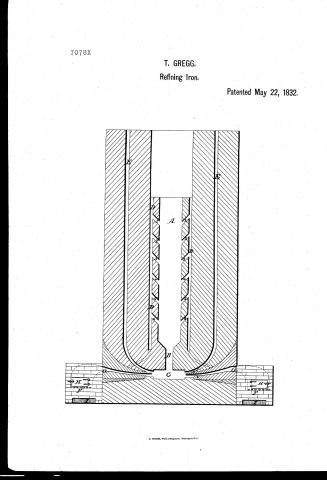
Page 1.
7078X
T. GREGG.
Refining Iron.
Patented May 22, 1832.

N. PETERS, Photo-Lithographer, Washington, D. C.
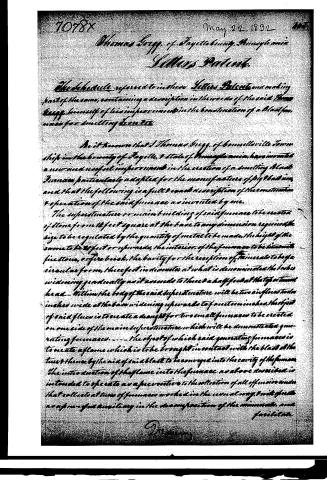
Page 2.
7078X
May 22, 1832
Thomas Slogg, of Fayetteburg, Pennsylvania
Letters Patent.
The Schedule referred to in these Letters Patent and making part of the same, containing a description in the words of the said Thomas Slogg himself of his improvement in the construction of a blast furnace for smelting ores.
Be it known that I Thomas Slogg, of Bellefonte Township in the county of Fayette, & State of Pennsylvania, have invented a new and useful improvement in the creation of a smelting Blast Furnace particularly adapted for the manufacture of pig lead, and that the following is a full & exact description of the construction & operation of the said furnace as invented by me.
The superstructure or main building of said furnace to be erected of stone from 18 feet square at the base to any dimension required the size to be regulated by the quantity of metal to be made, the height of the same to be 20 feet or upwards, the interior of the furnace to be lined with fire stone, or fire brick, the cavity for the reception of the ore to be of a circular form, three feet in diameter at what is denominated the bosh widening gradually as it ascends to three and a half feet at the top and head. Within the body of the said superstructure will be two air flues to be inches wide at the base widening upwards to fourteen inches, the object of said flues is to create a draught for two small furnaces to be erected on one side of the main superstructure which will be denominated generating furnaces. — — — the object of which said generating furnaces is to create a flame which is to be brought in contact with the blast at the time & hence by the aid of said blast to be conveyed into the cavity of the furnace, the introduction of the flame into the furnace as above described is intended to operate as a preventive to the collection of all offensive winds that collects at times of furnaces worked in the usual way, & will operate as a powerful auxiliary in the decomposition of the minerals, and facilitate
D. Slogg
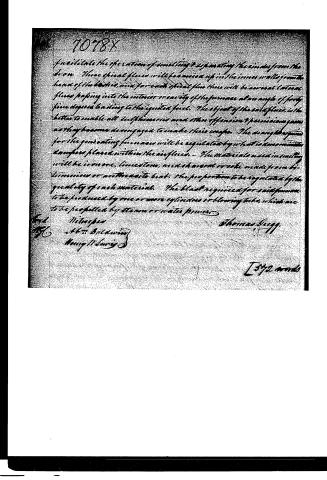
Page 3.
facilitate the operation of smelting & separating the air dry from the iron. Three spiral flues will be carried up in the inner walls from the head of the boilers, and for each spiral flue there will be several lateral flues, piping into the interior or cavity of the furnace at an angle of forty-five degrees leading to the ignited fuel. The object of the said flues is the better to enable all sulphurous and other offensive & poisonous gases as they become disengaged to make their escape. The air supply for the generating furnaces will be regulated by what is denominated dampers placed within the air flues. The materials used in smelting will be iron ore, limestone, and charcoal or coke made from bituminous or anthracite coal. The proportion to be regulated by the quality of each material. The blast required for said furnace to be produced by one or more cylinders or blowing tubes which are to be propelled by steam or water power.
Thomas Sagg
[372 words]
Published accounts: journal notice
Notice in the monthly list of patents, with remarks
Journal of the Franklin Institute, new ser., vol. 10 (1832), p. 392 · View the page
43. For an improvement in the Blast Furnace for Smelting Iron Ore; Thomas Gregg, Connelsville, Fayette county, Pennsylvania, May 22.
Remarks. The interior of this furnace is to be circular, and three feet in diameter at the boshes, widening out to three feet six inches at the tunnel head. Within the body of the stack there are to be two air flues, which are to create a draught for two small furnaces on one side of the superstructure, which are called generating furnaces. The flame created by these furnaces is to be brought into contact with the blast at the tuyere, in order to produce ignition at that part in which the force of the issuing blast ordinarily prevents it, and in this way to obviate the collection of cinder, which usually proves so troublesome by adhering around the tuyere.
About this record
- Patentee
- DATAMP
- Date
- the Name and Date index of patents, DATAMP, USPTO records
- Invention
- DATAMP
- Listed in
- the Name and Date index of patents, DATAMP, USPTO records, Jim Shaw's X-patent list, the Journal of the Franklin Institute, Burke's List of Patents (1847)
- Burke's 1847 Patent Office list gives the same patent.