

Drawings and documents
USPTO scan
The patent as scanned by the USPTO
-
 Page 1
-
 Page 2
-
 Page 3
-
 Page 4


U.S. Patent and Trademark Office · Google Patents
Show the transcription Hide (1,134 words)
Machine transcription (LightOnOCR) of the pages as scanned by the USPTO, most of them the handwritten copies made when the records were restored after the 1836 fire. Not checked; it can misread handwriting, so compare it with the scan.
Page 1.
7089X
E. Mayo,
Washing Machine,
Patented May 26, 1832.
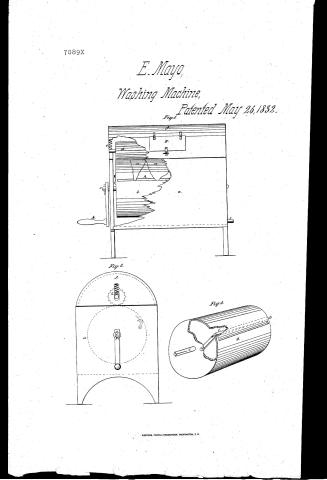
Fig. 1
Fig. 2.
Fig. 3.
Page 2.
7089X
Ebenezer Mayo
Letters Patent
May 26, 1892
The Schedule referred to in these Letters Patent and making part of the same containing a description in the words of the said Ebenezer Mayo himself of his improvement in the machine for washing and cleaning cloth & clothes, etc., called the wash Drum.
All persons to whom these presents shall come, Ebenezer Mayo of Hallowell in the county of Kennebeck in the state of Maine Brick-Mason sends Greeting. Be it known that I the said Ebenezer Mayo have invented constructed made and applied to use as new and useful machine for the washing and cleaning of cloth, clothes and other like substances to be called the wash Drum specified in the words following viz: The said machine consists of a tub or tight box of any convenient form (an oblong square box having been generally used by me as the most convenient form) in which is placed a cylindrical Drum or hollow cylinder, suspended on the sides of the tub or box by an axle fixed from through its centre hanging in the manner of a common grind stone at such a distance above the bottom of the tub or box that the periphery of the drum will dip into a convenient depth of water in the tub or box. Above or contiguous to any part of the outer circumference or surface of this large drum a smaller drum or cylinder with a plain or flat surface and which may be either hollow or solid, but the latter form is preferred for the sake of its greater weight, is suspended by an axle thru its centre so that the peripheries of the said large and smaller drums may just come in contact; and that the cylindrical surface of the larger drum may put in motion the smaller drum when the former is turned round by a crank. A convenient proportion between the diameters of the two drums will be about three or four to one. Springs either horizontal spiral or of any other convenient form are to be applied to said smaller drum, or to the extremities of its axle (and which may be done in
Page 3.
in many different ways) so that when the cloth or clothes to be washed shall pass between the peripheries of the two drums the smaller drum shall rise a little but at the same time be kept pressing down by the force of the springs so as to squeeze the cloth or clothes between the outer surfaces or peripheries of the drums. It is a convenient construction of the machine to prevent the water from being splashed around in the operation of washing, to have a box or cover to match the top of the tub or box. The sides of which should be carried up to such height as that the top of the cover will be above and over both drums; and then the ends of the axle or gudgeons of the smaller drum may be suspended by or inserted into the side of the box or cover which cover may be so made as that the same with the smaller drum contained in it may be removed from the top of the tub or box and a sliding door, or lid may be placed on any opening at one end of the box cover for the convenience of turning in water and placing in the clothes. The cloth or clothes to be washed are to be suspended or fastened by some small part or extremity of the clothes which lying on the periphery of the larger drum, by passing such part or extremity, thro' an opening or aperture or slit in the barrel or outer surface of the drum and then by bringing close and hard upon it a cross bar having arms so affixed as to turn vertically on pins or small bolts on the interior surface of the heads or circular ends of the larger drum; and securing the crossbar close down by a button, hook or slope of any kind so that the cross bar shall confine the small part or extremity of the cloth fast in the slit. The exterior of the larger drum may be covered by nailing or pinning slats at each end on the peripheries of the circular heads of drums, leaving small spaces or slits between them, or the spaces may be closed except the slits for inserting the ends of the clothes but the former mode is to be preferred. This machine is operated by confining one extremity or end of the clothes to be washed in the slit of the barrel or periphery of the large hollow drum, or by thus confining several pieces of cloth or clothes on different parts of the exterior of the drum, then turning the crank
Page 4.
May 26, 1832
If the drum, the clothes are carried round lying on the barrel of the drum and are passed under the small drum or cylinder suspended in contact with the barrel of the large drum. The springs on the small drum on the extremities of its axis giving way, the clothes are carried by the rotation of the large drum, between the drums, and the water being thus squeezed out of them they are passed again down into the water or duds in the tub, and when the large drum has gone once round, the clothes are drawn out of the water, and by continuing the motion, they again pass between the drums, and so on until sufficiently washed. Or you may turn the crank one way for several turns more or less and then by turning it the other way, the clothes lying on the surface of the large drum will be alternately reversed, first one side up and then the other until washed. You may at any time change the position of the clothes by confining some other or new part thereof in the slit of the drum. The water may be drawn off by a cock or aperture in the side or bottom of the tub and may be turned in at a slide opening in one end of the box (over). In testimony that the above is a true specification of my said machine as above described. I have hereunto set my hand and seal the ninth day of May, in the year of our Lord one thousand eight hundred and thirty-two.
Witnesses
Ephraim Mayo
Sam'l M. Handy
Edouard Mayo
Published accounts: journal notice
Notice in the monthly list of patents, with remarks
Journal of the Franklin Institute, new ser., vol. 10 (1832), p. 395 · View the page
52. For a Washing Machine; Ebenezer Mayo, Hallowell, Kennebeck county, Maine, May 26.
Remarks. A drum, or hollow cylinder, which we suppose may be about two feet in diameter, is hung so as to turn vertically in a tub, or trough, the lower edge of the cylinder dipping into the soap suds contained in it. A smaller cylinder, one-fourth or one-fifth the diameter of the former, either plain or fluted, is placed above it, and is caused to revolve by it, the large cylinder is turned by a winch, and the small one is made to bear upon it by springs operating upon its gudgeons. The large cylinder is generally covered with slats placed at a small distance from each other; upon this the articles to be washed are laid, being confined to it by hitching some string, or other small part, between the slats, or otherwise. It is recommended, in order to prevent the splashing of the suds, to enclose the whole in a box, which must be furnished with a door on one side to inspect and regulate the operation.
About this record
- Patentee
- DATAMP
- Date
- the Name and Date index of patents, DATAMP, USPTO records
- Invention
- DATAMP
- Listed in
- the Name and Date index of patents, DATAMP, USPTO records, Jim Shaw's X-patent list, the Journal of the Franklin Institute, Burke's List of Patents (1847)
- Burke's 1847 Patent Office list gives the same patent.