

Drawings and documents
USPTO scan
The patent as scanned by the USPTO
-
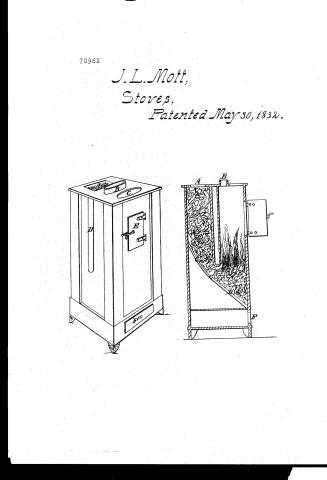 Page 1
-
 Page 2
-
 Page 3


U.S. Patent and Trademark Office · Google Patents
Show the transcription Hide (895 words)
Machine transcription (LightOnOCR) of the pages as scanned by the USPTO, most of them the handwritten copies made when the records were restored after the 1836 fire. Not checked; it can misread handwriting, so compare it with the scan.
Page 1.
7096X
J.L. Mott,
Stoves,
Patented May 30, 1832.

Page 2.
7096x May 20, 1852 433
Jordan Le Noll & New York City
Letters Patent
The Schedule referred to in these Letters Patent and making part of the same containing a description in the words of the said Jordan Le Noll himself of his improvement in Stoves for Burning Anthracite Coal.
To all to whom these presents shall come. We it known that the said Jordan Le Noll of the County and State of New York have invented, conducted and applied to use a new and useful improvement in Stoves used for burning Anthracite Coal. Said improvement is not confined to any particular form or dimensions of Stoves but is applicable to many of the Coal Stoves now in use.
It consists in dividing the interior of that part of the Stove intended for fuel into two compartments by means of a partition so as to form on one side a reservoir to contain a supply of coal, in the other side the fire and draught and a plain or curved plate inclined with an opening between the lower edge of the partition & the plate to admit the coal to slide forward from the reservoir on to the grate placed at the bottom of the fire or front division as follows: Near the bottom of the Stove on the side intended for the fire place a plain or curved grate inclined from the front of the Stove upwards leaving sufficient room under it for draught and to have a fire or draw to receive the ashes. The grate to extend from the side of the Stove to nearly under a line with the lower edge of the partition. At the bottom of the reservoir or coal division place the curved or plain plate inclined with the lower edge against or above the edge of the grate, its upper edge against the side of the Stove. The partition to commence at the top of the Stove or sufficiently near the top to give depth in the reservoir for a supply of coal and run down towards the lower edge of the curved or plain plate leaving a space between the lower edge of the partition and the curved or plain plate of say six inches (more or less) or in proportion to the depth of coal required to be burnt on the grate. If the coal be in small lumps make the distance less and increase the distance according to the size of the coal. The partition may be made double by placing
Page 3.
7096x
May 30, 1832
Plates, apart, mutually parallel or nearly so to each other to join near their lower edge with apertures through the sides of the stove to admit a free circulation of air between the plates. The plain or curved plate and grate to be inclined sufficiently to admit the coals to slide freely from the reservoir above to the lower edge of the grate to the front of the stove. The curved and plain plate & grate may be in one piece or otherwise. The partition may have a flat or curved surface. The partition and the plain or curved plate might be made of fire brick, soap stone, metal or any suitable material. The stove may be equally divided or otherwise. The reservoir may be a little larger at the bottom than the top to admit the coals to settle more freely. On the top or on the side near the top of the reservoir have an aperture or hole of suitable dimensions for filling it with coal with a door or lid to prevent the air passing through the reservoir. On the side of the stove on the grate near the surface of the plate or coal place a door for the admission of smoking fire. On the top or on the side near to the top of the fire division place the pipe flue or hole. If the partition or coal division is not carried to the top of the stove the draught may be carried over the top of the reservoir from the fire division by placing the pipe flue or hole on the back of the stove over the top of the reservoir. Have a door or opening under the curved or plain plate to admit the ashes being freed.
Manner of use: - Kindle a fire on the grate, when the coal gets burning fill the reservoir with coal, and as the coal on the grate is consumed and thus is freed, that in the reservoir by means of its gravity and the inclined plane or curved plate and grate is brought forward on the grate and to the front of the stove thereby keeping up a regular supply.
That which I claim as my invention and improvement is the dividing of the stove, the inclined plane or curved plate, and the inclined grate or slab specified for the above mentioned purposes.
In witness whereof I have hereunto subscribed my name this twenty third day of April 1832.
For.
Stephen B. Dawson
James C. Mills
Jordan C. Mills
(May 30, 1832)
Published accounts: journal notice
Notice in the monthly list of patents, with remarks
Journal of the Franklin Institute, new ser., vol. 10 (1832), p. 398 · View the page
59. For an improvement in Stoves for Burning Anthracite Coal; Jordan L. Mott, city of New York, May 30.
Remarks. H d a Ъ e C ( The improvement here proposed, consists in dividing a stove into two parts by a partition which reaches to the top plate, but does not descend to the bottom of the stove, as is shown at a in the section in the margin. The fire is to be lighted at b in the usual manner; the part c is to be filled with coal, and the cover d placed on, which will give a continued supply of fuel by the descent of the coal down the inclined plate e, as that in the front is consumed. The claim is to the dividing of the stove, and the fixing an inclined plate, and grate, for the descent of the fuel.
About this record
- Patentee
- DATAMP, Burke's List of Patents (1847)
- Date
- the Name and Date index of patents, DATAMP, USPTO records
- Invention
- DATAMP
- Listed in
- the Name and Date index of patents, DATAMP, USPTO records, Jim Shaw's X-patent list, the Journal of the Franklin Institute, Burke's List of Patents (1847)
- The name conflict was settled by Burke's 1847 list.
- Burke's 1847 Patent Office list gives the same patent.