

Drawings and documents
National Archives restored drawings: drawing
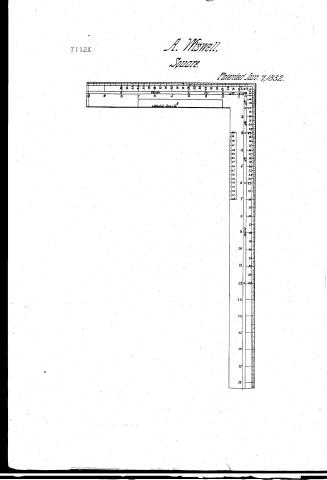
Andrew Wiswell's Patent Drawing for a Plan of an Improved Square

National Archives, Restored Patent Drawings (Record Group 241) · Full-size scan at the National Archives · Catalog record
Show the text on the drawing Hide (46 words)
Words on the drawing as machine-read by the National Archives; not checked. Useful mainly for searching.
23 / 22 / [7] / 20 / 19 / 18 / 17 / 16 / CL / 11 / 13 / 12 / 22 / 20 / 16 / 14 / 12 / 20 / 16 / or / 16 / 12 / 12 / 16 / Thirds / 6ths / 12ᵗʰ / бд / NOT / 7112-+ TION X / [.] ] Squares. / 24 / 20 / 12 / the / 16 / 16 / 20 / 12 / 73. MEASURING INSTRUMENTS. / 14 / 16 / 18 / the / 20 / 22 / 18 / 12 / 19 / 13 / Patented "Tune 1832. / 20 / 14 / 21 / 13 / 22 / 16 / 23 / 24 / injt / 18 / 25 / 19 / 26 / 20 / 27 / 27 / ANDREW WISWELL'S / 28 / 22 / 29 / 23 / 30 / 12 / Plan of an improved Square / 31 / For delineating Aarments. / 32 / 13 / 33 / 34 / 14 / 15 / 10 / 17 / Halves / 18 / 19 / 10 / 20 / 21 / 11 / 22 / 23 / 12 / nið / 13 / 14 / 15 / 16 / 17 / 18
USPTO scan
The patent as scanned by the USPTO
-
 Page 1
-
 Page 2
-
 Page 3


U.S. Patent and Trademark Office · Google Patents
Show the transcription Hide (768 words)
Machine transcription (LightOnOCR) of the pages as scanned by the USPTO, most of them the handwritten copies made when the records were restored after the 1836 fire. Not checked; it can misread handwriting, so compare it with the scan.
Page 1.
7112X
A. Wiswell.
Square.
Patented Jan. 7, 1832.

Page 2.
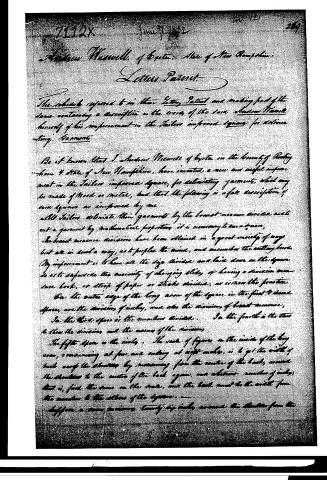
7112X June 7, 1852 No. 121 289
Andrew Newell, of Exeter, State of New Hampshire.
Letters Patent.
The schedule referred to in these Letters Patent and making part of the same containing a description in the words of the said Andrew Newell himself of his improvement in the Tailor improved square for obtaining fitting Garments.
Be it known that I Andrew Newell of Exeter in the county of Rockingham & State of New Hampshire, have invented a new and useful improvement in the Tailor improved square, for deliniating garments, which may be made of Wood or Metal, and that the following is a full description of said square as improved by me.
All Tailors deliniate their garments by the breast measure divided and set out a garment by mathematical proportions it is necessary to have a square. The breast measure divisions have been obtained in a great variety of ways but are in such a way, as to perplex the mind, and mislead the cutting hand. My improvement is to have all the said divisions set laid down on the square so as to supersede the necessity of changing slides, or having a division measure book, or strip of paper or sticks divided, as is now the practice.
On the outer edge of the long arm of the square in the first to fourth spaces, are the divisions of inches, and also the divisions of breast measure, In the third space is the number divided. In the fourth is the same as the divisions and the names of the divisions.
The fifth space is the inches. The scale of figures on the inside of the long arm, commencing at four and ending at eight inches, is to get the width of back and of the shoulder by measuring from the center of the back, around the shoulder to the center of the back again, and whatever number of inches that is, find the same on the scale, and the back must be the width from the number to the elbow of the square.
Suppose a man measuring twenty six inches around the shoulder from the
Page 3.
7112X
centre of the book, then the backs of the arms must be six inches except the divider. The first and second space on the short arm, is divided into inches, thirds, halves, sixths, and twelfths of an inch and also the divisions of bread measure. The strip of paper thin on the inner space is to fasten the measure on. To explain the square more fully. The divisions from twelve to twenty four inches, are laid down on the square. If you wish to work by twenty four inches, the half of that number may be found at twelve inches, the eighth at three inches, the sixteenth at one and a half inch, the thirty second at three quarters of an inch. The third at eight inch (on the short arm), the eight at four inches, the twelfth at two inches, the twenty fourth at one inch, and in this way you may find the divisions of twenty three, or any other number down to twelve.
And when a tailor understands the principle of this square he may cut a garment by it of larger or smaller sizes than is laid down here. For instance the divisions of halves are one half inch to a size, the fourth, one fourth of an inch to a size, the eighth are one eighth of an inch to a size, the thirds are one third of an inch, the eight and eighth of an inch, the twelfth, one twelfth of an inch & the square is twenty four inches long, the long arm and the short arm are ten inches long and are one and an half inches wide, made of box wood. This I conceive to be the most convenient size & the best material to make them of, but they may be made of metal, or any other hard wood, and of any convenient size, above eight by twelve inches.
In testimony that the above is a true specification of my new improvement as above written, I have hereunto set my hand, this fourth day of May in the year of our Lord one thousand eight hundred and thirty two.
Witnesses
Joseph Atwood
Jonathan Lawrence
Andrew Atwell
770 120
Published accounts: journal notice
Notice in the monthly list of patents, with remarks
Journal of the Franklin Institute, new ser., vol. 11 (1833), p. 23 · View the page
15. For a Taylor's Square, for delineating garments; Andrew Wiswell, Exeter, Rockingham county, New Hampshire, June 7.
Remarks. A common square, having a long and a short arm, has divisions upon it, which bearing a certain relationship to the breast measure, is to be a complete guide in delineating garments, and to supersede all the more complex instruments which have been contrived for that purpose. Those who are curious to learn the particulars respecting it, are referred to the patentee, who will sell them a square, and describe its use, better than we can.
DATAMP: illustration
Illustrations from DATAMP

DATAMP (Directory of American Tool and Machinery Patents), via the Internet Archive · Archived DATAMP page
About this record
- Patentee
- DATAMP
- Date
- the Name and Date index of patents, DATAMP, USPTO records
- Invention
- DATAMP
- Listed in
- the Name and Date index of patents, DATAMP, USPTO records, Jim Shaw's X-patent list, the Journal of the Franklin Institute, Burke's List of Patents (1847)
- Burke's 1847 Patent Office list gives the same patent.