

Drawings and documents
National Archives restored drawings: drawing
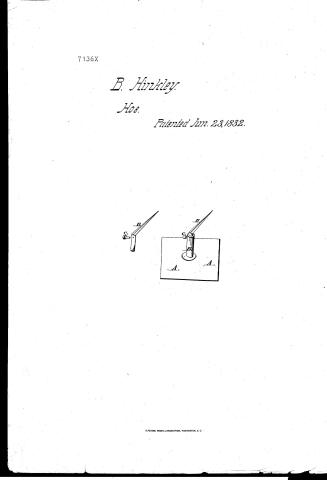
Benjamin Hinckley's Patent Drawing for a Hoe

National Archives, Restored Patent Drawings (Record Group 241) · Full-size scan at the National Archives · Catalog record
Show the text on the drawing Hide (35 words)
Words on the drawing as machine-read by the National Archives; not checked. Useful mainly for searching.
81, METAL WORKING. / 6. TOOLS. / [141] Hoes & Shovels / 61 / BENJAMIN HINKLEY'S. / GARDEN / CLASSI TICATION / L141 Леса / HOE. / Patented June 236 1832. / 7136-+ / DIVISION. / ID
USPTO scan
The patent as scanned by the USPTO
-
 Page 1
-
 Page 2


U.S. Patent and Trademark Office · Google Patents
Show the transcription Hide (453 words)
Machine transcription (LightOnOCR) of the pages as scanned by the USPTO, most of them the handwritten copies made when the records were restored after the 1836 fire. Not checked; it can misread handwriting, so compare it with the scan.
Page 1.
7136X
B. Hinkley.
Hoe.
Patented Jun. 23, 1832.

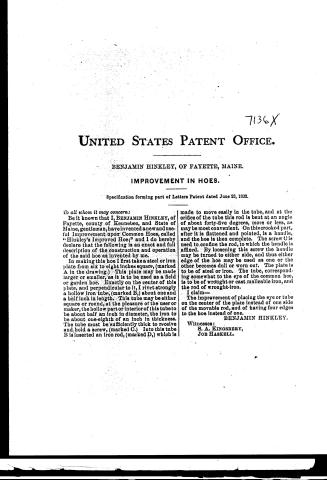
Page 2.
UNITED STATES PATENT OFFICE.
BENJAMIN HINKLEY, OF FAYETTE, MAINE.
IMPROVEMENT IN HOES.
Specification forming part of Letters Patent dated June 23, 1832.
To all whom it may concern:
Be it known that I, BENJAMIN HINKLEY, of Fayette, county of Kennebec, and State of Maine, gentleman, have invented a new and useful Improvement upon Common Hoes, called "Hinkley's Improved Hoe;" and I do hereby declare that the following is an exact and full description of the construction and operation of the said hoe as invented by me.
In making this hoe I first take a steel or iron plate from six to eight inches square, (marked A in the drawing.) This plate may be made larger or smaller, as it is to be used as a field or garden hoe. Exactly on the center of this plate, and perpendicular to it, I rivet strongly a hollow iron tube, (marked B,) about one and a half inch in length. This tube may be either square or round, at the pleasure of the user or maker, the hollow part or interior of this tube to be about half an inch in diameter, the iron to be about one-eighth of an inch in thickness. The tube must be sufficiently thick to receive and hold a screw, (marked C.) Into this tube B is inserted an iron rod, (marked D,) which is made to move easily in the tube, and at the orifice of the tube this rod is bent at an angle of about forty-five degrees, more or less, as may be most convenient. On this crooked part, after it is flattened and pointed, is a handle, and the hoe is then complete. The screw C is used to confine the rod, to which the handle is affixed. By loosening this screw the handle may be turned to either side, and thus either edge of the hoe may be used as one or the other becomes dull or worn out. The plate is to be of steel or iron. The tube, corresponding somewhat to the eye of the common hoe, is to be of wrought or cast malleable iron, and the rod of wrought-iron.
I claim—
The improvement of placing the eye or tube on the center of the plate instead of one side of the movable rod, and of having four edges to the hoe instead of one.
BENJAMIN HINKLEY.
Witnesses:
S. A. KINGSBERRY,
JOB HASKELL.
Published accounts: journal notice
Notice in the monthly list of patents, with remarks
Journal of the Franklin Institute, new ser., vol. 11 (1833), p. 33 · View the page
40. For an improved Hoe; Benjamin Hinkley, Fayette, Kennebeck county, Maine, June 23.
Remarks. A steel plate, six or eight inches square, forms the blade of the hoe. In the centre of this plate a socket is fixed, which rises vertically from it to the height of an inch and a half. This socket is to have a bore of about half an inch, and must be sufficiently thick to receive a tapped screw through its side; a piece of common gun barrel would answer the purpose. A piece of iron is fitted into the tube, where it may be tightened by means of a screw; the part that projects out is formed into a tine, and is bent down to an angle of forty-five degrees; this part is then driven into the hoe handle, and the hoe is complete. The design of this construction is to allow the hoe to be turned in any direction, so that either side or corner may be used.
About this record
- Patentee
- DATAMP
- Date
- the Name and Date index of patents, DATAMP, USPTO records
- Invention
- DATAMP
- Listed in
- the Name and Date index of patents, DATAMP, USPTO records, Jim Shaw's X-patent list, the Journal of the Franklin Institute, Burke's List of Patents (1847)
- Burke's 1847 Patent Office list gives the same patent.