

Drawings and documents
National Archives restored drawings: drawing
Aaron Hale's Patent Drawing for a Press


National Archives, Restored Patent Drawings (Record Group 241) · Full-size scan at the National Archives · Catalog record
Show the text on the drawing Hide (210 words)
Words on the drawing as machine-read by the National Archives; not checked. Useful mainly for searching.
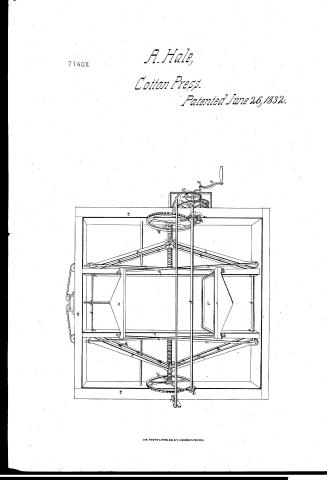
Sheet 1. 100. / [7] Hay® / PRESSES toy Pressess / /2 / AARON HALE'S / 2 Sheets-Sheet 1, / Baling / PRESS. / ICATION / 7140-7 / Patented :June 26:1832. / DIVISION. / (No mumber) / References / Frame / Toggle guides / screws / wheel / the / Pinion Long wheel for revolaring to drive great / taggle ser / E. / Bridge / Crank / nut. / K. / the / nut / L. / Balts / Toggle / joints / N. / Platten rods / Plattens Rods connecting the toggles / Patent office 25 Git 1838 / Made under the direction of the Commipioner / of Patents in conformity with Oct 3d March 1837 / Comminioner of Retints
Sheet 2. Patent Office / no / 100. PRESSES. / d Jan: T2. 1842. / Baling, / Toggle-Joint. / Eng Cotton & Hay Presses / Aaron Hales Standing Press Patented June. 26th 1832. / 25heets-Sheet2, / no / 7140 X / Pho number / References / a Timber frame / h.b Platen & Toggle guides / CC Toggle Screws / d.d Dentated Wheets / e.e. Pinion wheets which drive d.d / f Arbor of Pinion wheels / g Intermediate Pinion, / h.i Two other wheels on the arbor f. / k Crank arbor / L. Crank / mm Spherical Nuts. / 12,0. n.o. Toggle joints / p.p.x Stats or rounds of do / 9.9 Hinges of Toggle Bars / 7'. 1" Platen Rods / S.S. Rods connecting ends of toggtes. / t.t Mortices, / u.v Platens / w.w Nuls to Platen Rods / first / thirty / Tate / County
USPTO scan
The patent as scanned by the USPTO
-
 Page 1
-
 Page 2
-
 Page 3
-
 Page 4


U.S. Patent and Trademark Office · Google Patents
Show the transcription Hide (1,300 words)
Machine transcription (LightOnOCR) of the pages as scanned by the USPTO, most of them the handwritten copies made when the records were restored after the 1836 fire. Not checked; it can misread handwriting, so compare it with the scan.
Page 1.
7140X
A. Hale,
Cotton Press.
Patented June 26, 1832.
AM. PHOTO-LITHO. CO. N.Y. (OSBORNE'S PROCESS)
Page 2.
X7140 June 26. 1832 597
Aaron Hale of Boston Massachusetts
Sellers Patent
The Schedule referred to in their Letters Patent and making part of this one containing a description in the words of the said Aaron Hale himself of his improvement in the Standing Press called the Boston Press.
To all persons to whom these presents shall come, Be it known that A. Aaron Hale of the City of Boston, County of Suffolk and Commonwealth of Massachusetts, mechanic, have invented, constructed made and applied to use, a new and useful improvement in the Standing Press, called the Boston Press, and that the following is a full and exact description of the construction and operation of the said machine as invented or improved by me.
I make a strong timber frame of four pieces including seven feet in the clear. The upright pieces are six inches thick, the top and bottom pieces are four inches thick, and they are each and all two feet wide. There are two other pieces which serve for platen and toggle guides, about 4 inches by 3, framed into the top and bottom pieces standing upright 3 feet apart and parallel with the other uprights. These four uprights are perforated horizontally and in the same line for the purpose of receiving the pivots of the toggle screws.
I make and use two toggle screws, they are 3 feet long, and one 4 a half inch in diameter. They have a pivot well turned on each end & are fitted to the holes aforesaid, which are then the centre of each upright piece. On the end of each toggle screw which plays in the outside upright piece and close to the pivot is made fast a dentated wheel 3 feet diameter for the purpose of revolving the toggle screws. These wheels are driven by pinion wheels about eleven inches diameter fixed upon a long arbor extending from one great wheel to the other, on the backside of the machine.
One pinion wheel is made to match and drive the great wheel directly, but the other is made to match and drive an intermediate pinion wheel matches and drives the great wheel, by which means the direction of the great wheel is inverted. On the right hand side or end of the machine, the aforesaid long arbor extends, then the box so far as to admit two other wheels
Page 3.
to be made fast to it, about three inches from each other, the outer one being about half the diameter of the other. Then by means of a bridge made fast in the outside of the upright foot a crank arbor is fitted, parallel to the aforesaid long arbor, having elongated pivots, so that it may slide and move about three inches for the purpose of shifting gearings. It has two wheels fixed upon it, one of which is equal in diameter to that of the largest wheel on the long arbor and the other is so large as to extend to and drive the smaller wheel on the extended end of the long arbor, so that when these are in gear, the other wheels are out of gear, and so alternately. By which means the motions of the machine may be accelerated or retarded at option. On the last mentioned arbor is a crank by which the machine is moved. On each large screw foot mentioned a strong spherical nut having pivots on opposite sides in a line with each other, about six inches long and one and a half inch in diameter. There are two toggle joints, one on each toggle lever, suspended in an upright position, on the pivots of the spherical nuts.
Each arm of the toggles is three feet long, one foot wide and two inches and a half inch thick, either solid or open work somewhat like a section of a ladder having three slats or rounds across. The outside slats being six inches from the ends of the side bars. The inner ends of the side bars are excavated across like common pivot boxes and fitted to the pivot of the spherical nuts and then held and supported by small hinges screwed fast to the edges of the toggle bars. The outermost ends are a little enlarged somewhat like one side of a butt hinge joint and bored thro' large enough to receive a bolt two inches diameter. These bolts are fifteen inches long and project on each side of the toggles far enough to receive the heads of the platen rods. There are eight platen rods, they are six feet long and one inch and a half thick, all formed alike. One end of each rod is enlarged and perforated, so as to fit and screw on one end of the aforesaid Bolts. The other ends have screw threads cut on them to the distance of six inches, and two strong nuts fitted to each one. Two of these rods are screwed on the upper end of each toggle hanging
Page 4.
downwards, and two swivelled on the lower end of each toggle standing upwards. The upper ends of the toggles are connected together by a round rod the same size of the plates and perforated at each end and swivelled on the aforesaid bolts at the middle of them; and the lower ends of the toggles are connected by a similar rod and in the same manner. These rods being just so long as to keep the outward ends of the toggles in contact with the plates and toggle guides. These rods pass thro' and slide up & down in mortises, made thro' the plates and toggle guides for that purpose. There are two plates, three feet long and two feet wide and of such thickness as to render them sufficiently strong. They have a hole drilled thro' each corner of a proper size to receive the square end of a plate rod, and they have a recess cut in each end of an equal size of the plates and toggle guides and fitted to them so that they may slide up and down without any end chase or lateral play. One plate is a little wider than the other which is suspended on the four plate rods descending from the uppermost ends of the toggles. A nut is first screwed on the end of each rod, the plate is then placed free side uppermost, and each rod placed in its respective corner and a nut screwed on underneath the plate. The other four rods are next armed with the shoulder nuts, the plate placed on them with the free side downwards and nuts screwed on to confine it there. The plates are adjusted when their faces are parallel to each other and perpendicular to their line of motion. For a further support of the frame I insert a strong brace across each corner which is made tight by screwing a nut on each end on the outside of the frame.
What I claim as my invention and improvement in the above described machine is the construction and arrangement of those parts which connect the plates and toggles and the advantages which result from such arrangements.
In testimony that the above is a true specification and description of my said improvement, I have hereunto set my hand this 23 day of May in the year of our Lord one thousand eight hundred & thirty six.
Witnesses: John Doughty, Aaron Hale, Francis O'Watts
(265) (Passed 26 June 1836)
Published accounts: journal notice
Notice in the monthly list of patents, with remarks
Journal of the Franklin Institute, new ser., vol. 11 (1833), p. 34 · View the page
Wood is to be placed in the intervals below, and this being ignited sets fire to the coal, which is allowed to burn out. 45. For a Standing Press; Aaron Hale, Boston, Massachusetts, June 26.
Remarks. Ъ f C C e a d C a f b a This standing press is to operate by means of toggle joints, in a way which will be understood by the sketch in the margin. a a a a are cheeks, or uprights, framed into b b, the top and bottom timbers, ccccare the levers of toggle joints, in the middle of beach of these there is a nut through which the screws dd work, being turned by means of pinions placed upon a shaft which crosses the press and take into toothed wheels e e. There are two platens, ff, one of which is forced up and the other down as the levers of the toggle joints are straightened. To increase the power of the press, wheels and pinions occupy the place where the winch is shown. We The articles to be pressed must of course be placed between the two platens, where they will be very powerfully acted upon. are at a loss, however, to discover to what use this press can be applied; its range will be very small, it cannot be made to follow up any article between the platens after the joints are once brought straight, and it loses its greatest effect excepting they can be straightened; if the goods are susceptible of greater pressure than they have received from this straightening it cannot be given. It will undoubtedly be a press of great power, where all the circumstances necessary to its exertion concur, but when will that be? We noticed a toggle joint standing press at p. 164, vol. viii., patented also by a gentleman whose name is Hale. The joints in that were operated upon by tackle, a mode of employing power very inferior to that now proposed.
About this record
- Patentee
- DATAMP
- Date
- the Name and Date index of patents, DATAMP, USPTO records
- Invention
- DATAMP
- Listed in
- the Name and Date index of patents, DATAMP, USPTO records, Jim Shaw's X-patent list, the Journal of the Franklin Institute, Burke's List of Patents (1847)
- Burke's 1847 Patent Office list gives the same patent.