

Drawings and documents
National Archives restored drawings: drawing
Thomas Bonton's Patent Drawing for Elastic Stamp Painting

National Archives, Restored Patent Drawings (Record Group 241) · Full-size scan at the National Archives · Catalog record
Show the text on the drawing Hide (113 words)
Words on the drawing as machine-read by the National Archives; not checked. Useful mainly for searching.
Color / C.18. / $ 0.00 Painling / Signs /c / Surfaces. / Thomas Beynton / CLASSIFICATION / 7164-X DIVISION. / Elastic Itamp Painting / 14 / Patenter July 12. 1832. / Preferences. / Tig i. a the mould. / big. 2 B the stamper. Jig. 31 lection of b. / C.CCR. ke. thumbscrew. / d. handle. / e. composition stamp. / if the block. / Lig.5. / gg. pallet board. / h paintpoted bush / "Lig. 3 Thows the manner of putting on the colour / upon the stamper / Stish Thows the manner of / using the stamper. / Sigh / Jig.2. / Fig.3. / Patent office Deer 7. 1841. / made under the direction of / of Patent in conformity with act. / chin Alichmann ficit. / Mem missioner of Patents. / H L Sumsith
USPTO scan
The patent as scanned by the USPTO
-
 Page 1
-
 Page 2
-
 Page 3
-
 Page 4


U.S. Patent and Trademark Office · Google Patents
Show the transcription Hide (822 words)
Machine transcription (LightOnOCR) of the pages as scanned by the USPTO, most of them the handwritten copies made when the records were restored after the 1836 fire. Not checked; it can misread handwriting, so compare it with the scan.
Page 1.
No Printed Specification Available
7164X
T. Boynton.
Stamp Color Printing.
Patented Jul. 12, 1832.
Fig. 1.
Fig. 2.
Fig. 3.
Fig. 4.
Fig. 5.
Page 2.
7164X July 12, 1832 307
Thomas Boynton. Windsor, Vermont.
Letters Patent.
The defendant referred to in these Letters Patent, and making part of the same, containing a description in the works of the said Thomas Boynton himself of his improvement in the mode of ornamenting the walls & floors of rooms & various other things, called elastic stamp painting.
To all persons to whom these presents shall come, Thomas Boynton of Windsor, county of Windsor & State of Vermont, undaunting.— Be it known that I the aforesaid Thomas Boynton have discovered invented & applied to use, a new and useful art, for the purpose of ornamenting the walls & floors of rooms and various other things called, elastic stamp painting. Specified in the words following to wit:—
1st make one or more moulds, by carving, engraving, or forming any desired ornament on a flat surface of wood, stone, metal or other material of the size you want your ornament, by indenting it so as to sink or raise, the ornament, as maybe most convenient from one eighth to one fourth of an inch, and around the edge of the mould raise a line, about three fourths of an inch high & give it a coat or two of varnish to keep it smooth. Moulds made as above, may be used to cast the composition stamps in— or they may be used for patterns, to cast metal moulds in sand. 2nd make a composition of glue and Molasses dust such as printers use for making ink rollers when this is moderately hot pour it into the moulds (after they have been carefully oiled to prevent sticking) about half an inch thick, and keep them hot & still, till cold, then take the stamps from the moulds. 3rd prepare some circular blocks of wood to glue the composition stamps on. These should be made of boards or plank according as they are wanted, more or less circular. They should
Page 3.
should be made hollow on one side and rounding on the other, and about three-fourths of an inch thick, being a segment of a cylinder. These blocks should be of a size to suit the stamps—about nine inches is a medium size, but they may be more or less, either square or oblong. On the hollow side and if it has a handle, on the rounding face, glue the composition stamps, put some very small thumb screws into the edges, and turn them till their ends are even with the surface of the stamp, to prevent their being pressed on too hard when used. Give them a coat or two of paint to prevent their drying too hard, and they are fit for use.
4th. To make plain ornaments, prepare a broad smooth level, called a pallet board, large enough to inspect your stamps upon. Lay this on a bench or table, and on this lay a thick coat of paint with a brush. Then take it off with your stamp, by pressing every part gently on the board with a rolling motion, and apply it to the wall, floor, or other work, with the same motion, alternately having previously laid a ground work in dead colors with a brush.
5th. To make variegated ornaments, several methods are practised, viz. put two or more colors on different parts of a smooth pallet board, and take them on your stamp with one inspection and apply it to the wall or other work. Or make two or more indented pallet boards, to match in such a manner, that the raised part of one shall correspond to the indented part of the other, so that by putting different colors on each board and pressing your stamp on first one, then the other by a guide at one side, and then applying it to the wall, etc., stripes, flowers, etc., of various colors may be produced; or stamps may be made with parts of figures to match, so that by using them with different colors on smooth pallet boards, variegated figures are produced. These different methods are chosen, according to the nature of the ornaments.
6th. Walls, floors, etc., may
Page 4.
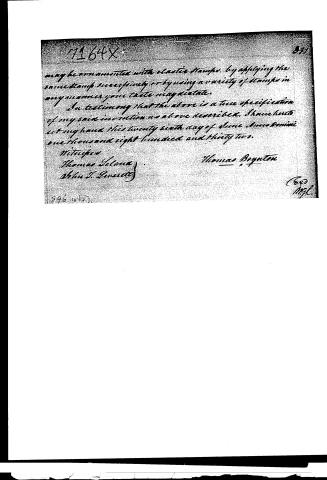
may be ornamented with elastic stamps, by applying the same stamp successively or by using a variety of stamps in any manner your taste may dictate.
In testimony that the above is a true specification of my said invention as above described, I have hereunto set my hand this twenty sixth day of June, June 26th, one thousand eight hundred and thirty two.
Witnesses
Thomas Selman
John L. Gower
Thomas Boynton
(640
MPL
Published accounts: journal notice
Notice in the monthly list of patents, with remarks
Journal of the Franklin Institute, new ser., vol. 11 (1833), p. 96 · View the page
13. For an improvement in the Mode of Ornamenting the Walls and Floors of Rooms, &c.; Thomas Boynten, Windsor, Windsor county, Vermont, July 12.
Remarks. The mode of ornamenting here proposed is denominated Elastic Stamp Painting. The elastic stamp is made by casting a mixture of glue and molasses, like that used for the making of inking rollers. A reversed mould is to be made and oiled, and upon this the composition is poured. It should be about half an inch in thickness when on the mould, and after it has been cooled and removed from it, it is to be fastened on to a piece of wood, the face of which is cylindrical, and having its back furnished with a handle. The composition mould is to be painted to prevent its drying too hard. To use it, the colour is to be spread upon a pallet board with a brush, the mould applied to it, and the colour then transferred to the wall, &c. by giving a rolling motion to the elastic stamp.
About this record
- Patentee
- DATAMP
- Date
- the Name and Date index of patents, DATAMP, USPTO records
- Invention
- DATAMP
- Listed in
- the Name and Date index of patents, DATAMP, USPTO records, Jim Shaw's X-patent list, the Journal of the Franklin Institute, Burke's List of Patents (1847)
- The X number was worked out from the patent’s place in the date sequence.
- The Franklin Institute's journal spells the name differently.
- Burke's 1847 Patent Office list gives the same patent.