

Drawings and documents
National Archives restored drawings: drawing
John C. Whitin's Patent Drawing for a Machine for Spreading and Picking Cotton

National Archives, Restored Patent Drawings (Record Group 241) · Full-size scan at the National Archives · Catalog record
Show the text on the drawing Hide (46 words)
Words on the drawing as machine-read by the National Archives; not checked. Useful mainly for searching.
Sex / 19. CARDING / [28] Pickers. / who Modil / JOHNC. WHITIN'S / CLASSIFICATION / 7178-+ DIVISION. / Machine for spreading & picking Cotton. / full Part and hum during / LA / LA / I A Д / PI / Pl / RR / IL
USPTO scan
The patent as scanned by the USPTO
-
 Page 1
-
 Page 2
-
 Page 3


U.S. Patent and Trademark Office · Google Patents
Show the transcription Hide (696 words)
Machine transcription (LightOnOCR) of the pages as scanned by the USPTO, most of them the handwritten copies made when the records were restored after the 1836 fire. Not checked; it can misread handwriting, so compare it with the scan.
Page 1.
NO PRINTED SPECIFICATION AVAILABLE
7178X
J. C. Whitin.
Machine for Spreading and Picking Cotton.
Patented Jul. 20, 1832.

Page 2.
7178x July 20 1892 489
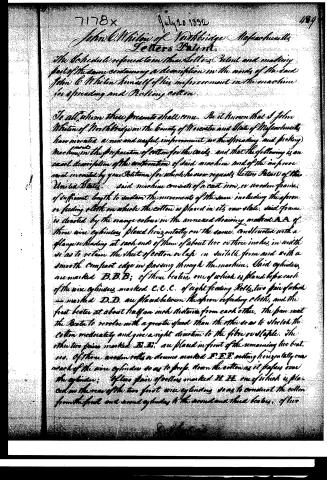
John C. Whelan of Northbridge Massachusetts
Letters Patent.
The Schedule referred to in these Letters Patent and making part of the same containing a description in the words of the said John C. Whelan himself of his improvement in the machine for spreading and Picking cotton.
To all whom these presents shall come. Be it known that I John Whelan of Northbridge in the County of Worcester and State of Massachusetts have invented a new and useful improvement in the spreading and picking machine in the preparation of cotton for the cards, and that the following is an exact description of the construction of said machine and of the improvement invented by you Patents for which he now requests Letters Patent of the United States. Said machine consists of a cast iron, or wooden frame, of sufficient length to sustain the movements of the same including the apron or feeding cloth on which the cotton is placed in its raw state. Said frame is denoted by the orange colour in the annexed drawing marked A A of three wire cylinders placed horizontally on the same. Constructed with a flange or heading at each end of them of about two or three inches in width so as to retain the sheet of cotton or laps in suitable form and with a smooth compact edge in passing through the machine. Said cylinders are marked B.B.B; of three beaters, one of which is placed before each of the wire cylinders marked C.C.C. of eight feeding Rolls, two pair of which are marked D.D. are placed between the apron or feeding cloth, and the first beater at about half an inch distance from each other. The pair next the Beater to revolve with a greater speed than the other so as to stretch the cotton moderately and give a right direction to the fibre or staple. The other two pairs marked E.E. are placed in front of the remaining two beaters. Of three wooden rolls or drums marked F.F.F. resting horizontally one each of the wire cylinders so as to press down the cotton as it passes over the cylinders; Of two plain of rollers marked H.H. one of which is placed in the rear of the two first wire cylinders so as to conduct the cotton from the first and second cylinders to the second and third beaters, of two
Page 3.
7178x
July 20, 1832
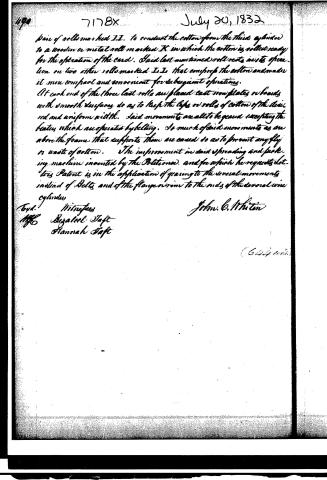
pair of rolls marked I.I. to conduct the cotton from the third cylinder to a wooden or metal roll marked K in which the cotton is rolled ready for the operation of the card. Said last mentioned roll rests in its operation on two other rolls marked I.I. that compress the cotton and render it more compact and convenient for subsequent operations.
At each end of the three last rolls are placed cast iron plates or boards with smooth surfaces, so as to keep the laps or rolls of cotton of the desired and uniform width. Said movements are all to be geared excepting the beater, which are operated by belting. So much of said movements as are above the frame that supports them are caused so as to prevent any fly or waste of cotton. The improvement in said spreading and packing machine invented by the Petitioner, and for which he requests letters Patent is in the application of gearing to the several movements instead of Belts, and of the flange or rim to the ends of the several wire cylinders.
John C. Whitin
Test.
Witnesses
Beyaluel Taft
Hannah Taft
(644 words)
Published accounts: journal notice
Notice in the monthly list of patents, with remarks
Journal of the Franklin Institute, new ser., vol. 11 (1833), p. 100 · View the page
25. For a Cotton Spreading and Picking machine; John C. Whitin, Northbridge, Worcester county, Massachusetts, July 20.
Remarks. This spreading and picking machine is constructed like some others now in use, but the wire cylinders are to have a flanch, or heading, on each end, projecting about two inches, so as to retain the sheet or lap of cotton, with a smooth, compact edge. All the moving cylinders, rollers, &c., excepting the beaters, are to be geared, and these are to be run as usual by straps. The claim is to "the application of gearing to the several movements, instead of belts, and of the flanch or rim to the ends of the several wire cylinders."
About this record
- Patentee
- DATAMP
- Date
- the Name and Date index of patents, DATAMP, USPTO records
- Invention
- DATAMP
- Listed in
- the Name and Date index of patents, DATAMP, USPTO records, Jim Shaw's X-patent list, the Journal of the Franklin Institute, Burke's List of Patents (1847)
- The X number was worked out from the patent’s place in the date sequence.
- Burke's 1847 Patent Office list gives the same patent.