

Drawings and documents
National Archives restored drawings: drawing
James Bennett's Patent Drawing for a Suspended Water Wheel

National Archives, Restored Patent Drawings (Record Group 241) · Full-size scan at the National Archives · Catalog record
Show the text on the drawing Hide (63 words)
Words on the drawing as machine-read by the National Archives; not checked. Useful mainly for searching.
[168] / Vames Bennett Suspended Water wheel. / Vol / 529 / 124 / Patentia any 10. 1:32. / .A.CIFICATION / 7197-1 / DIV ISION. / Patent affice March // 1842 / References. a. shaft. b.b headblocks. e.e C.C posts. / made / undu / the / ofth / of / Patents / in / wallower / 1. / spuresheel. / upright / shaftfluted / in / waterwheel. / roller / lever / p.p. / fright / af Patints
USPTO scan
The patent as scanned by the USPTO
-
 Page 1
-
 Page 2
-
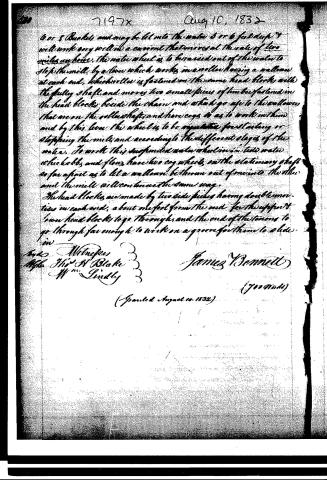 Page 3


U.S. Patent and Trademark Office · Google Patents
Show the transcription Hide (663 words)
Machine transcription (LightOnOCR) of the pages as scanned by the USPTO, most of them the handwritten copies made when the records were restored after the 1836 fire. Not checked; it can misread handwriting, so compare it with the scan.
Page 1.
416-185
J. Bennett,
Water Wheel,
7,197x Patented Aug. 10, 1832.
Page 2.
7197X Aug 10 1832 329
James Bennett of Vigo Indiana
Letters Patent
The Schedule refers to in these Letters Patent and making part of them containing a description with the words of the said James Bennett himself of his improvement in propelling Mills on Rivers by force of the current or tide by a suspended water wheel and head block.
To all to whom these presents shall come: Be it known that I James Bennett of the County of Vigo and State of Indiana have invented a new and useful improvement in propelling mills on Rivers by force of the current or tide by a suspended water wheel and head block, and that the following is a full and exact description of the construction and operation of the said machine as mounted or improved by me.
The water wheel shaft may be 40 or 50 feet long, and to lie horizontally across the stream. The head blocks are to slide between two posts at each end, which have ways for it to slide in, so that it may be raised or lowered as the water may require.
There are two large chains fastened to each head block and which go up around or over the pulleys on the top of the frame which the posts and which have large weights at the end of them heavy enough to balance the water wheel and head blocks, so as to make the wheel stand whenever it is set.
On the end of the water wheel shaft there is a wheel with 110 or 80 cogs in it which works in a wallower of 18 or 20 rounds, which is on a shaft that stands on the head block, which works up and down with the water wheel, and in this upright shaft above the wallower there is a spur wheel with 30 or 60 cogs in it which is to work into a stationary shaft which is fluted from the bottom up as high as the water wheel one wants to be raised, and on the top of the long upright shaft there is a spur wheel as large as it will bear not to touch the chains or head blocks.
The water wheel may be from 16 to 20 feet high and should have
Page 3.
7197x Aug 10, 1832
6 or 8 Bushels, and may be let into the water 3 or 6 feet deep & will work very well in a current that moves at the rate of two miles an hour. The water wheel is to be raised out of the water to stop the mill, by a lever which works in a roller having a wallow at each end, which roller is fastened on the same head blocks with the pulley shaft, and moves two small pieces of timber fastened in the head blocks beside the chain and which go up to the wallows that are on the roller shafts, and have cogs to as to work with them and by this lever the wheel is to be operated for starting or stopping the mill and according to the different stages of the water. To work this suspended water wheel in tide water which ebbs and flows have two cog wheels on the stationary shaft so far apart as to let a wallow be thrown out of one into the other and the mill will continue the same way.
The head blocks are made by two side pieces having double mortises in each end, about one foot from the end for the upper & lower head blocks to go through, and the end of the tenons to go through far enough to work on a groove for them to slide in.
Witnesses
Mrs. H. Blake
Wm. Lindly
James Bennett
(700 words)
(Granted August 10, 1832)
Published accounts: journal notice
Notice in the monthly list of patents, with remarks
Journal of the Franklin Institute, new ser., vol. 11 (1833), p. 161 · View the page
8. For a Current and Tide Water Wheel; James Bennet, Vigo county, Indiana, August 10.
Remarks. A water wheel with floats made in the usual way, is to have its gudgeons run in head blocks placed between uprights which admit of their sliding up and down by the aid of chains or racks, operated upon by suitable machinery. The contrivance has undoubtedly been made without a knowledge of what has been already done, as the whole is very inferior in point of arrangement to structures of a similar kind which have repeatedly been carried into effect, although with but little advantage. The specification does not pretend to claim any thing as new.
About this record
- Patentee
- DATAMP
- Date
- the Name and Date index of patents, DATAMP, USPTO records
- Invention
- DATAMP
- Listed in
- the Name and Date index of patents, DATAMP, USPTO records, Jim Shaw's X-patent list, the Journal of the Franklin Institute, Burke's List of Patents (1847)
- The X number was worked out from the patent’s place in the date sequence.
- The Franklin Institute's journal spells the name differently.
- Burke's 1847 Patent Office list gives the same patent.