

Drawings and documents
National Archives restored drawings: drawing
S. Ustick's Patent Drawing for a Saw

National Archives, Restored Patent Drawings (Record Group 241) · Full-size scan at the National Archives · Catalog record
Show the text on the drawing Hide (60 words)
Words on the drawing as machine-read by the National Archives; not checked. Useful mainly for searching.
7J Saws. / 50 / S. O USTICK / Sam / CLASSIFICATION / 7200-+ / DIVISION. / Patented Hang 1832 / to / A. / y/o / of / A. Side cullers / B. Common leeth / Frickland Det / Patent laffee Ockn1's / Made under the direction of the commissione of has / in conformuty with act of 3 March 1837 / Humya
USPTO scan
The patent as scanned by the USPTO
-
 Page 1
-
 Page 2
-
 Page 3


U.S. Patent and Trademark Office · Google Patents
Show the transcription Hide (401 words)
Machine transcription (LightOnOCR) of the pages as scanned by the USPTO, most of them the handwritten copies made when the records were restored after the 1836 fire. Not checked; it can misread handwriting, so compare it with the scan.
Page 1.
7200X
S. Ustick,
Sarr.
Patented Aug. 11, 1832.

A.M. PHOTO-LITHO. CO. N.Y. (OSBORNE'S PROCESS)
Page 2.
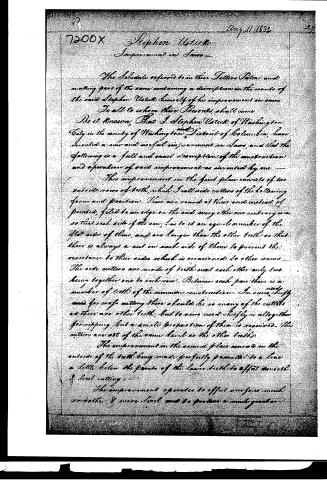
7200X Stephen Usticko
Improvement in Saws
The Schedule referred to in these Letters Patent and making part of the same containing a description in the words of the said Stephen Usticko himself of his improvement in saws.
To all to whom these Presents shall come
Be it Known, That I, Stephen Usticko of Washington City in the county of Washington and District of Columbia, have invented a new and useful improvement in Saws, and that the following is a full and exact description of the construction and operation of said improvement as invented by me.
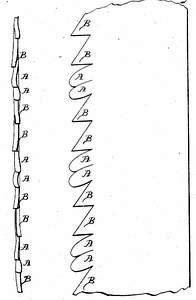
This improvement in the first place consists of two outside rows of teeth, which I call side cutters of the following form and position. These are round at their end instead of pointed, filed to an edge on the end, every other one contrary wise so that each side of the saw, has to it an equal number of the flat sides of them, and are larger than the other teeth so that there is always a cut on each side of them to prevent the resistance to their sides which is occasioned to other saws.
The side cutters are made of teeth next each other only two being together one to each row. Between each pair there is a number of teeth of the common construction. In saws chiefly used for cross cutting there should be as many of the cutters as there are other teeth; but to saws used chiefly or altogether for ripping, but a small proportion of them is required. The cutters are set of the same level as the other teeth.
The improvement in the second place consists in the outside of the teeth being made perfectly parallel to a line a little below the points of the lower teeth to effect smooth & level cutting.
The improvement operates to effect surfaces much smoother & more level and to produce a much greater
Page 3.
7200x - Aug 11, 1832
quantity of mark than other mines
Miners
Sam Williams
J. B. White
Stephen White
Drawing made
396.48
Published accounts: journal notice
Notice in the monthly list of patents, with remarks
Journal of the Franklin Institute, new ser., vol. 11 (1833), p. 162 · View the page
10. For an improvement in Saws; Stephen Ustick, city of Washington, District of Columbia, August 11.
Remarks. The proposed improvement in saws consists in giving to a certain portion of the teeth a form different from that which they usually receive, which teeth the patentee calls "side cutters." The other teeth of the saw, say five or six in succession, are to be of the ordinary shape. The side cutters, instead of being pointed, are round at their ends, and filed to a sharp edge; they are to be a little longer than the other teeth, and are to be set alternately on each side of the saw. It is intended that their cutting edges shall clear the sides of the stuff, and make smooth work; in order to this, they must be so set as to be perfectly parallel to the sides of the saw. The improvement is said to consist in the form of these rounding teeth, and in the setting them in the way described. There are but few workmen who are able to sharpen and set a saw really well; it is in fact a very nice job to any one but the saw maker who is constantly employed at it. To sharpen and set a saw in the manner described, will be a task of still greater difficulty, and one, we think, that will rarely be undertaken, however well such a saw may be found to work when perfectly set. To keep the side cutters a little longer than the common teeth will not be a very easy thing, as their substance will be less. We might urge other objections, but they will be so obvious to the workman, as to deter him from leaving the beaten track.
DATAMP: illustration
Illustrations from DATAMP

DATAMP (Directory of American Tool and Machinery Patents), via the Internet Archive · Archived DATAMP page
About this record
- Patentee
- DATAMP
- Date
- the Name and Date index of patents, DATAMP, USPTO records
- Invention
- DATAMP
- Listed in
- the Name and Date index of patents, DATAMP, USPTO records, Jim Shaw's X-patent list, the Journal of the Franklin Institute, Burke's List of Patents (1847)
- The X number was worked out from the patent’s place in the date sequence.
- Burke's 1847 Patent Office list gives the same patent.