

Drawings and documents
USPTO scan
The patent as scanned by the USPTO
-
 Page 1
-
 Page 2
-
 Page 3
-
 Page 4


U.S. Patent and Trademark Office · Google Patents
Show the transcription Hide (864 words)
Machine transcription (LightOnOCR) of the pages as scanned by the USPTO, most of them the handwritten copies made when the records were restored after the 1836 fire. Not checked; it can misread handwriting, so compare it with the scan.
Page 2.
United States Patent
Patent No.: X7204
Henry Reisinger of York, Pennsylvania
Letters Patent.
The Schedule referred to in these Letters Patent and making part of the same containing a description in the words of the said Henry Reisinger himself of his improvement in the Bedstead.
To all to whom these presents shall come. Be it known that I Henry Reisinger of York in the County of York and State of Pennsylvania have invented a new and useful improvement in the art of making Bedsteads and that the following is a full and exact description of the construction and operation of the said improvement as invented or improved by me.
This Bedstead differs from the common Bedstead in general. The Bedstead to be of the ordinary length and Breadth, say 6 feet long and 4 feet wide between the posts. From the head post to the centre of the upper shaft is 2 feet 7 inches. The shaft to be made of hard wood two inches square with gudgeons on each end, which are to be one and a half or two inches long to extend or run into the centre of side rails.
There are two cross pieces of hard wood screwed on the shaft extending from the head post to the semicircular rule joint, there which there is to be a pin of hard wood or iron put near the side rails. The length from the centre of the shaft to the end of the rule joint to be 23 inches. From the foot post to the other end of the rule joint is twenty two inches.
The Bedstead to be made sufficiently high (say two feet two inches to the top of the rail, with castors or rollers underneath) to admit that part from the foot post to the rule joint to fall and raise easily as this Bedstead can be converted into a Bed or seat at pleasure.
There are four upright square posts, two of which are two inches from the rule joint to be of the same length as
Page 3.
United States Patent
Patent No.: X7204
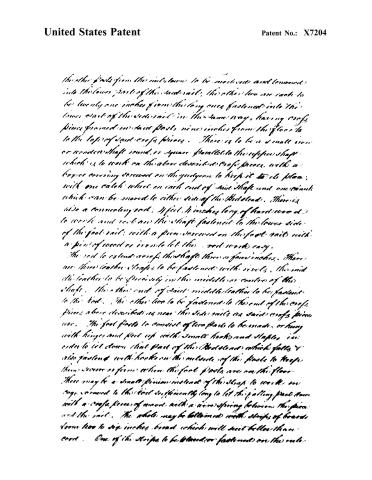
the other parts from the middle down to be mounted and lowered into the lower part of the side rails, the other two are each to be twenty-one inches from the long ones fastened into the lower part of the side rails in the same way, having cross pieces framed in said posts, nine inches from the floor to the top of said cross pieces. There is to be a small iron or wooden shaft round, or square parallel to the upper shaft which is to work on the above described cross pieces, with a box or covering screwed on the top to keep it in its place, with one catch wheel on each end of said shaft and one crank which can be moved to either side of the Bedstead. There is also a connecting rod, 14 feet 11 inches long of hard wood to work and rest on the shaft fastened to the lower side of the foot rails, with a piece screwed on the foot rails with a pin of wood or iron to let the rod work easy.
The rod to extend across the shaft three or four inches. There are three leather straps to be fastened with rivets, the middle leather to be precisely in the middle or center of the shaft. The other end of said middle leather to be fastened to the rod. The other two to be fastened to the end of the cross pieces above described as near the side rails as said cross pieces are. The foot parts to consist of two parts to be made, or hung with hinges and put up with small hooks and staples in order to let down that part of the Bedstead which falls & also fastened with hooks on the outside of the posts to keep them secure as firm when the foot posts are on the floor. There may be a small pinion instead of the shaft to work on rods screwed to the rod sufficiently long to let the falling part down with a cross piece of wood with a wire spring between the piece and the rail. The whole may be bolted with strips of boards from two to six inches broad which will suit better than cord. One of the strips to be placed or fastened on the rails
Page 4.
United States Patent
Patent No.: X7204
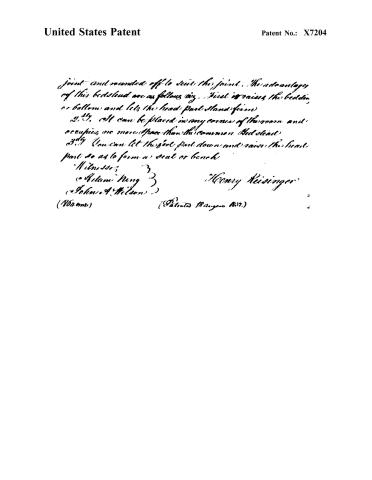
joint and rounded off to suit the joint. The advantages of this bedstead are as follows viz. First it raises the bedding or bottom and lets the head part stand firm.
2dly. It can be placed in any corner of the room and occupies no more space than the common Bedstead.
3dly. You can let the foot part down and raise the head part so as to form a seat or bench.
Witnesses:
Adam King
John A. Wilson
(Victoria)
Henry Reisinger
(Patented May 2nd 1872.)
Published accounts: journal notice
Notice in the monthly list of patents, with remarks
Journal of the Franklin Institute, new ser., vol. 11 (1833), p. 163 · View the page
15. For a Bedstead; Henry Reisinger, York, York county, Pennsylvania, August 18.
Remarks. This is intended for an invalid bedstead, and is so constructed that by the turning of a windlass, one end of it can be raised, or lowered. There is no novelty whatever in the means by which this is to be effected, whilst a number of movements and conveniences not attempted in this bedstead, have, in addition to the mode of raising and lowering, been accomplished in others, several of which we have had occasion to notice. There is a drawing of the plan, but it is without the written references which are required by law.
About this record
- Patentee
- DATAMP
- Date
- the Name and Date index of patents, DATAMP, USPTO records
- Invention
- DATAMP
- Listed in
- the Name and Date index of patents, DATAMP, USPTO records, Jim Shaw's X-patent list, the Journal of the Franklin Institute, Burke's List of Patents (1847)
- Burke's 1847 Patent Office list gives the same patent.