

Drawings and documents
National Archives restored drawings: drawing
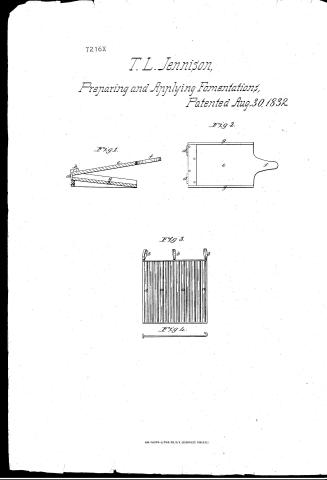
Timothy L. Jennison's Patent Drawing for a Mode of Preparing and Applying Fomentations

National Archives, Restored Patent Drawings (Record Group 241) · Full-size scan at the National Archives · Catalog record
Show the text on the drawing Hide (40 words)
Words on the drawing as machine-read by the National Archives; not checked. Useful mainly for searching.
128. SURGERY, / [156] Pharmaceutical. / CLASSIFICATION / Rung Miss / 7216-7 / DIVISION. / TIMOTHY L. JENNISON'S / MODE OF PREPARING & APPLYING FOMENTATIONS. / Patented 30ᵗʰAugt1832. / Fig. 2. / Fig. 1. / Fig 3. / 1' / 01 / Fig.4. / bB.
USPTO scan
The patent as scanned by the USPTO
-
 Page 1
-
 Page 2
-
 Page 3
-
 Page 4
-
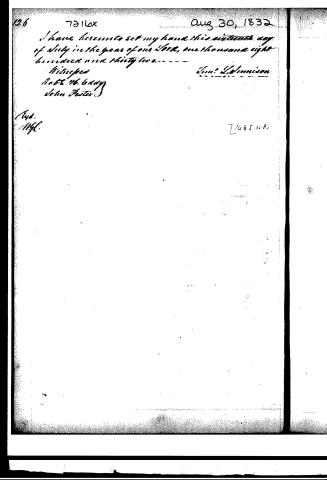 Page 5


U.S. Patent and Trademark Office · Google Patents
Show the transcription Hide (1,198 words)
Machine transcription (LightOnOCR) of the pages as scanned by the USPTO, most of them the handwritten copies made when the records were restored after the 1836 fire. Not checked; it can misread handwriting, so compare it with the scan.
Page 1.
7216X
T. L. Jennison,
Preparing and Applying Fomentations,
Patented Aug. 30, 1832.
Fig 1.

Fig 2.

Fig 3.

Fig 4.

AM. PHOTO-LITHO. CO. N.Y. (OSBORNE'S PROCESS)
Page 2.
Aug. 30, 1832
7216X Timothy L. Dennison, Cambridge, Massachusetts
Letters Patent.
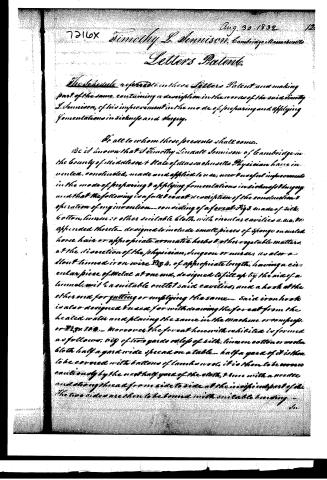
The schedule referred to in these Letters Patent and making part of the same, containing a description in the words of the said Timothy L. Dennison, of his improvement in the mode of preparing and applying fomentations in sickness and surgery.
To all to whom these presents shall come.
Be it known that I Timothy Lincoln Dennison of Cambridge in the County of Middlesex & State of Massachusetts Physician have invented, constructed, made and applied to use, new & useful improvements in the mode of preparing & applying fomentations in sickness & surgery and that the following is a full & exact description of the construction & operation of my invention... consisting of a foresaid Fig. 3 made of silk, cotton, linen or other suitable cloth, with circular cavities a, a, a, to affixed thereto... designed to include small pieces of sponge or mules horse hair or appropriate aromatic herbs & other vegetable matters, at the discretion of the physician, surgeon or nurse; as also a stout tinned iron wire Fig. 4, of appropriate length, having a circular piece of metal at one end, designed to fill up by the aid of a funnel, with a suitable outlet said cavities; and a hook at the other end for getting or emptying the same... said iron hook is also designed to serve for withdrawing the foresaid from the heated water and placing the same in the machine or troughs or Fig. 1 & 2... Moreover the foresaid here with exhibited is formed as follows: viz of two yards or less of silk, linen, cotton or woolen cloth half a yard wide spread on a table... half a yard of it is then to be covered with battens of lamb's wool, it is then to be covered cautiously by the next half yard of the cloth, & sewn with a needle and strong thread from side to side at the insufficient part of it. The two sides are then to be bound with suitable binding...
Page 3.
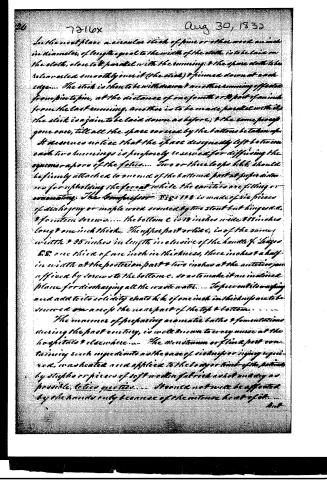
In the next place, a circular stick of pine or other wood an inch in diameter, of length equal to the width of the state, is to be laid on the cloth, close to & parallel with the running; & the space cloth to be reinvolved smoothly over it (the stick) & pinned down at each edge. The stick is then to be withdrawn & another running effected from pin to pin, at the distance of one fourth or 1/4 part of an inch from the last running. Another is to be made parallel with it; the stick is again to be laid down as before; & the same process gone over, till all the space covered by the buttons be taken up.
It deserves notice that the space designedly left between each two runnings is purposely reserved for diffusing the aqueous vapors of the fetus. Two or three loops h.h., should be firmly attached to one end of the buttoned part at proper distance for upholding the foreskin while the cavities are filling or evacuating. The Compressor—Figs 122 is made of six pieces of deal, holly or maple wood secured by two stout but hinges a.a., & four iron screws. The bottom c is 18 inches wide & 11 inches long & one inch thick. The upper part or lid, is of the same width & 25 inches in length inclusive of the handle f. Ledges b.b. one third of an inch in thickness, three inches & a half in width at the posterior part & two inches at the anterior part affixed by screws to the bottom c. so as to make it an inclined plane for discharging all the waste water. To prevent its warping and add to its solidity, seats h.h., of one inch in thickness are to be secured on a cross the inner part of the top & bottom.
The manner of preparing aromatic baths & fomentations during the past century, is well known to every nurse at the hospitals & elsewhere. The menstruum or fluid part containing such ingredients as the case of sickness or injury required, was heated and applied to the important part of the patient by slings or pieces of soft woven fabrics as hot and dry as possible, to the greatest extent. It would not well be affected by the hands only because of the intense heat of it.
Page 4.
7216X Aug 30, 1832 120
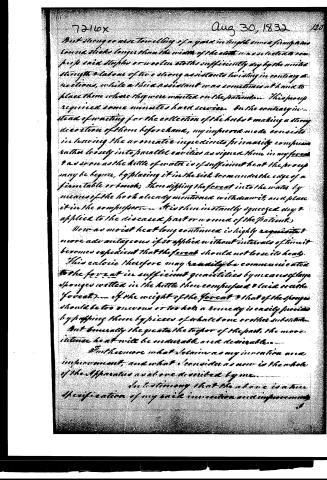
But strong as was the twisting of a yarn in length since fermentation, sound sticks longer than the width of the cloth is not selected to romp, pulp, shred, shreds or woolen cloths sufficiently dry by the united strength & labors of two strong assistants twisting in contrary directions, while a third assistant was sometimes at hand to place them where they were wanted on the patient. This process required some minutes hard service. But the contrary instead of waiting for the collection of the herbs & making a strong decoction of them beforehand, my improved mode consists in having the aromatic ingredients primarily compressed rather loosely into parallel cavities as signed them in my figure & as soon as the kettle of water is of sufficient heat the process may be begun, by placing it in the sick room under the edge of a firm table or bench; then dipping the foveat into the water by means of the hook already mentioned with an air, and place it in the compressors. It is then instantly squeezed dry & applied to the diseased part or wound of the patient.
Now as moist heat long continued is highly requisite & more advantageous if so applied without intervals of time it becomes expedient that the foveat should not lose its heat. This caloric therefore may readily be communicated to the foveat in sufficient quantities by means of large sponges wetted in the kettle then compressed & laid over the foveat. If the weight of the foveat & that of the sponges should be too onerous or too hot a remedy is easily provided by propping them by pieces of what bone or other substance.
But generally the greater the toffor of the part, the more intense heat will be endurable and desirable.
I further more what I claim as my invention and improvement, and what I consider as new is the whole of the apparatus as above described by me.
In testimony that the above is a true specification of my said invention and improvement,
Page 5.
Aug 30, 1832
I have hereunto set my hand this sixteenth day of July in the year of our Lord, one thousand eight hundred and thirty two.
Witnesses
Robt. W. Gady
John Foster
Jno. L. Morrison
Tyd.
Mgk.
7/455 20-8
Published accounts: journal notice
Notice in the monthly list of patents
Journal of the Franklin Institute, new ser., vol. 11 (1833), p. 168 · View the page
26. For an improvement in the mode of Preparing Fomentations used in cases of Sickness; Timothy L. Jennison, Cambridge, Middlesex county, Massachusetts, August 30.
About this record
- Patentee
- DATAMP
- Date
- the Name and Date index of patents, DATAMP, USPTO records
- Invention
- DATAMP
- Listed in
- the Name and Date index of patents, DATAMP, USPTO records, Jim Shaw's X-patent list, the Journal of the Franklin Institute, Burke's List of Patents (1847)
- Burke's 1847 Patent Office list gives the same patent.