

Drawings and documents
National Archives restored drawings: drawing
James Atwater's Patent Drawing for a Fire Grate for Stoves

National Archives, Restored Patent Drawings (Record Group 241) · Full-size scan at the National Archives · Catalog record
Show the text on the drawing Hide (39 words)
Words on the drawing as machine-read by the National Archives; not checked. Useful mainly for searching.
$2 / 126. STOVES & furnaces. / nates- / [154] Grates. idjustable, / CLASSIFICA NON / 7230x 3 # 7230x / DIV / James Alwaters. Fire Grate. / for / STOVE, S. . / Patented 25th Oct 1882. / 1. / 5. / 2. / 3. / ea / OF
USPTO scan
The patent as scanned by the USPTO
-
 Page 1
-
 Page 2
-
 Page 3
-
 Page 4
-
 Page 5
-
 Page 6
-
 Page 7


U.S. Patent and Trademark Office · Google Patents
Show the transcription Hide (2,459 words)
Machine transcription (LightOnOCR) of the pages as scanned by the USPTO, most of them the handwritten copies made when the records were restored after the 1836 fire. Not checked; it can misread handwriting, so compare it with the scan.
Page 1.
7230X
J. ATWATER.
FIRE GRATE FOR STOVES.
Patented Oct. 25, 1832.
Fig. 3.
Fig. 2.
Fig. 5.
Fig. 1.
Fig. 4.
THE MORRIS PETERS CO., PHOTO-LITHO., WASHINGTON, D. C.
Page 2.
No. 76
Oct. 25, 1852
161
7230X James Atwater
Letters Patent
The Schedule referred to in these Letters Patent and making part of the same containing a description on the words of the said James Atwater himself of his improvement on the common Fire Grate
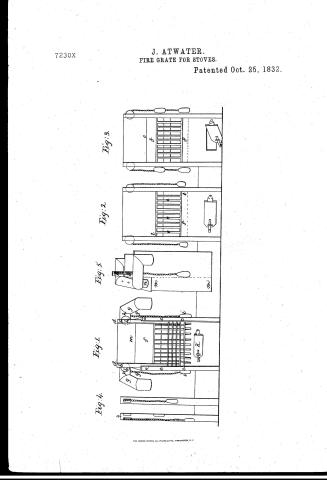
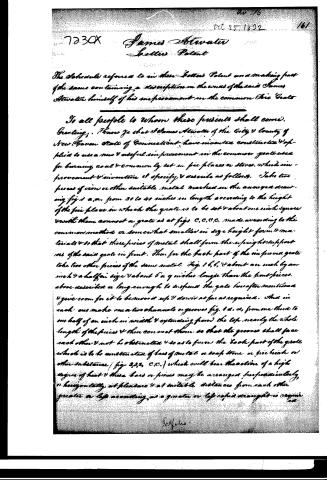
To all people to whom these presents shall come, Greeting. Know ye that I James Atwater of the City & County of New Haven State of Connecticut have invented constructed & applied to use a new & useful improvement on the common grates used for burning coal & commonly set in fire places or Stoves, which improvement & invention I specify & describe as follows. Take two pieces of iron or other suitable metal marked in the annexed drawing figs 1 a, a, from 30 to 40 inches in length according to the height of the fire place in which the grate is to be set & about one inch square & with them connect a grate as at figs c, c, c, c, made according to the common method or somewhat smaller in size height form & materials & so that these pieces of metal shall form the upright supports of the said grate in front. Then for the back part of the improved grate take two other pieces of the same metal figs 1 b, b, & about an inch by an inch & a half in size & about 6 or 9 inches longer than the front pieces above described or long enough to suspend the grate hereafter mentioned & give room for it to be moved up & down as far as required. Then in each one make one or two channels or grooves fig. 1 a, a, from one third to one half of an inch in width & extending from the top nearly the whole length of the pieces & then connect them so that the grooves shall face each other & not be obstructed & so as to form the back part of the grate which is to be constructed of bars of metal or soap stone or fire brick or other substance (fig 2, 2, 2, c, c, c.) which will bear the action of a high degree of heat & these bars or pieces may be arranged perpendicularly or horizontally at pleasure & at suitable distances from each other greater or less according as a greater or less radius or height is required.
Witness:
Page 3.
ed. & according to the size of the grate & so many of them must be used & of such length that the space they shall occupy will be little indeed the height & nearly or quite equal the width of the front of the grate or that part which contains the fuel. The front pair of upright pieces fig. 1, a, p., & the back pair fig. 1, b, b., may be also connected with a piece of the same material placed at the bottom of the grate fig. 1, c, c., & of a suitable size & shape to support the sides of that part of the grate which is to contain the fuel.
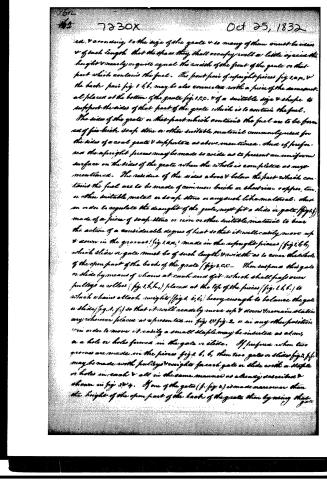
The sides of the grate or that part which contains the fuel are to be formed of fire-brick, soap-stone or other suitable material commonly used for the sides of a coal grate & supports as above mentioned. And if preferred the upright pieces may be made so wide as to present an uniform surface on the sides of the grate when the whole is complete as here mentioned. The residue of the sides above & below the part which contains the fuel are to be made of common brick or that iron, copper, tin, or other suitable metal or soap-stone or any such like material. And in order to regulate the draught of the grate, next fit a slide or gate (fig. 1, f) made of a piece of soap-stone or iron or other suitable material to bear the action of a considerable degree of heat so that it will easily move up & down in the grooves (fig. 1, a, a,) made in the upright pieces (fig. 1, b, b,) which slide or gate must be of such length & width as to cover the whole of the open part of the back of the grate (fig. 2, c, c.). Then suspend this gate or slide by means of chains at each end of which shall pass over pulleys or rollers (fig. 1, h, h,) placed at the top of the pieces (fig. 1, b, b.) to which chains attach weights (fig. 1, i, i,) heavy enough to balance the gate or slide (fig. 1, f,) so that it will readily move up & down & remain stationary wherever placed as represented in fig. 1 & fig. 2, or in any other position & in order to move it easily a small staple may be inserted as at m, or a hole or holes formed in the gate or slide. If preferred when two grooves are made in the pieces fig. 1, b, b., then two gates or slides fig. 2, f, f., may be made with pulleys & weights for each gate or slide with a staple or holes in each & all in the same manner as already described & shown in fig. 3 & 4. If one of the gates (f. fig. 2.) is made narrower than the height of the open part of the back of the grate then by using that gate
Page 4.
7230x Oct 25, 1832
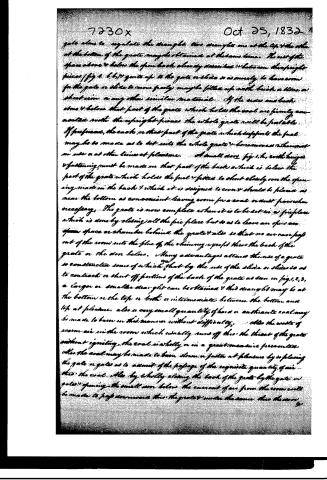
gates alone to regulate the draught, two draughts one at the top & the other at the bottom of the grate may be obtained at the same time. The rest of the space above & below the fire back already described & between the upright pieces (fig 1. 2. 3.) & quite up to the gate or slide is merely to have room for the gate or slide to move freely, maybe filled up with brick or stone or sheet iron or any other similar material. If the sides and back above & below that part of the grate which holds the coal are firmly connected with the upright pieces the whole grate will be portable. If preferred, the back or that part of the grate which supports the fuel may be so made as to set into the whole grate & be removed when not in use or at other times at pleasure. A small door fig 1. h, with hinges & fastening must be made in that part of the back which is below the part of the grate which holds the fuel & fitted to shut closely over the opening made in the back & which it is designed to cover & should be placed as near the bottom as convenient leaving room for a coal or dust pan when necessary. The grate is now complete when it is to be set in a fireplace which is done by closing all the fireplace but so as to leave an open space or chamber behind the grate & also so that no air can pass out of the room into the flue of the chimney except thru the back of the grate or the door below. Many advantages attend the use of a grate so constructed some of which are that by the use of the slide or slides so as to contract or shut off portions of the back of the grate as seen in figs 1, 2, 3, a larger or smaller draught can be obtained & this draught may be at the bottom or the top or both or in time intervals between the bottom and top at pleasure. Also a very small quantity of hard or anthracite coal may be made to burn in this manner without difficulty. Also the waste of warm air in the room which usually runs off thru the throat of the grate without igniting the coal is wholly or in a great measure prevented. Also the coal may be made to burn slower or faster at pleasure by so placing the gate or gates as to admit of the passage of the requisite quantity of air thru the coal. Also by wholly closing the back of the grate by the gate or gates & opening the small door below the current of air from the room will be made to pass downwards thru the grate & under the same thru the room by
Page 5.
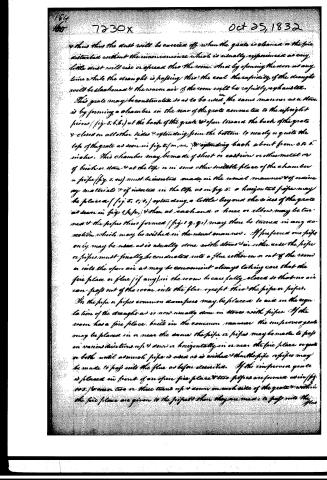
thus the dust will be carried off when the grate is cleaned or the fire disturbed without the inconvenience which is usually experienced as very little dust will rise or spread into the room. And by opening the oven at any time while the draught is passing thro' the coal the rapidity of the draught will be slackened & the warm air of the room will be rapidly rephastated.
This grate may be constructed so as to be used in the same manner as a stove is by forming a chamber in the rear of the grate connected to the asphight pieces (fig. 5. b. b.) at the back of the grate & open towards the back of the grate & closed on all other sides & extending from the bottom to nearly or quite the top of the grate as seen in fig. 5. m. m. & extending back about from 3 to 6 inches. This chamber may be made of sheet or cast iron or other metal or of brick or stone & at the top or in some other suitable place of the chamber a pipe (fig. 5. o.) must be inserted made in the usual manner & of ordinary materials & if inserted in the top as in fig. 5. a horizontal pipe may be placed (fig. 5. c. c.) extending a little beyond the sides of the grate as seen in fig. 1. h. h. & then at each end a knee or elbow may be turned & the pipes thus formed (fig. 1. q. q.) may then be turned in any direction which may be wished in the usual manner. If preferred one pipe only may be used as is usually done with stoves & in either case the pipe or pipes must finally be conducted into a flue either in or out of the room or into the open air as may be convenient always taking care that the fire place or flue (if any) in the room be carefully closed so that no air can pass out of the room into the flue except thro' the pipe or pipes.
On the pipe or pipes common dampers may be placed to aid in the regulation of the draught as is now usually done in stoves with pipes. If the room has a fire place built in the common manner the improved grate may be placed in or near the stove the pipe or pipes may be made to pass in various directions up & down or horizontally in or near the fire place or grate or both until as much pipe is used as is wished & then the pipe or pipes may be made to pass into the flue as before described. If the improved grate is placed in front of an open fire place & two pipes are formed as in (fig. 105.) from two or three turns up & down on each side of the grate & within the fire place are given to the pipes & then they are made to pass into the flue
Page 6.
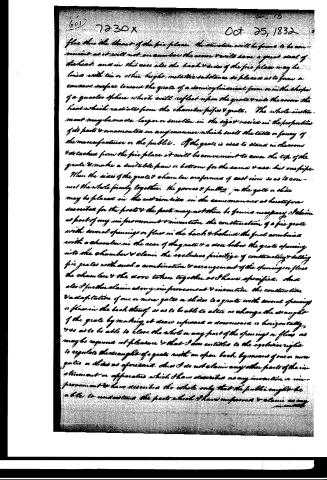
flue thru the throat of the fireplace, the structure will be found to be convenient as it will not encumber the room & will save a great deal of the heat, and in this case also the back side of the fireplace may be lined with tin or other bright metallic substance so placed as to form a concave surface toward the grate of a conicylindrical form or in the shape of a quarter sphere which will reflect upon the grate & into the room the heat which radiates from the chamber pipes & grate. The whole instrument may be made larger or smaller in the size & varied in the proportion of its parts & ornamented in any manner which suits the taste or fancy of the manufacturer or the public. If the grate is used to stand in the room & detached from the fireplace it will be convenient to cover the top of the grate & make a suitable pan or bottom for the same & use but one pipe.
When the sides of the grate & chamber are formed of cast iron so as to connect the whole firmly together, the grooves & fulties in the gate or slide may be placed in the cast iron sides in the same manner as heretofore described for the posts & the posts may not then be found necessary. I claim as part of my improvement & invention the construction of a fire grate with several openings or flues in the back & behind the fuel chamber with a chamber in the rear of the grate & a door below the grate opening into the chamber & claim the exclusive privilege of constructing & selling fire grates with such a combination & arrangement of the openings or flues the chamber & the door taken together as I have specified. And also I further claim as my improvement & invention the construction & adaptation of one or more gates or slides to a grate with several openings or flues in the back thereof so as to be able to alter or change the draught of the grate by making it draw upwards or downwards or horizontally & so as to be able to close the whole or any part of the openings or flues as may be required at pleasure & that I am entitled to the exclusive rights to regulate the draught of a grate with an open back by means of one or more gates or slides as aforesaid. And I do not claim any other parts of the instrument or apparatus which I have described as my invention or improvement but have described the whole only that the public might be able to understand the parts which I have improved & claim as my
Page 7.
Oct 25, 1832
In testimony that the above is a true specification of my said improvement as above described I have hereunto set my hand this 25th day of July, A.D. 1832.
James Atwater
Witness
Samuel H. Atwater
John Beach
2656 n.b.
Published accounts: journal notice
Notice in the monthly list of patents, with remarks
Journal of the Franklin Institute, new ser., vol. 11 (1833), p. 226 · View the page
10. For an improvement in the Common Grate for Burning Coal; James Atwater, New Haven, Connecticut, October 25.
Remarks. In this grate, which is intended for burning anthracite, there are to be registers or sliding shutters, made of soap stone, iron, or other material, which are to be furnished with chains passing over pulleys, and weights to counterpoise them. Sometimes there may be but one of these slides, but at others it is proposed to use two, and to hang them in such a way that they may direct the draft upwards or downwards. The back of the grate is to be hollow, and several pipes or openings may be used for the escape of air; the pipes, or flues, may also be made to return upwards and downwards so as to expose a large surface to emit heat. The claims are to "the invention of a fire grate with several openings or flues in the back, and behind the fuel, combined with a chamber in the rear of the grate, and a door below the grate opening into the chamber. The construction and adaptation of one or more gates, or slides, to a grate with several openings, or flues, in the back thereof, so as to be able to alter or change the draft of the grate by making it draw upward or downward, or horizontally; and so as to be able to close the whole or any part of the openings or flues, as may be required, at pleasure, And to the exclusive right to regulate the draft of a grate with an open back by means of one or more gates, ates, or slides, as aforesaid." We think that there are more contrivances about this affair than will be found to be either convenient or useful, leaving elegance altogether out of the question. We also think that the claims are too general and indefinite, and are likely, therefore, to interfere, or rather to be interfered with, by things which have been already and frequently done.
About this record
- Patentee
- DATAMP
- Date
- the Name and Date index of patents, DATAMP, USPTO records
- Invention
- DATAMP
- Listed in
- the Name and Date index of patents, DATAMP, USPTO records, Jim Shaw's X-patent list, the Journal of the Franklin Institute, Burke's List of Patents (1847)
- Burke's 1847 Patent Office list gives the same patent.