

Drawings and documents
National Archives restored drawings: drawing
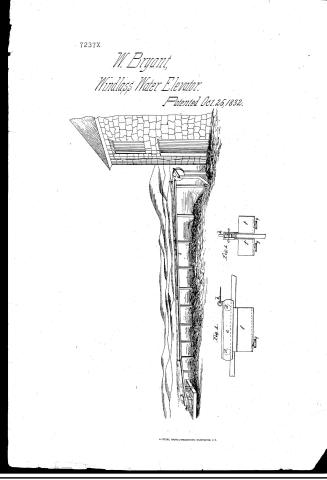
William Bryant's Patent Drawing for a Machine for Supplying Houses with Water

National Archives, Restored Patent Drawings (Record Group 241) · Full-size scan at the National Archives · Catalog record
Show the text on the drawing Hide (65 words)
Words on the drawing as machine-read by the National Archives; not checked. Useful mainly for searching.
57.-MOIZTING 57 / Elevators, / Inclined. / hater / $250 / William Bryant / Supplying houses with water. / Vol 14. pg.209 / CLASSIFICATION / Patented Oct 25. 1832. / 7237-X DIVISION / op / Fig.1. Lideview of the carriage / Fij.2. / Front vition the carriage. / Intent affice Dear Hish / Puferences. / B. single 2ac / mall wheels. / made under the direction of the / vessel. g.g. / e. issy.
USPTO scan
The patent as scanned by the USPTO
-
 Page 1
-
 Page 2
-
 Page 3
-
 Page 4


U.S. Patent and Trademark Office · Google Patents
Show the transcription Hide (726 words)
Machine transcription (LightOnOCR) of the pages as scanned by the USPTO, most of them the handwritten copies made when the records were restored after the 1836 fire. Not checked; it can misread handwriting, so compare it with the scan.
Page 1.
7237X
W. Bryant,
Windlass Water Elevator.
Patented Oct. 25, 1832.
Page 2.
7237x William Bryant, Davidson, Tennessee
Letters Patent.
The schedule referred to in these Letters Patent, and making part of the same, containing a description in the words of the said William Bryant himself of his improvement in the mode of supplying houses with water.
To all whom these presents shall come.
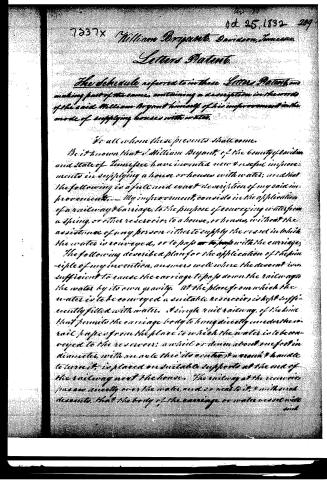
Be it known that I William Bryant, of the County of Davidson and State of Tennessee have invented new & useful improvements in supplying a house or houses with water; and that the following is a full and exact description of my said improvements. — My improvement consists in the application of a railway carriage, to the purpose of conveying water from a spring, or other reservoir, to a house, or houses, without the assistance of any person either to supply the vessel in which the water is conveyed, or to pump with the carriage.
The following described plan for the application of the principle of my invention, answers well where the descent is sufficient to cause the carriage to pass down the railway to the water by its own gravity. At the place from which the water is to be conveyed a suitable reservoir is kept sufficiently filled with water. A single rail railway, of the kind that permits the carriage body to hang directly under the rail, passes from the place to which the water is to be conveyed to the reservoir; a wheel or drum about one foot in diameter, with an axle through its center, and a crank handle to turn it, is placed on suitable supports at the end of the railway next the house. The railway at the reservoir passes directly over the water, and so near to it, & with such descents, that the body of the carriage or water vessel will not
Page 3.
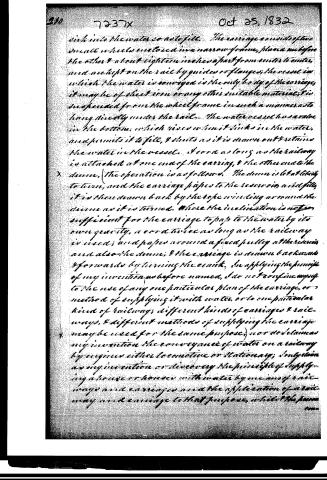
sink into the water so not to fill. The carriage consists of two small wheels enclosed in a narrow frame, placed one before the other, and about eighteen inches apart from center to center, and are kept on the rail by guides or flanges; the vessel in which the water is conveyed is the only body of the carriage, it may be of sheet iron or any other suitable material; it is suspended from the wheel frame in such a manner as to hang directly under the rail. The water vessel has a valve in the bottom, which rises when it sinks in the water, and permits it to fill, and shuts as it is drawn out and returns the water in the vessel. A cord as long as the railway is attached at one end of the carriage, and the other end to the drum. The operation is as follows. The drum is let at liberty to turn, and the carriage pipes to the reservoir and fills, it is then drawn back by the rope winding around the drum as it is turned. Where the inclination is not sufficient for the carriage to pay to the water by its own gravity, a cord twice as long as the railway is used; and passes around a fixed pulley at the reservoir and also the drum, and the carriage is drawn backwards and forwards by turning the crank. In applying the principle of my invention as before named, I do not confine myself to the use of any one particular plan of the carriage, or method of supplying it with water, or to one particular kind of railway; different kinds of carriages and railways, and different methods of supplying the carriage may be used for the same purpose, nor do I claim as my invention the conveyance of water on a railway by engines either locomotive or stationary; I claim as my invention or discovery the principle of supplying a house or houses with water by means of railways and carriages and the application of a railway and carriage to that purpose, which the patent
Page 4.
7237x
Oct 25, 1832
conveying the water remains at the house to which it is conveyed.
Witnesses
Samuel Robertson
John H. Robertson
William Bryant
Published accounts: journal notice
Notice in the monthly list of patents, with remarks
Journal of the Franklin Institute, new ser., vol. 11 (1833), p. 225 · View the page
6. For a Method of supplying Houses with Water; William Bryant, Davidson county, Tennessee, October 25.
Remarks. An elevated rail-way is to extend from the house to the reservoir containing the water. The box, or vessel, in which the water is to be conveyed hangs below the rail, being attached to a small carriage with wheels which run upon the rail. At the house there is to be a wheel and axle, turning by means of a crank, a rope from which, affixed to the vessel, is of sufficient length to allow it to descend to the reservoir; if the inclination is sufficient it will descend by its own gravity, otherwise the rope must be of double length, and pass round a pulley at the reservoir. The bottom of the vessel is furnished with a valve opening inwards, admitting the water when it dips into the reservoir. The claim is to "the principle of supplying houses with water by means of a rail-way and carriage, and the application of a rail-way and carriage to that purpose, whilst the person conveying the water remains at the house to which it is conveyed."
About this record
- Patentee
- DATAMP
- Date
- the Name and Date index of patents, DATAMP, USPTO records
- Invention
- DATAMP
- Listed in
- the Name and Date index of patents, DATAMP, USPTO records, Jim Shaw's X-patent list, the Journal of the Franklin Institute, Burke's List of Patents (1847)
- Burke's 1847 Patent Office list gives the same patent.