

Drawings and documents
National Archives restored drawings: drawing
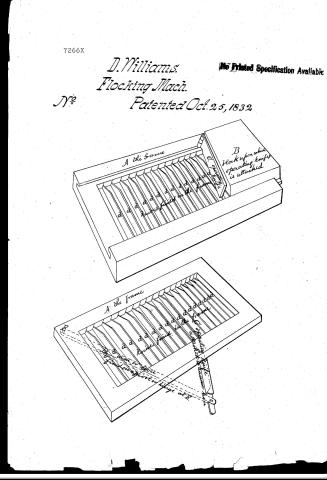
Denison Williams' Patent Drawing for a Machine for Cutting Fur

National Archives, Restored Patent Drawings (Record Group 241) · Full-size scan at the National Archives · Catalog record
Show the text on the drawing Hide (86 words)
Words on the drawing as machine-read by the National Archives; not checked. Useful mainly for searching.
ELT & FINA / Fung & Polty / Denisen Williams / /50 / Sets / 7266 x / DIV / Cutting Furl / Patented 25 our 25 1832, / A the frame / a is / Km / A the frame <<<<<<<< / a the dddddad frame / of / lever / hunge / operating knife to anamon lever / atE, / Patent Office ylept 1841 / Made under the docution of the Comminion win coun of Patients / in conformity with tht of bougrefs 3. March 1837, / Menuyh illnorth / Commisioner of
USPTO scan
The patent as scanned by the USPTO
-
 Page 1
-
 Page 2
-
 Page 3


U.S. Patent and Trademark Office · Google Patents
Show the transcription Hide (657 words)
Machine transcription (LightOnOCR) of the pages as scanned by the USPTO, most of them the handwritten copies made when the records were restored after the 1836 fire. Not checked; it can misread handwriting, so compare it with the scan.
Page 1.
7266X
D. Williams.
Flocking Mach.
No Printed Specification Available.
Patented Oct. 25, 1832
A the frame
B block upon which operating knife is attached
A the frame
B a door or cover fixed on a pivot or hinge at E
C operating knife attached to vacuum tube
Page 2.
7266X
Denison Williams.
Letters Patent
Dated October 25, 1832.
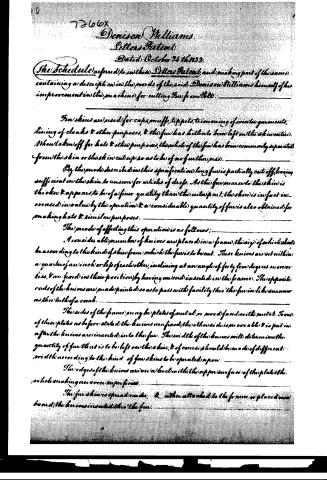
The Schedule referred to in this Letters Patent, and making part of the same, containing a description in the words of the said Denison Williams himself of his improvement in the machine for cutting Fur from Skins.
Fur skins are used for caps, snuff, tippets, trimming of winter garments, lining of cloaks & other purposes, & the fur has hitherto been left on the skin entire. When taken off for hats & other purposes, the whole of the fur has been commonly separated from the skin or the skin cut up so as to be of no further use.
By the mode described in this specification, long fur is partially cut off, leaving sufficient on the skin to answer for articles of dress. As the fur near to the skin is thicker & appears to be of a finer quality than the outer part, the skin is in fact increased in value by the operation & a considerable quantity of fur is also obtained for making hats & similar purposes.
The mode of effecting this operation is as follows:
A considerable number of knives are placed in a frame, the size of which should be according to the kind of skin from which the fur is to be cut. These knives are set within a quarter of an inch or less of each other, inclining at an angle of forty five degrees or over less, & are fixed in their position by having one end inserted in the frame. The opposite ends of the knives are made pointed so as to pass with facility thru the fur in the manner as the teeth of a comb.
The sides of the frame may be plates of metal, or wood faced with metal. Two of these plates as before stated the knives are fixed, the other side is so overable & is put in after the knives are inserted into the fur. The width of the knives will determine the quantity of fur that is to be left on the skin, & of course should be in a degree of different widths according to the kind of fur skins to be operated upon.
The edges of the knives are on a level with the upper surface of the plates, the whole making one even surface.
The fur skin is spread under, & either attached to the frame or placed overboard, the knives inserted thru the fur.
Page 3.
7266x
Oct. 25, 1832
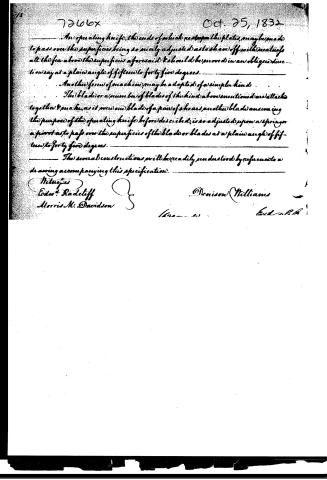
An operating knife, the ends of which parts of the plates, may be made to pass over the superficies being so nicely adjusted as to shear off with neatness all the fur above the superficies aforesaid & should be moved in an oblique direction say at a plain angle of fifteen to forty five degrees.
Another form of machine may be adapted of a simpler kind. The blade or a number of blades of the kind above mentioned are attached together to make as it were one blade of a pair of shears, another blade answering the purpose of the operating knife before described, is so adjusted upon a spring or a pivot as to pass over the superficies of the blade or blades at a plain angle of fifteen to forty five degrees.
The several constructions will be readily understood by reference to a drawing accompanying this specification.
Witnesses
Edw^t Radcliff
Morris M. Davidson
Denison Williams
Published accounts: journal notice
Notice in the monthly list of patents, with remarks
Journal of the Franklin Institute, new ser., vol. 11 (1833), p. 232 · View the page
23. For an improvement in Lamps for Burning Compound Spirits or Oil; William Magee, city of New York, October 25.
Remarks. There is some difficulty in guessing, from the specification and drawings, in what consist the improvements which are intended to be patented, although, in the latter, there are eight different forms of this lamp represented. The general construction is that of the Argand's lamp, with glass burners. A conical piece, which may be raised or lowered, occupies the places of the button, or disc, which is sometimes used to force the supply of air through the centre tube against the wick. The draft on the outside of the circular wick is also to be directed towards the flame by a hollow, truncated cone, or inverted funnel, which surrounds it. There is not in this specifi-. cation any thing which we can torture into a claim.
Published accounts: journal notice
Notice in the monthly list of patents, with remarks
Journal of the Franklin Institute, new ser., vol. 11 (1833), p. 235 · View the page
32. For a Machine for cutting Fur from Pelt; Dennison Williams, city of New York, October 25.
Remarks. It is intended, by means of the machine here patented, to cut a portion only of the fur from skins, leaving them still with enough upon them for the manufacture of trimmings, caps, and other articles for which fur is employed. It is stated that whilst a quantity of fur is thus obtained for the manufacture of hats, the pelt will frequently be rendered the more valuable by cutting it down to that part where the fur is finest and thickest. A considerable number of knives are to be prepared of such length and width as may be required by the nature of the fur to be cut. Their edges are to be straight, and they are to be pointed at one end; by their opposite ends they are to be fixed in a piece of wood, or metal, so that their blades may form an angle of about 45 degrees with the face of the piece in which they are fixed, their edges being even with it, and all lying in the same horizontal plane; they will then stand, in relation to each other, like the slats of a Venitian blind, but they are, in general, to be within one-fourth of an inch of each other. The pointed ends then stand out like the points of a comb, and may be passed through the fur of a skin, laying upon a table. A strip adapted to the purpose is then placed over the points of the knives, by which means the frame by which they are enclosed is rendered complete. A portion of the fur rises above the blades, and this is what is to be cut off. A single knife, called the operating knife, is fixed to a block which is made to slide over the frame; the edge of this knife just clears those before described, and cuts the fur, to do which the more perfectly it is made to pass in an oblique direction. Another modification of the machine is described, which, however, is the same in principle.
About this record
- Patentee
- DATAMP
- Date
- the Name and Date index of patents, DATAMP, USPTO records
- Invention
- DATAMP
- Listed in
- the Name and Date index of patents, DATAMP, USPTO records, Jim Shaw's X-patent list, the Journal of the Franklin Institute, Burke's List of Patents (1847)
- The Franklin Institute's journal spells the name differently.
- Burke's 1847 Patent Office list gives the same patent.