

Drawings and documents
USPTO scan
The patent as scanned by the USPTO
-
 Page 1
-
 Page 2
-
 Page 3
-
 Page 4
-
 Page 5
-
 Page 6
-
 Page 7


U.S. Patent and Trademark Office · Google Patents
Show the transcription Hide (2,643 words)
Machine transcription (LightOnOCR) of the pages as scanned by the USPTO, most of them the handwritten copies made when the records were restored after the 1836 fire. Not checked; it can misread handwriting, so compare it with the scan.
Page 2.
United States Patent
Patent No.: X7272
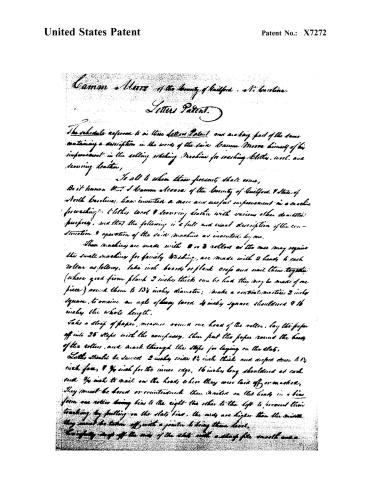
Carmen Moore of the County of Guilford, State of North Carolina.
Letters Patent.
The schedule referred to in these Letters Patent and making part of the same containing a description in the words of the said Carmen Moore himself of his improvement in the rolling, stitching, machine for washing clothes, wool, and scouring leather,
To all to whom these presents shall come,
Be it known that I Carmen Moore of the County of Guilford, State of North Carolina, have invented a new and useful improvement in a machine for washing clothes, wool & scouring leather with various other domestic purposes, and that the following is a full and exact description of the construction & operation of the said machine as invented by me.
These machines are made with 2 or 3 rollers as the case may require. The small machines for family washing, are made with 2 heads to each roller as follows, take inch boards or plank cros and nail them together (where good firm plank 2 inches thick can be had they may be made of one piece) round them to 13½ inches diameter; make a central mortice 2 inches square, to receive an angle of heavy board 4 inches square shouldered & 16 inches the whole length.
Take a strip of paper, measure round one head of the roller, lay the paper off into 25 steps with the compasses, then put the paper round the head of the roller, and mark through the steps for laying on the slots.
Slots should be sawed 2 inches wide ½ inch thick and depth down to ½ inch face, & ¾ inch for the inner edge, 16 inches long shouldered at each end ¾ inch to nail on the heads where they were laid off or marked. They must be bored or countersunk then nailed on the heads in a line from one notch being bias to the right the other to the left to prevent their touching by putting on the slots bias, the ends are higher than the middle they must be taken off with a jointer & being then level,
Carefully rasp off the ends of the slots with a sharp file smooth and a
Page 3.
United States Patent
Patent No.: X7272
little rounding, to prevent chafing the clothes. There must be a ½ inch hole bored in the center in each end of the axles to receive an iron guigeon 4 inches long made in the form of a spike all but one inch, this made round and smooth to receive the coupling rods which are two rods of iron exactly of a length with a hole in each, and one long enough to allow the rollers to run entirely free of each other. They must be bored out in the middle to prevent their coming off, or rubbing the heads of the rollers. If handles are used instead of the sweep they are made like plough handles, only less thinner and lighter with 2 rounds to hold them in place. 9 on the inside of the lower ends, a flat piece of iron 6 inches long put on with screws with a hole at the lower end, to go on the guigeon, over the coupling rods.
The rollers now done which are the first things to be made and the back box, to be made to receive the rollers without rubbing.
The boards or plank should all be good timber (pine) and without sap 9 when dressed out of the dimensions specified. Where a wooden bottom is intended, the water bed is first to be made, the side plank must be one inch thick and 7 inches wide and long enough to allow the straight parts of the bottom to be 4 feet 8 inches long. The ends of the side plank are slanted out boat fashion to an angle of about 25 degrees the short set edge down. The bottom and ends of good inch plank put across making the water bed or box wide enough, to allow the rollers ½ inch play between the sides of the water bed. The bottom must be nailed with 8c nails in a zigzag form to prevent splitting the plank. Dope off the ends of the bottom case with the side plank, 9 put on a neat and well fitted moulding on each side, nailing it to the ends of the bottom 9 to the side plank, then a border plank ¾ inch thick 9 8 inches wide, is to be put on the outside of the water bed with 2½ inch lap, the ends square with a similar plank. 4 iron clamps at each end one at each corner, upon the border and also on the water bed. Then put a short moulding over the clamps.
The light frame to support the counter bottom is made of two pieces of good strong wood 1 inch thick 1½ inch wide 9 as long as the inside of the principal bottom. There must be a round notch in the middle of the upper edge 1 inch wide 9 ½ inch deep, after it is done with that iron, from the
Page 4.
United States Patent
Patent No.: X7272
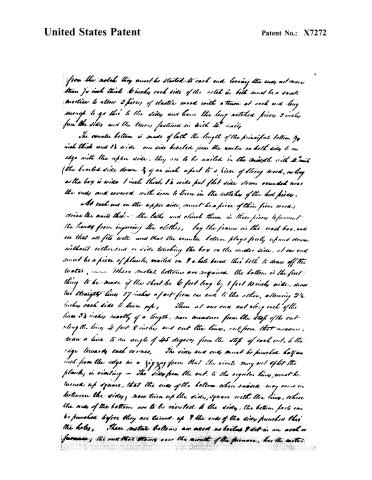
from the notch they must be started to each end leaving the ends not more than ½ inch thick. Likewise, each side of the notch in both must be a small portion to allow 2 pieces of elastic wood with a tenon at each end long enough to go into the sides and leave the long notched pieces 2 inches from the sides, and the tenons fastened in both ½ inch.
The counter bottom is made of lath the length of the principal bottom ¾ inch thick and 1½ wide. One side beveled from the centre on both sides to an edge with the upper side, they are to be nailed in the middle with 2 nails (the beveled side down) ½ of an inch apart to a piece of strong wood, as long as the box is wide 1 inch thick 1½ wide put flat side down rounded across the ends and covered with iron to turn in the notches of the bed pieces.
At each end on the upper side, must be a piece of thin firm wood; drive the nails through the lath and clinch them in these pieces to prevent the hands from injuring the clothes. Lay the frame in the coach box, and see that all fits well and that the counter bottom plays freely up and down without either end or side touching the box on the under side. At one end must be a piece of plank, nailed on ½ a hole bored this hole to draw off the water.
Where metal bottoms are required, the bottom is the first thing to be made if the sheet be 6 feet long by 1 foot 10 inches wide, draw two straight lines 17 inches apart from one end to the other, allowing 2½ inches each side to turn up. Then at one end cut along each of the lines 2½ inches exactly of a length, now measure from the stop of the cut along the lines 4 feet 8 inches, and cut the lines out from that measure, draw a line to an angle of 45 degrees from the stop of each cut, to the edge towards each corner. The sides and ends must be punched half an inch from the edge in a zigzag form that the sides may not split the plank, in joining — the sides from the cut to the regular line, must be turned up square, that the ends of the bottom when raised may come in between the sides; now turn up the sides, square with the lines, where the ends of the bottom are to be riveted to the sides, the bottom parts can be punched before they are turned up & the ends of the sides punched this the holes. These metal bottoms are used as boilers & set in an arch or furnace; the one that stands over the mouth of the furnace, has the metal.
Page 5.
United States Patent
Patent No.: X7272
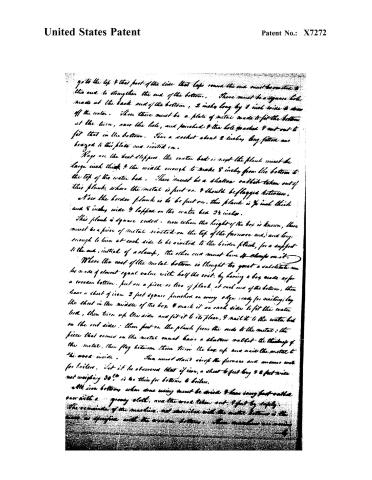
go to the top & that part of the side that laps round the one must be riveted to the end to strengthen the end of the bottom. There must be a square hole made at the back end of the bottom, 2 inches long by 1 inch wide & down off the water. Then there must be a plate of metal made to fit the bottom at the turn, over the hole, and punched & the hole marked & cut out to fit that in the bottom. Then a socket about 2 inches long fitted and brazed to this plate and riveted on.
Rags are the best clappers. The water bed is next the plank must be large inch thick & the width enough to make 8 inches from the bottom to the top of the water bed. There must be a shallow rabbet taken out of this plank, where the metal is put on & should be flapped between.
Now the border plank is to be put on. This plank is ½ inch thick and 8 inches wide & lapped on the water bed 2½ inches.
This plank is square ended. Now when the height of the box is known, there must be a piece of metal riveted on the top of the furnace end, and long enough to turn at each side to be riveted to the border plank, for a support to the end, instead of a clamp, the other end must have 4 clamps on it.
Where the cost of the metal bottom is thought too great a substitute can be made of almost equal value with half the cost, by having a box made as for a wooden bottom, put on a piece or two of plank at each end of the bottom, then have a sheet of iron 3 feet square punched on every edge ready for nailing; lay the sheet in the middle of the box & mark it on each side to fit the water bed, then turn up the sides and fit it to its place, & nail it to the water bed on the end side; then put on the plank from the ends to the metal; the piece that comes on the metal must have a shallow rabbet the thickness of the metal, then flay between them turn the box up and nail the metal to the wood inside.
Then must stand over the furnace and answer well for boilers. Let it be observed that if iron, a sheet 6 feet long & 2 feet wide not weighing 30 lb is too thin for bottom & boilers.
All iron bottoms when done using must be dried & have every part rubbed over with a greasy cloth, and the wood taken out & kept by safety.
The remainder of the machine, not described with the water bottom is the same as specified with the wooden bottom. When machines are working
Page 6.
United States Patent
Patent No.: X7272
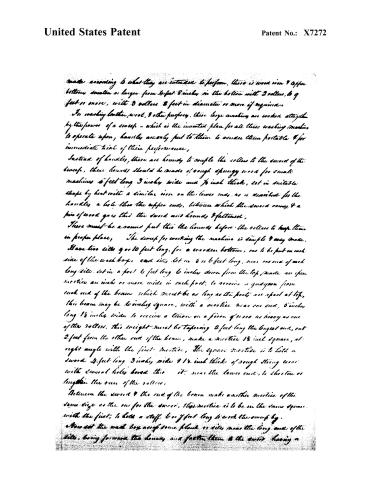
made according to what they are intended to perform, there is wood iron & copper bottoms smaller or larger from 4 feet 8 inches in the bottom with 2 rollers, to 9 feet or more, with 3 rollers 8 feet in diameter or more if required.
For washing leather, wool, & other purposes, these large washing are worked altogether by the power of a screw — which is the invented plan for all these washing machines to operate upon, handles are only put to them to make them portable & for immediate trial of their performance,
Instead of handles, there are hounds to couple the rollers to the sword of the screw, these hounds should be made of rough springy wood for small machines 6 feet long 3 inches wide and ½ inch thick, set in suitable shape by heat with a similar iron on the lower end, as is described for the handles, a hole thru the upper ends, between which the sword comes, & a pin of wood goes thru the sword and hounds & fastened.
There must be a round put thru the hounds before the rollers to keep them in proper place, The screw for working the machine is simple & easy made. Have two sills 9 or 10 feet long, for a wooden bottom, one to be put on each side of the wash box, and sills, let in 5 or 6 feet long, near one end of each long sill, set in a foot 6 feet long 6 inches down from the top, made an open mortice an inch or more wide in each foot, to receive a gudgeon from each end of the beam which must be as long as the feet are apart at top, this beam may be 6 inches square, with a mortice near one end, 6 inches long ½ inch wide to receive a tenon on a piece of wood as heavy as one of the rollers, this weight must be tapering 2 feet long the longest end, cut 2 feet from the other end of the beam, make a mortice ½ inch square, at right angle with the first mortice, The square mortice is to hold a sword 3 feet long 3 inches wide & ½ inch thick of rough strong wood with several holes bored thru it, near the lower end, to shorten or lengthen the arm of the roller.
Between the sword & the end of the beam make another mortice of the same size as the one for the sword, this mortice is to be in the same square with the first, to hold a staff 6 or 7 feet long to work the screw by.
Now set the wash box across some plank or sills near the long ends of the sills, bring forward the hounds and fasten them to the sword having a
Page 7.
United States Patent
Patent No.: X7272
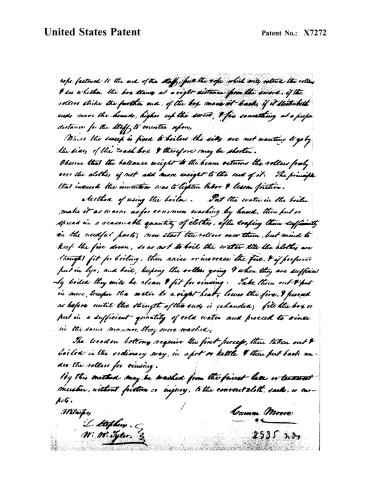
rope fastened to the end of the staff, put the rope which will rotate the rollers & see whether the box stands at a right distance from the sword, if the rollers strike the further end, if the box moves it back, if it strikes both ends move the boards, higher up the sword, & fix something at a proper distance for the staff to counter upon,
When the sweep is fixed to boilers the sides are not wanting to go by the sides of the wash box & therefore may be shorter.
Observe that the balance weight to the beam returns the rollers fully over the clothes, if not add more weight to the end of it. The principle that induced the invention was to lighten labor & lessen friction.
A method of using the boiler. Put the water in the boiler make it as warm as for common washing by hand, then put or spread in a reasonable quantity of clothes, after soaking them sufficiently in the needed parts; now start the rollers over them, but mind to keep the fire down, so as not to boil the water till the clothes are thought fit for boiling, then raise or increase the fire, & if preferred put in lye, and boil, keeping the rollers going & when they are sufficiently boiled they will be clean & fit for rinsing. Take them out & put in more, temper the water to a right heat, lower the fire, & proceed as before until the strength of the suds is exhausted; fill the box or put in a sufficient quantity of cold water and proceed to rinse in the same manner they were washed;
The wooden bottom require the first sweep, then taken out & boiled in the ordinary way, in a pot or kettle & then put back under the rollers for rinsing.
By this method may be washed from the finest lace or tullest muslin, without friction or injury, to the coarsest cloth, sacks, or carpets.
Witnesses
L. Stephens
W. W. Tyler
Cannon Moore
2535 207
About this record
- Patentee
- DATAMP
- Date
- the Name and Date index of patents, DATAMP, USPTO records
- Invention
- DATAMP
- Listed in
- the Name and Date index of patents, DATAMP, USPTO records, Jim Shaw's X-patent list, Burke's List of Patents (1847)
- Burke's 1847 Patent Office list gives the same patent.