

Drawings and documents
National Archives restored drawings: drawing
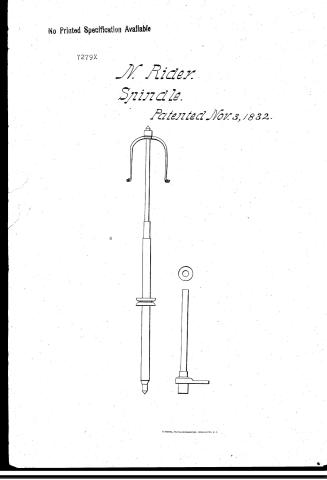
N. Rider's Patent Drawing for a Cotton Spindle

National Archives, Restored Patent Drawings (Record Group 241) · Full-size scan at the National Archives · Catalog record
Show the text on the drawing Hide (31 words)
Words on the drawing as machine-read by the National Archives; not checked. Useful mainly for searching.
118.-SPIMIDG, / Spindies & Apportenances. / [143] / CLASSIFICATION / No RIDER'S. / 7279-X / DIVISION. / COTTON SPINDLE. / Patented. 3 Nov: 1832. / OlR
USPTO scan
The patent as scanned by the USPTO
-
 Page 1
-
 Page 2
-
 Page 3


U.S. Patent and Trademark Office · Google Patents
Show the transcription Hide (734 words)
Machine transcription (LightOnOCR) of the pages as scanned by the USPTO, most of them the handwritten copies made when the records were restored after the 1836 fire. Not checked; it can misread handwriting, so compare it with the scan.
Page 1.
No Printed Specification Available
7279X
N. Rider.
Spindle.
Patented Nov. 3, 1832.
Page 2.
7279X Nov 3 1832 429
Nathaniel Rider. Dudley. Mass.
Letters Patent
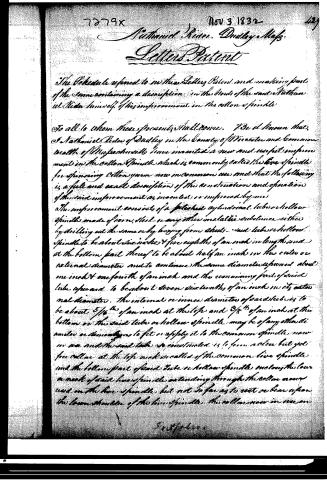
The Schedule annexed to my then Letter Patent and making part of the same containing a description in the Words of the said Nathaniel Rider himself of his improvement in the cotton spindle.
To all to whom these presents shall come. It is known that I Nathaniel Rider of Dudley in the County of Worcester and Commonwealth of Massachusetts have invented a new and useful improvement in the cotton Spindle which is commonly called the line spindle for spinning cotton yarn now in common use and that the following is a full and exact description of the construction and operation of the said improvement as invented or improved by me.
The improvement consists of a polished cylindrical tube or hollow spindle made of iron, steel or any other metallic substance either by drilling out the same or by buying from sheets said tube or hollow spindle to be about six inches & five eighths of an inch in length and at the bottom part thereof to be about half an inch in the outer or external diameter and to continue the same diameter upward about one inch & one fourth of an inch and the remaining part of said tube upward to be about seven sixteenths of an inch in its external diameter. The internal or inner diameter of said tube is to be about 5 1/16ths of an inch at the top and 3 5/8ths of an inch at the bottom or the said tube or hollow spindle may be of any other diameter or diameters to fit or apply it to the common spindle now in use and the said tube or construction is to form a close but yet free collar at the top and is called of the common line spindle and the bottom part of said tube or hollow spindle encloses the lower or neck of said line spindle extending through the collar now used on the line spindle but not so far as to rest or bear upon the lower shoulder of the line spindle. The collar now in use on
F. F. Spalding
Page 3.
7279x Nov 3, 1832
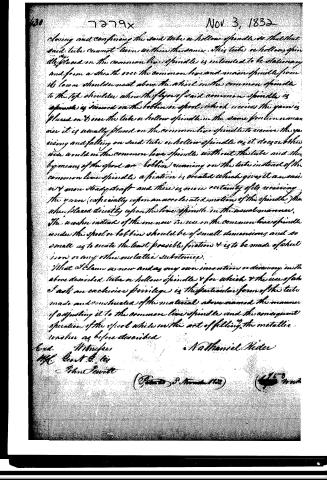
closing and confining the said tube or hollow spindle so that the said tube cannot turn within the same. This tube or hollow spindle placed on the common line spindle is intended to be stationary and from a sheath over the common line and main spindle from its lower shoulder next above the skirt in the common spindle to the top shoulder where the flyer of said common spindle is operative is secured on the bobbin or spool, which receives the yarn is placed on & over the tube or hollow spindle in the same position in which it is usually placed on the common line spindle to receive the yarn rising and falling on said tube or hollow spindle as it does or should rise would on the common line spindle without the tube and thus by means of the spool or bobbin running on the tube instead of the common line spindle a friction is created which gives it an easier & more steady draft and there is more certainty of its receiving the yarn (especially upon an accelerated motion of the spindle) than when placed directly upon the line spindle in the usual manner.
The washer instead of the one now in use on the common line spindle under the spool or bobbin should be of small dimensions and so small as to create the least possible friction & is to be made of sheet iron or any other metallic substance.
What I claim as new and as my own invention or discovery in the above described tube or hollow spindle & for which & the use of which I ask an exclusive privilege is the particular form of the tube made and constructed of the material above named the manner of adjusting it to the common line spindle and the consequent operation of the spool while on the act of filling the metallic washer as before described.
Nathaniel Rider
Patented 3 March 1833
Published accounts: journal notice
Notice in the monthly list of patents, with remarks
Journal of the Franklin Institute, new ser., vol. 11 (1833), p. 305 · View the page
4. For an improvement in the Common Spindle for Spinning Cotton; Nathaniel Rider, Dudley, Worcester county, Massachusetts, November 3.
Remarks. The common live spindle is to be surrounded by a tube along that part of it upon which the bobbin is usually placed; this tube is to receive the bobbin, which then occupies the same part, in relationship to the flyer and whirl, which it would were the tube not there; the bobbin is also made to rise and fall on the tube as it would on the naked spindle. The advantage said to result from this is, the creation of a friction which gives an easier and more steady draft, especially when the motion is rapid. The washer, it is stated, should be much smaller than that now in use on the live spindle. The claim is to the particular form of the tube, and the metallic washer. The drawing which accompanies the specification is without written references, but those VOL. XI.-No. 5.-MAY, 1833. 39 acquainted with the subject, will perceive the nature of the thing claimed.
About this record
- Patentee
- DATAMP
- Date
- the Name and Date index of patents, DATAMP, USPTO records
- Invention
- DATAMP
- Listed in
- the Name and Date index of patents, DATAMP, USPTO records, Jim Shaw's X-patent list, the Journal of the Franklin Institute, Burke's List of Patents (1847)
- Burke's 1847 Patent Office list gives the same patent.