

Drawings and documents
National Archives restored drawings: drawing
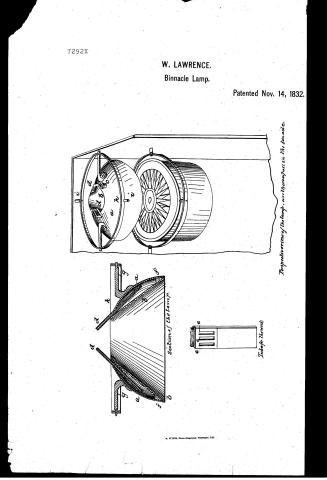
William Lawrence's Patent Drawing for a Binacle Lamp

National Archives, Restored Patent Drawings (Record Group 241) · Full-size scan at the National Archives · Catalog record
Show the text on the drawing Hide (117 words)
Words on the drawing as machine-read by the National Archives; not checked. Useful mainly for searching.
William Lawrinee / CLASSI ICATION / Binacle Lamp / Vol. 14. pg 389 / 7292. X / Patented Nov. 14th 1832. / DIV ISION. / to / Section of the lamp. / Tube for the wiek. / Preference. a the outside shell. binside shell C opening for filling the lamp. / Perspective view of the Lamp, over the companin the Binaele. / d.d tubes for wicks, see Jig. 3. eee slits. f the balance zim of lead. / g.g. arms to suspend the lamp to the circle h. insuports for the hoops attached / to the binacle. / Patent affice Decr. / made undu the dischor of Commissioner / of Intents in conformity with acrof s? / n.s. Summith / of Paten
USPTO scan
The patent as scanned by the USPTO
-
 Page 1
-
 Page 2
-
 Page 3


U.S. Patent and Trademark Office · Google Patents
Show the transcription Hide (908 words)
Machine transcription (LightOnOCR) of the pages as scanned by the USPTO, most of them the handwritten copies made when the records were restored after the 1836 fire. Not checked; it can misread handwriting, so compare it with the scan.
Page 1.
7292X
W. LAWRENCE.
Binnacle Lamp.
Patented Nov. 14, 1832.

N. PETERS, Photo-Lithographer, Washington, D.C.
Page 2.
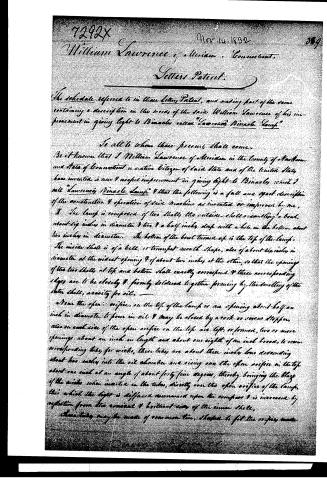
William Lawrence of Meriden, Connecticut.
Letters Patent.
The schedule referred to in these Letters Patent, and making part of the same, containing a description in the words of the said William Lawrence of his improvement in giving light to Binnacle called "Lawrence's Binnacle Lamp."
To all to whom these presents shall come,
Be it known that I William Lawrence of Meriden in the County of Hartford and State of Connecticut a native Citizen of said State and of the United States, have invented a new and useful improvement in giving light to Binnacle, which I call "Lawrence's Binnacle Lamp" and that the following is a full and exact description of the construction and operation of said machine as invented or improved by me.
I. The lamp is composed of two shells, the outside shell resembling a bowl, about six inches in diameter and two and a half inches deep with a hole in the bottom about two inches in diameter. The bottom of the bowl turned up is the top of the lamp. The inside shell is of a bell, or trumpet mouth shape, also of about six inches in diameter at the widest opening and of about two inches at the other, so that the opening of the two shells at top and bottom shall exactly correspond and these corresponding edges are to be closely and firmly soldered together forming by the swelling of the outer shell, a cavity for oil.
Near the open orifice, on the top of the lamp is an opening about half an inch in diameter to pour in oil and may be closed by a cork or screw stopper. Also on each side of the open orifice on the top are left, or formed, two or more openings about an inch in length and about one eighth of an inch broad, to receive corresponding tubes, for wicks, these tubes are about three inches long descending about two inches into the oil chamber and rising from the open orifice in the top about one inch at an angle of about forty-five degrees, thereby bringing the blaze of the wicks when inserted in the tubes, directly over the open orifice of the lamp, thus which the light is diffused downward upon the compass and is increased by reflection from the concave and brilliant sides of the inner shell.
These tubes may be made of common tin, shaped to fit the orifices made
Page 3.
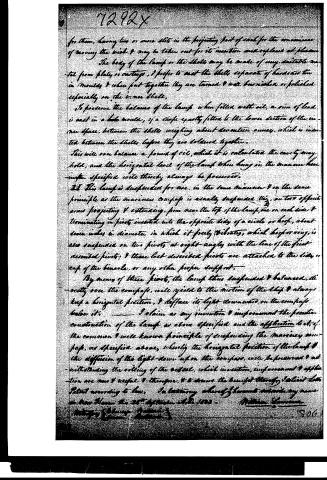
for them, having two or more slits in the projecting part of each for the convenience of moving the wick & may be taken out for its insertion and replaced at pleasure.
The body of the lamp or the shells may be made of any suitable material from plates or castings, I prefer to cast the shells separate of hard wax tin in moulds & when put together they are turned & well burnished or polished especially on the inner shells.
To preserve the balance of the lamp when filled with oil, a pin of lead is cast in a hole mould, of a shape exactly fitted to the lower section of the inner space, between the shells weighing about seventeen grains, which is inserted between the shells before they are soldered together.
This will even balance a pound of oil, which it is calculated the cavity may hold, and the horizontal level of the lamp when hung in the manner hereinafter specified will thereby always be preserved.
2. This lamp is suspended for use, in the same manner & on the same principle as the mariner's compass is usually suspended viz. on two opposite arms projecting & extending from near the top of the lamp, one on each side & terminating in pivots inserted into the opposite side of a circle or hoop, about two inches in diameter in which it freely vibrates, which hoop or ring is also suspended on two pivots at right-angles with the line of the first described pivots; & these last described pivots are attached to the sides or end of the binnacle, or any other proper support.
By means of these pivots, the lamp thus suspended & balanced, directly over the compass, will yield to the motion of the ship & always keep a horizontal position, & diffuse its light downward on the compass below it.
I claim as my invention & improvement the peculiar construction of the lamp as above specified and the application to it, of the common & well known principle of suspending the mariner's compass, as specified above, whereby the horizontal position of the lamp & the diffusion of the light downward on the compass, will be preserved & not withstanding the rolling of the vessel, which invention, improvement & application are new & useful & therefore, & to secure the benefit thereof, I solicit Letters Patent according to law. In testimony whereof I have set my name in the presence of two witnesses this 28th day of March 1833.
William Glarman
Witnesses: Henry D. Brown & John H. Brown
Published accounts: journal notice
Notice in the monthly list of patents, with remarks
Journal of the Franklin Institute, new ser., vol. 11 (1833), p. 311 · View the page
19. For a Binnacle Lamp; William Lawrence, Meriden, New Haven county, Connecticut, November 14.
Remarks. The body of this lamp, in which the oil is to be contained, is made in the manner of that of the astral lamps, with two shells, which when united form a ring-like reservoir. The outside of the lamp is to be six inches in diameter, and the opening in the middle two inches. Tubes for the wicks are to rise from the upper edge, and project over the opening, so as to throw a light down upon the compass. The inner shell is to be brightly polished, that it may serve as a reflector. The lamp is to be hung by gimbals, in the manner of the common compass. The claim is to "the peculiar construction of the lamp as above described, and the application to it of the common and well known principle of suspending the mariner's compass, as specified above, whereby the horizontal position of the lamp, and the diffusion of light down upon the compass, will be preserved, notwithstanding the rolling of the vessel." On the 23d March, 1831, Mr. Lawrence obtained a patent for a hanging lamp, constructed as above, an account of which, with a sketch, will be found in vol. viii. p. 18. He cannot now, therefore, make a valid claim to the peculiar construction of this lamp, for he would, in that case, have two patents for the same thing. The hanging of lamps on gimbals is also old, and we do not think that there is enough of novelty in the arrangement and application to sustain a patent; if, in fact, his old patent was good, no one could take his lamp, place it on gimbals, in a binnacle, and thereby make it his own.
About this record
- Patentee
- DATAMP
- Date
- the Name and Date index of patents, DATAMP, USPTO records
- Invention
- DATAMP
- Listed in
- the Name and Date index of patents, DATAMP, USPTO records, Jim Shaw's X-patent list, the Journal of the Franklin Institute, Burke's List of Patents (1847)
- Burke's 1847 Patent Office list gives the same patent.