

Drawings and documents
USPTO scan
The patent as scanned by the USPTO
-
 Page 1
-
 Page 2
-
 Page 3
-
 Page 4
-
 Page 5
-
 Page 6
-
 Page 7
-
 Page 8
-
 Page 9
-
 Page 10
-
 Page 11
-
 Page 12
-
 Page 13
-
 Page 14
-
 Page 15
-
 Page 16
-
 Page 17
-
 Page 18
-
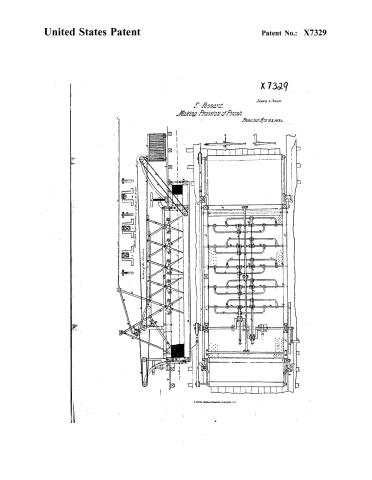 Page 19


U.S. Patent and Trademark Office · Google Patents
Show the transcription Hide (6,829 words)
Machine transcription (LightOnOCR) of the pages as scanned by the USPTO, most of them the handwritten copies made when the records were restored after the 1836 fire. Not checked; it can misread handwriting, so compare it with the scan.
Page 2.
United States Patent
Patent No.: X7329
Felix Rossard,
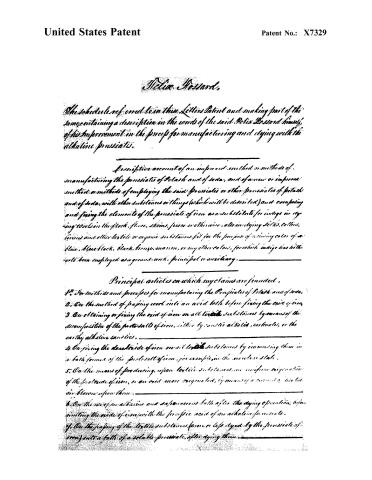
The schedule referred to in this Letters Patent and making part of the same containing a description in the words of the said Felix Rossard himself, of his improvement in the process for manufacturing and dyeing with the alkaline prussiates.
A descriptive account of an improved method or methods of manufacturing the prussiates of Potash and of soda, and of a new or improved method or methods of employing the said prussiates or other prussiates of potash and of soda, with other substances or things (which will be described) and composing and fixing the elements of the prussiate of iron as a substitute for indigo in dyeing wool in the flock, fleece, shins, fleece or otherwise, also in dyeing silks, cottons, linens and other textile or organic substances fit for the purpose of receiving color of a blue, blue black, black, bronze, mason, or any other color, for which indigo has hitherto been employed as a ground-work, principal or auxiliary.
Principal articles on which my claims are founded.
1. For methods and processes for manufacturing the Prussiates of Potash and of soda.
2. On the method of passing wool into an acid bath before fixing the oxide of iron.
3. On obtaining or fixing the oxide of iron on all textile substances by means of the decomposition of the proto salts of iron, either by caustic alkalies, carbonates, or the earthy alkaline caustics.
4. On fixing the deutoxide of iron on all textile substances by immersing them in a bath formed of the proto salt of iron, for example, in the molecular state.
5. On the means of producing, upon textile substances, an uniform origination of the protoxide of iron, or an oxide more originated, by means of a current of hot air blown upon them.
6. On the use of an alkaline and soapyaceous bath after the dyeing operation, before uniting the oxide of iron with the prussic acid of an alkaline prussiate.
7. On the passing of the textile substances (iron or dye dyed by the prussiate of iron) into a bath of a soluble prussiate, after dyeing them.
Page 3.
United States Patent
Patent No.: X7329
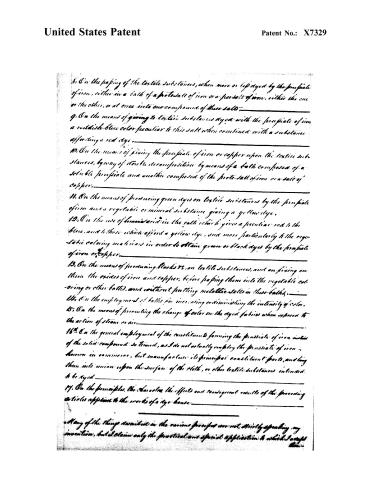
8. On the fazing of the textile substances, when more or less dyed by the precipitate of iron, either in a bath of a protosalt of iron or a persalt of iron, either the one or the other, or at once into one compound of these salts.
9. On the means of giving to textile substances dyed with the precipitate of iron a reddish-blue color peculiar to this salt when combined with a substance affording a red dye.
10. On the means of fixing the precipitate of iron or copper upon the textile substances, by way of double decomposition by means of a bath composed of a soluble precipitate and another composed of the protosalt of iron or a salt of copper.
11. On the means of producing green dyes on textile substances by the precipitate of iron and a vegetable or mineral substance giving a yellow dye.
12. On the use of bismuthic acid in the bath which gives a peculiar red to the blue, and to those which afford a yellow dye, and more particularly to the vegetable coloring materials in order to obtain green or black dyes by the precipitate of iron or copper.
13. On the means of producing blacks, on textile substances, and on fixing on them the oxides of iron and copper, before fazing them into the vegetable coloring or other baths, and without putting metallic salts in these baths.
14. On the employment of baths for increasing or diminishing the intensity of color.
15. On the means of preventing the change of color on the dyed fabrics when exposed to the action of steam or air.
16. On the general employment of the constituents forming the precipitate of iron instead of the solid compound so termed, as I do not actually employ the precipitate of iron known in commerce, but manufacture its principal constituent parts, and bring them into union upon the surface of the cloth, or other textile substances intended to be dyed.
17. On the principles, the character, the effects and consequent results of the foregoing articles applicable to the works of a dye house.
Many of the things described in the various precedents are not, strictly speaking, my invention, but I claim only the practical and special application to which I apply them.
Page 4.
United States Patent
Patent No.: X7329
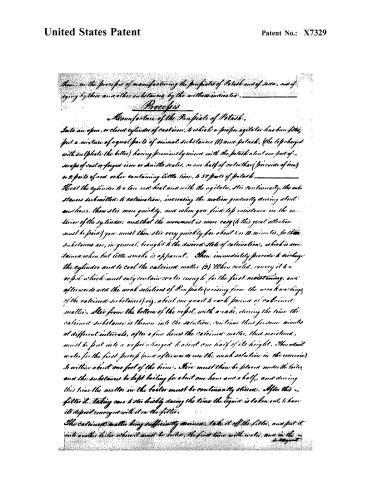
them, in the process of manufacturing the purificate of Potash and of soda, and of drying by them and other substances by the method indicated.
Process
Manufacture of the Purificate of Potash.
Into an open, or closed cylinder of cast iron, to which a proper agitator has been fitted, put a mixture of equal parts of animal substances (1) and potash, (the latter charged with sulphate the better) having previously mixed with the potash about one part of scrap of cast or forged iron or smiths scales, or one half of colcothar (peroxide of iron) or 2 parts of red ochre containing little lime, to 50 parts of potash.
Heat the cylinder to a low red heat and with the agitator, stir continually the substances submitted to calcination, increasing the motion gradually during about an hour, then stir more quickly, and when you find less resistance in the interior of the cylinder, and that the movement is more easy (to this great attention must be paid) you must then stir very quickly for about 8 or 10 minutes, for these substances are, in general, brought to the desired state of calcination, which is ascertained when but little smoke is apparent. Then immediately proceed to discharge the cylinder and to cool the calcined matter (2). When cooled, convey it to a vessel which must only contain water enough for the first moistening, and afterwards add the weak solutions of Purificate (arising from the weak washings of the calcined substances) viz, about one quart to each pound of calcined matter. Stir from the bottom of the vessel, with a rake, during the time the calcined substance is thrown into the solution, continue thus for some minutes at different intervals, after a few hours the calcined matter, thus moistened, must be put into a vessel charged to about one half of its height. Then admit water for the first proof (and afterwards use the weak solution in the receiver) to within about one foot of the brims. Here must then be placed under the boiler, and the substances be kept boiling for about one hour and a half, and during this time the matter in the boiler must be continually stirred. After this, filter it, taking care to stir briskly during the time the liquid is taken out, to have it deposit conveyed with it on the filter.
The calcined matter being sufficiently warm, take it off the filter, and put it into another boiler where it must be boiled, the first time with water, and in the
Page 5.
United States Patent
Patent No.: X7329
subsequent process with the weak solutions of the precipitate, for about an hour, then let it fall into another filter. The calcined substance being sufficiently drained is then to be carried to a vessel where it must be washed with hot water to obtain the weak solutions, of which mention has been made for boiling the calcined substance. — The Prussiate solution of the two boilings of the calcined matter being brought into one common solution, concentrate it in a boiler until it forms a pellicle or skin (3) on the surface of the boiling liquid, then put the solution into the crystallizer. — When the prussiate is crystallized and the solution cooled, convey the mother waters (that is to say the solution of carbonate of Potash) into a reservoir upon which a filter has been placed, on which the crystals are to be thrown and drained, afterwards put all the solution into another boiler for the purpose of being concentrated. — When the calcined substances are sufficiently washed and drained in order to obtain the required weak waters, they must be completely dried in a stove. — Having concentrated the solution of potash until it precipitates a sufficient quantity of its carbonate — the dried calcined matter kept as hot as possible, is to be carried to a vessel placed close to the boiler, which vessel is to be about one third filled. Add to it by portions, and that continuously, the solution of boiling concentrated potash; mix the calcined matter with the potash as equally and quickly as possible. The liquid must be added until the calcined matter becomes sufficiently wetted. This mixture is submitted to calcination in the same manner as a mixture formed with fresh animal matters and potash, nevertheless a small quantity of good animal substance may be added (if desired) for the first operation, but not to exceed one fifteenth part in the weight of the mixture, and one tenth part for the second operation generally speaking, which is the last one.
As regards the potash from the mother waters, it will serve for an indefinite number of operations, until the whole is converted into Prussiate, but previously to that the mother waters will have passed almost entirely into the state of subcarbonate and bicarbonate of Potash. To even them of these salts they may from time to time be crystallized and the crystals be employed for such purposes as may be desired; or the crystals may be decarbonated by calcination. For the second crystallization saturate boiling —
Page 6.
United States Patent
Patent No.: X7329
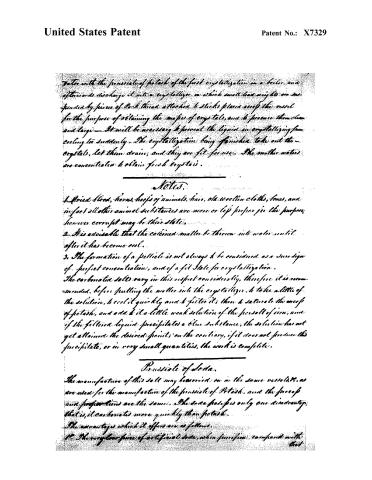
water with the prussiate of potash of the first crystallization in a boiler, and afterwards discharge it into a crystallizer, in which small lead weights are suspended by pieces of bark thinned attached to sticks placed across the vessel for the purpose of obtaining the masses of crystals, and to prevent them from being too large — It will be necessary to prevent the liquid in crystallizing from cooling too suddenly. The crystallization being finished, take out the crystals, let them drain, and they are fit for use. The mother waters are concentrated to obtain fresh crystals.
Notes.
1. Dried blood, horns, hoofs of animals, hair, old woollen cloths, bones, and in fact all other animal substances are more or less proper for the purpose, however corrupt may be their state.
2. It is advisable that the calcined matter be thrown into water until after it has become cool.
3. The formation of a pellicle is not always to be considered as a sure sign of perfect concentration, and of a fit state for crystallization. The carbonated salts vary in this respect considerably, therefore it is recommended, before putting the matter into the crystallizer, to take a little of the solution, to cool it quickly and to filter it; then to saturate the excess of potash, and add to it a little weak solution of the persalt of iron, and if the filtered liquid precipitates a blue substance, the solution has not yet attained the desired point; on the contrary, if it does not produce this precipitate, or in very small quantities, the work is complete.
Prussiate of Soda.
The manufacture of this salt may be carried on in the same vessels, as are used for the manufacture of the prussiate of Potash, and the process and proportions are the same. The soda possesses only one disadvantage, that is, it carbonates more quickly than potash.
The advantages which it offers are as follows:
1. The very clear point of artificial soda, when purified, compared with that
Page 7.
United States Patent
Patent No.: X7329
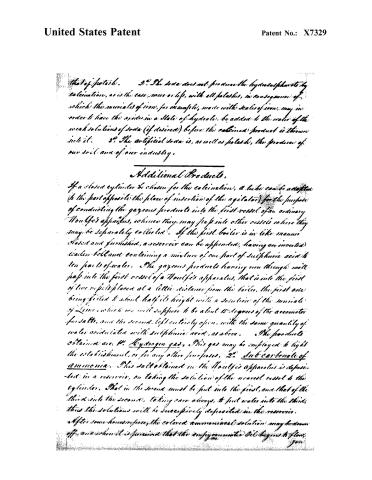
that of potash. 2° The soda does not produce the hydrosulphurets by calcination, as is the case, more or less, with all potashes, in consequence of which the muriates of iron, for example, made with scales of iron, may in order to have the oxides in a state of hydrole, be added to the water of the weak solutions of soda (if desired) before the calcined product is thrown into it. 3° The artificial soda is, as well as potash, the product of our soil and of our industry.
Additional Products.
If a closed cylinder be chosen for the calcination, a tube can be adapted to the part opposite the place of insertion of the agitator, for the purpose of conducting the gaseous products into the first vessel of an ordinary Woulfe’s apparatus, whence they may pass into other vessels where they may be separately collected. If the first boiler is in like manner closed and furnished, a reservoir can be appended, having an inverted leaden bell and containing a mixture of one part of sulphuric acid to ten parts of water. The gaseous products having run through will pass into the first vessel of a Woulfe’s apparatus, that is into the first of two vessels placed at a little distance from the boiler, the first one being filled to about half its height with a solution of the muriate of Lime, which we will suppose to be about 15 degrees of the areometer for salts, and the second, left entirely open, with the same quantity of water acidulated with sulphuric acid, as above. The products obtained are: 1° Hydrogen gas. This gas may be employed to light the establishment, or for any other purposes. 2° Sub-carbonate of ammonia. This salt obtained in the Woulfe’s apparatus is deposited in a reservoir, on taking the solution of the nearest vessel to the cylinder. That in the second must be put into the first, and that of the third into the second, taking care always, to put water into the third, thus the solutions will be successively deposited in the reservoir. After some hours, from the colored ammoniacal solution may be drawn off, and when it is perceived that the empyreumatic oil begins to flow, you
Page 8.
United States Patent
Patent No.: X7329
you collect it. 3. Emphyreumatic Oil. This oil may be employed with the calcined matter (produced by the first calcination) instead of mixing it with solid animal substances, as it answers quite as well as the best of those substances. 4. Sub-carbonate of ammonia. This salt is heated by the means already known, and used for its ordinary purposes. 5. Acetate of ammonia. This salt obtained in the two vessels of the Houlis apparatus requires only to be collected and sublimed to obtain the salt in its ordinary form.
General Observations
Great advantages will arise if the steam reservoirs & are made of mules, Cast iron in preference to all others, as those constructed with wood do not answer so well. The utmost rapidity is required in charging the cylinders, so that the materials remain as short a time as possible without being agitated; and also in discharging it, so that the calcined matter may be withdrawn from the cylinder as soon as it has arrived at the proper point: at that point the matter will be of a clammy nature somewhat like the mortar used by masons — if notwithstanding this state of semi-fluidity, small or lifting appearances of smoke should proceed from it, this will not be an unfavorable circumstance. This semi-fluidity will never take place if a sufficient quantity of potash has not been employed; therefore care should be taken to apply rather an excess of alkali, because that part of it, which is not converted into fusinate, will not be lost — experience will prove the best guide on this subject. The work of calcination once commenced should be continued night and day for the sake of economy, and conducted in the same manner, with this only difference, when the mixture is made of animal substances which have already been employed: the operation is more prompt, and it will not be necessary to add any, or at all events but a small quantity of the foreign substances. Pumps and channels should be employed to transport the liquids from one vessel to another because they can be transported infinitely more quickly and without the waste occasioned by transporting them by hand.
The reservoirs should be about 8 feet high.
Oxying Processes.
Page 9.
United States Patent
Patent No.: X7329
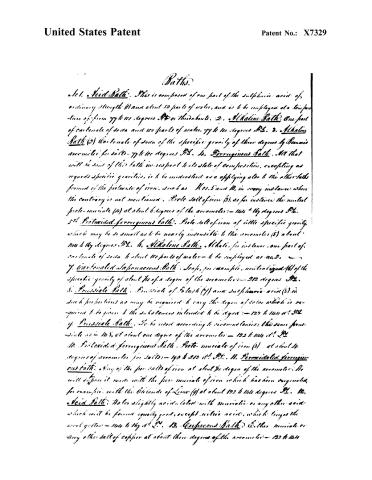
Baths.
1. Acid Bath. This is composed of one part of the sulphuric acid of ordinary strength (1) and about 50 parts of water, and is to be employed at a temperature of from 77 to 100 degrees F. or thereabouts.
2. Alkaline Bath. One part of carbonate of soda and 100 parts of water, 77 to 100 degrees F.
3. Alkaline Bath (2) Carbonate of soda of the specific gravity of three degrees by Baumé’s areometer for salts—77 to 100 degrees F.
4. Ferruginous Bath. All that will be said of this bath in respect to its state of composition, excepting as regards specific gravity, is to be understood as applying also to the other baths formed of the ferrocyanide of iron, such as Nos. 5 and 10, in every instance when the contrary is not mentioned. Proto-salt of iron (3), as for instance the neutral proto-muriate (4) at about 6 degrees of the areometer:—100 to 107 degrees F.
5. Protoxidated ferruginous bath. Proto-salt of iron of little specific gravity, which may be so small as to be nearly insensible to the areometer (5) about 100 to 107 degrees F.
6. Alkaline Bath. Alkali, for instance, one part of carbonate of soda to about 100 parts of water—to be employed as no. 2.
7. Carbonated Saponaceous Bath. Soap, for example, neutralized (6) of the specific gravity of about ½ of a degree of the areometer:—212 degrees F.
8. Prussiate Bath. Prussiate of Potash (7) and sulphuric acid (8) in such proportions as may be required to vary the degree of color which is required to be given to the substances intended to be dyed:—122 to 100 at 30 F.
9. Prussiate Bath. To be used according to circumstances: the same prussiate as in No. 8, at about one degree of the areometer—122 to 100 at 30 F.
10. Protoxidated ferruginous Bath. Proto-muriate of iron (9) at about 4 degrees of areometer for salts:—140 to 212 at 30 F.
11. Peroxidated ferruginous bath. Any of the fer salts of iron at about ½ degree of the areometer. We will suppose it made with the fer-muriate of iron which has been oxygenated, for example, with the Chloride of Lime (10) at about 122 to 100 degrees F.
12. Acid Bath. Water slightly acidulated with muriatic or any other acid which will be found equally good, except nitric acid, which tinges the wool yellow—100 to 107 at 30 F.
13. Cupreous Bath. Either muriate or any other salt of copper at about three degrees of the areometer—122 to 100
Page 10.
United States Patent
Patent No.: X7329
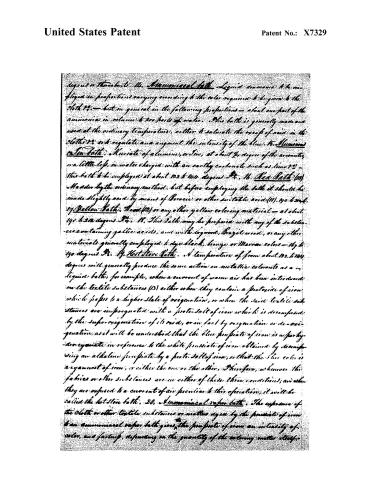
14. Ammoniacal bath. Liquid ammonia to be employed in proportions varying according to the color required to be given to the cloth (14) — but in general in the following proportions — about one part of the ammonia in volume to 200 parts of water. This bath is generally made and used at the ordinary temperature, either to saturate the excess of acid in the cloth (15) or to regulate and augment the intensity of the blue.
15. Alumina or Tin bath. Muriate of alumina, or tin, at about 140 degrees of the areometer, or a little less, in water charged with an earthy carbonate such as lime (16) — this bath to be employed at about 132 to 140 degrees F.
16. Acid Bath (17). Made by the ordinary method, but before employing the bath it should be made slightly acid by means of Boracic or other suitable acid (18), 140 to 200.
17. Yellow Bath. Acid (19) or any other yellow coloring material — at about 140 to 200 degrees F.
18. This bath may be prepared with any of the substances containing gallic acids, and with logwood, Brazil wood, or any other materials generally employed to dye black, bronze or Marron colors — 140 to 200 degrees F.
19. Hot Stove Bath. A temperature of from about 132 to 184 degrees will generally produce the same action on metallic colorants as a liquid bath; for example, when a current of warm air has been introduced on the textile substances (20) either when they contain a protoxide of iron which passes to a higher state of oxygenation, or when the said textile substances are impregnated with a proto-salt of iron which is decomposed by the superoxygenation of its oxide, or in fact by oxygenation or de-oxygenation, as it will be understood that the blue precipitate of iron is a perhydrocyanate in reference to the white ferrous oxide obtained by decomposing an alkaline precipitate by a proto-salt of iron, or that the blue color is a cyanuret of iron, or either the one or the other. Therefore, whenever the fabrics or other substances are in either of these three conditions, and when they are exposed to a current of air peculiar to this operation, it will be called the hot stove bath.
20. Ammoniacal vapor bath. The exposure of the cloth or other textile substances or matters dyed by the ferrous oxide of iron to an ammoniacal vapor bath gives the precipitate of iron an intensity of color, and fastness, depending on the quantity of the coloring matter employed.
Page 11.
United States Patent
Patent No.: X7329
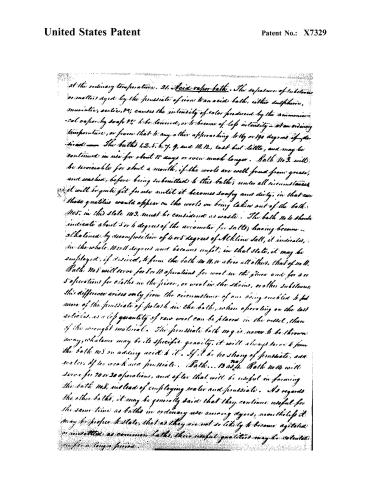
at the ordinary temperature. 21. Acid vapor bath. The exposure of substances or matters dyed by the ferric salts of iron to an acid bath, either sulphuric, muriatic, acetic, &c., causes the intensity of color produced by the ammoniacal vapor by soap &c. to be lowered, or to become of less intensity — at an ordinary temperature, or from that to any other approaching to 160 or 190 degrees if desired — The baths 1, 2, 5, 6, 7, 9, and 10, 12, last but little, and may be continued in use for about 15 days or even much longer. Bath No. 3 will be serviceable for about a month, if the wool are well freed from grease, and washed, before being submitted to this bath; under all circumstances, it will be quite fit for use until it becomes soapy and dirty, in that case those qualities would appear on the wool on being taken out of the bath. No. 5 in this state No. 3 must be considered as waste. The bath No. 4 should indicate about 5 or 6 degrees of the arometer for salts, having become alkalined by decomposition of 4 or 5 degrees of Alkali salt, it indicates, in the whole, 10 or 11 degrees and becomes unfit; in that state, it may be employed, if desired, to form the bath No. 10, or above all others, that of No. 8. Bath No. 5 will serve for 8 or 10 operations for wool in the piece and for 4 or 5 operations for cloths in the piece, or wool in the shins, or other substances. This difference arises only from the circumstance of our being enabled to put more of the ferric salts of potash in the bath, when operating on the last articles, as a large quantity of raw wool can be placed in the vessel, than of the wrought material. The ferric bath No. 9 is never to be thrown away, whatever may be its specific gravity, it will always serve to form the bath No. 5 on adding acid to it. If it be too strong of ferric salts, add water, if too weak, more ferric salts. Bath... 13 as 4. Bath No. 4 will serve for 20 or 30 operations, and after that will be useful in forming the bath No. 8, instead of employing water and ferric salts. As regards the other baths, it may be generally said that they continue useful for the same time as baths in ordinary use among dyers, nevertheless it may be proper to state, that as they are not so likely to become agitated or unsettled as common baths, their useful qualities may be calculated for a longer period.
Page 12.
United States Patent
Patent No.: X7329
The process for dyeing the above materials being the same, the operation differs only in the manner of handling them, which manner their various kinds will suggest. I will take, for example, wool in the fleece or flock. It is to be observed that only the woolen materials require the baths 1 and 2. Put into the bath No. 1, wool which has undergone the first operation of being freed from grease, allow it to remain about 10 minutes, stirring it for a short time. When it is taken out, if the liquor which drains from it be sensibly acid to the taste the operation is thus far accomplished. If on the contrary it be not, add a little acid to the bath and repeat the operation. When drained introduce it into the bath No. 2, and treat it in the same manner and during the same time as No. 1. The liquor which drains from the wool on its being withdrawn from bath No. 2, should have an alkaline taste. Whatever may be the nature of the wool submitted to these two baths or at least to the first one, it will absorb a much greater quantity of the oxide of iron than if it had been prepared by any other method, and after the oxide has been saturated by means of Prussian acid, the cloth will preserve its color during the operation of finishing, and in its general wear and usage.
The general method of fixing the oxide rests on two grand principles which we distinguish by the names of first and second methods. The first method is that of giving the proto-oxide of iron on the wool by means of the decomposition of the proto-salt of iron by alkalis, or by their alkaline carbonates, or by caustic earthy alkalis. The second method is founded on the general nature or quality of the oxide of the proto-salt of iron, a portion of which is constantly originated when it comes in contact with the air, and when it abandons or throws off a part of its acid; and by this abandonment causing a much greater degree of origination, and thus fixing on, and impregnating the wool with this salt, when this chemical change takes place.
First method of fixing the oxide of iron.
The wool having been prepared by the baths No. 1 and 2, washed and strained, is even dried, and to be put in bath No. 3 and stirred for a short time. When taken out, and drained one hour, place it in the bath No. 4. The small quantity of wool which is not perfectly drained should be squeezed, or
Page 13.
United States Patent
Patent No.: X7329
wrong, before it is put into that bath. Take care to spread the wool as equally as may be in the vessel in order that the mordant may be equally diffused, to prevent an irregularity of color. One workman must continually agitate the surface of the bath with a stick in order to submerge the wool, and he should be careful not to push the wool to the bottom of the vessel until it has been well bathed in the liquid. Once or twice during this operation it may be well to discontinue putting wool into the bath, for a few seconds, during which time the wool already in the bath should be well turned round from top to bottom. This operation is more for the purpose of agitating the liquid than for anything else, by which means the same quantity of the ferruginous matter continues to be applied upon the surface of the wool as at the commencement of the operation;—after having thus turned the wool over continue to add more of it, whilst ever you find it sinks into the vessel without pressure. After having remained in the bath for about 1/2 of an hour, take it out, strain it, and a few minutes afterwards convey it to the warm stove bath No. 9, in an ordinary stove; but a current of air heated and forced into it, is preferable to that of a natural circulation. The oxide being sufficiently oxygenated, the wool is to be removed to another bath, suppose No. 5, having remained and been stirred in this for about 5 minutes, it is taken out, strained and conveyed to bath No. 6, where nearly the same course must be followed as with No. 5. When it is desired to obtain a greater intensity of color from the oxide of iron, the wool must be repeated several times into the baths No. 3, 4, 5 and 6, and probably a few more insertions into No. 5 and No. 9 may be requisite than into the others. Many things in fact, relating to this method, depend on the color of the oxide which it is desired to obtain, for example, if you desire to have a color of intense, make an alkaline bath of less strength, or contract the process of applying the mordant by the second method, or employ the baths generally less strong, or do not make use of the hot stove bath No. 9.
Second Method
The principal difference in this method from the first one, is that the bath No. 9 is not employed, as for this is substituted the immersing the wool, more or less
Page 14.
United States Patent
Patent No.: X7329
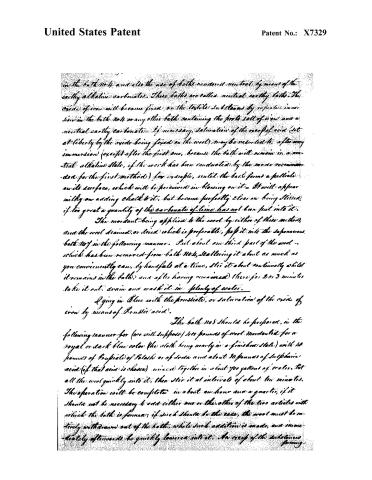
in the bath No. 4 and also the use of baths rendered neutral by means of the earthy alkaline carbonates. These baths are called neutral earthy baths. The oxide of iron will become fixed on the textile substances by repeated immersion in the bath No. 4 or any other bath containing the proto salt of iron and a neutral earthy carbonate. If necessary, saturation of the excess of acid (set at liberty by the oxide being fixed on the wool) may be renewed, after any immersion (except after the first one, because the bath will remain in a neutral alkaline state, if the work has been conducted by the mode recommended for the first method) for example, until the bath forms a pellicle on its surface, which will be perceived in blowing on it — It will appear milky on adding chalk to it, but become perfectly clear on being stirred, if too great a quantity of the carbonate of lime has not been put into it.
The mordant being applied to the wool by either of these methods, and the wool drained, or dried which is preferable, put it into the saponaceous bath No. 7 in the following manner. Put about one third part of the wool — which has been removed from bath No. 4, scattering it about as much as you conveniently can, by handfuls at a time, stir it about continually while it remains in the bath, and after having remained there for 2 or 3 minutes take it out, drain and wash it in plenty of water.
Dying in Blue with the prussiate, or saturation of the oxide of iron by means of Prussic acid.
The bath No. 8 should be prepared, in the following manner for (we will suppose) 100 pounds of wool mordanted for a royal or dark blue color (the cloth being nearly in a finished state) with 10 pounds of Prussiate of Potash or of Soda and about 30 pounds of Sulphuric acid (if that acid is chosen) mixed together in about 700 gallons of water. Put all the wool quickly into it, then stir it at intervals of about ten minutes. The operation will be complete in about an hour and a quarter, if it should not be necessary to add either one or the other of the two articles with which the bath is formed; if such should be the case, the wool must be entirely withdrawn out of the bath, while such addition is made, and immediately afterwards be quickly lowered into it. An excess of the substances forming
Page 15.
United States Patent
Patent No.: X7329
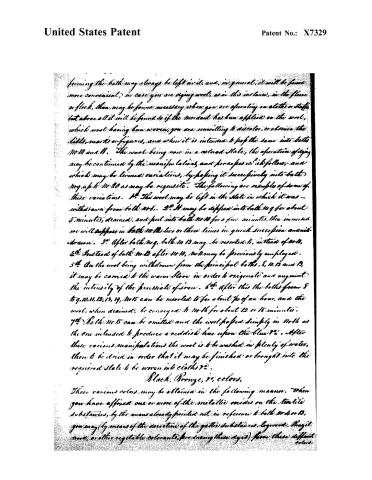
forming the bath may always be left in it, and, in general, it will be found more convenient, in case you are dyeing wool, as in this instance, in the fleece or flock, than may be found necessary when you are operating on cloths or stuffs, but above all it will be found so if the mordant has been applied on the wool, which wool having been woven, you are unwilling to discolor, or obscure the little marks or figures, and when it is intended to pass the same into baths No. 10 and 11. The wool being now in a colored state, the operation of dyeing may be continued by the manipulations and processes which follow, and which may be termed variations, by passing it successively into baths No. 9 up to No. 20 as may be requisite. The following are examples of some of these variations. 1st. The wool may be left in the state in which it was withdrawn from bath No. 8. 2nd. It may be dipped into bath No. 9 for about 5 minutes, drained, and put into bath No. 10 for a few minutes, then immersed as will be proper in bath No. 12 two or three times in quick succession and withdrawn. 3rd. After bath No. 9, bath No. 13 may be resorted to, instead of No. 10. 4th. Instead of bath No. 12 after No. 10, No. 11 may be previously employed. 5th. As the wool being withdrawn from the principal baths, 8, 10, 12 and 13, it may be carried to the warm stove in order to originate and augment the intensity of the products of iron. 6th. After this the baths from 8 to 9, 10, 11, 12, 13, 19, No. 15 can be resorted to for about ½ of an hour, and the wool, when drained, be conveyed to No. 16 for about 12 or 15 minutes. 7th. Baths No. 15 can be omitted and the wool passed simply in No. 16 as the one intended to produce a reddish hue upon the blue 9th. After these various manipulations the wool is to be washed in plenty of water, then to be dried in order that it may be finished or brought into the required state to be woven into cloths &c.
Black, Bronze, &c. colors.
These various colors may be obtained in the following manner. When you have affixed one or more of the metallic oxides on the textile substances, by the means already pointed out in reference to bath No. 4 or 13, you may (by means of the secretion of the galls substances, logwood, Brazil wood, or other vegetable colorants for tanning these dyed) form these different colors.
Page 16.
United States Patent
Patent No.: X7329
colors and shades, on passing the textile substances into them at about 150 to 160 degrees Fahrenheit and afterwards applying the Prussiate of iron by the use of baths 9 and 10, more or less concentrated. The dyeing bottom of a black, which will resist the action of the air, and the effects of washing, proceed as follows. 1st. Suppose bath No 3 to be made with the caustic earthy alkalis, with lime for example, and at 77 to 100 degrees. Instead of bath No 4 employ No 13 which we will suppose to be made with the aceto-muriate of copper, and only indicating about half a degree of the areometer for salts, if the bath No 3 has been formed and employed as before named taking care that it be limpid when the skins are plunged into it. 2nd. The skins may be plunged into milk of lime, but in that case the bath No 4 or 13 must be more strongly charged with metallic salts. 3rd. In fact, whatever may be the nature of the lime bath, several immersions must be made from 3 to 4 or 13 and vice versa, until the desired quantity of the oxide of copper is distributed over the fibrous substance. 4th. In the application of the salts of copper as a mordant, the bath No 2 properly called alkaline may be employed instead of the caustic earthy alkaline one, but above all when the bath is used at the ordinary temperature. 5th. A bath may be formed of one of the salts of copper and of iron. The mordant being fixed the cotton must be passed in the proper baths to produce a black dye (14).
The hair of different animals, and other substances which are used for making cloth or other fabrics, but which are generally felted, may with facility, be dyed of the different colors which have already been spoken of, in respect to other textile substances, after having been mordanted as already described. In fact, all organic substances, such as skins, wool, &c., may be dyed by the processes and means before stated, &c. referring to the baths. 1st.
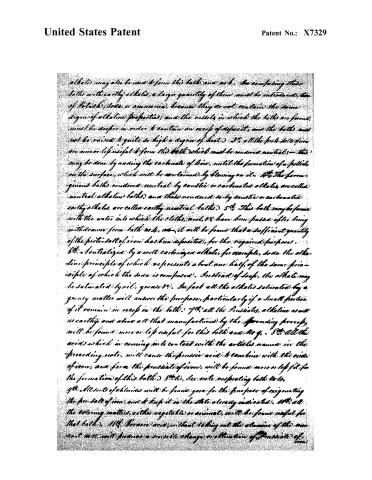
1st. Almost all the acids, except nitric acid, are fit for the formation of this bath. 2nd. Soda, Potash, or ammonia, either caustic or carbonated are fit for this bath, but the carbonates are preferable, and the carbonate of soda is recommended in preference to all others. The earthy caustic alkalis,
Page 17.
United States Patent
Patent No.: X7329
alkali may also be used to form this bath and not. In composing these baths with earthy alkalis, a large quantity of them must be introduced, than of potash, soda, or ammonia, because they do not contain the same degree of alkaline properties; and the vessels in which the baths are formed, must be deeper in order to contain an excess of deposit, and the bath must not be raised to quite so high a degree of heat. 3. all the proto-salts of iron are more or less useful to form this bath which must be rendered neutral;—this may be done by adding the carbonate of lime, until the formation of a pellicle on the surface, which will be ascertained by blowing on it. 4. The foreign baths rendered neutral by caustic or carbonated alkalis, are called neutral alkaline baths, and those rendered so by caustic or carbonated earthy alkalis, are called earthy neutral baths. 5. This bath may be formed with the water into which the cloths, wool, &c. have been passed after being withdrawn from bath no. 4, as it will be found that a sufficient quantity of the proto-salt of iron has been deposited, for the required purposes. 6. Neutralized by a well carbonized alkali, for example, soda (the alkaline principle of which represents about one half of the same principle of which the soda is composed). Instead of soap, the alkali may be saturated by oil, grease, &c. In fact all the alkalis saturated by a greasy matter will answer the purpose, particularly if a small portion of it remain in excess in the bath. 7. all the Prussiates, alkaline as well as earthy, and above all that manufactured by the preceding process, will be found more or less useful for this bath and no. 9. 8. all the acids which in coming into contact with the articles named in the preceding note, will cause the prussic acid to combine with the oxide of iron, and form the prussiate of iron, will be found more or less fit for the formation of this bath. 9. See note respecting bath no. 4. 9. All sorts of chlorides will be found good for the purpose of oxygenating the per-salt of iron, and to keep it in the state already indicated. 10. all the coloring matters, either vegetable or animal, will be found useful for that bath. 11. Boracic acid, without taking out the alumine of the mordant no. 11, will produce a sensible change or alteration of Prussiate of iron.
Page 18.
United States Patent
Patent No.: X7329
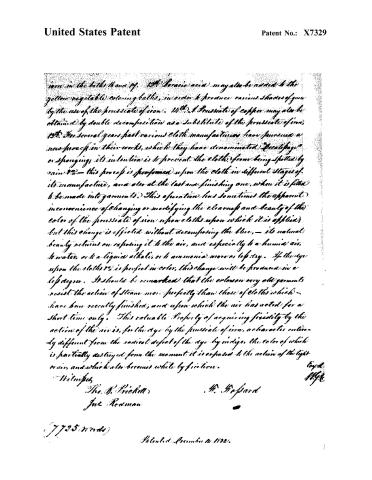
iron in the baths 16 and 17. 18th. Boracic acid may also be added to the yellow vegetable coloring baths, in order to produce various shades of green by the use of the prussiate of iron. 19th. A Prussiate of copper may also be obtained by double decomposition as a substitute of the prussiate of iron.
20th. For several years past various cloth manufacturers have pursued a new process in their works, which they have denominated "Decatpage" or "Spangings." Its intention is to prevent the cloth from being spotted by rain. 21st. — this process is performed upon the cloth in different stages of its manufacture, and also at the last and finishing one, when it is fitted to be made into garments. This operation has sometimes the apparent inconvenience of changing or modifying the clearness and beauty of the color of the prussiate of iron upon cloths upon which it is applied; but this change is effected without decomposing the blue, — its natural beauty returns on exposing it to the air, and especially to a humid air, to water, or to a liquid alkali, or to ammonia more or less strong. If the dye upon the cloths 22 is perfect in color, this change will be produced in a less degree. It should be remarked that the color on very old garments resist the action of steam more perfectly than those of cloths which have been recently finished, and upon which the air has acted for a short time only. This valuable property of acquiring firmness by the action of the air is, for the dye by the prussiate of iron, a character entirely different from the radical defect of the dye by indigo, the color of which is partially destroyed from the moment it is exposed to the action of the light or air, and which also becomes white by friction.
Witnesses,
The. H. Pickett
Jno. Rodman
H. H. Heford
(7725 words)
Patented December 14, 1832.
Page 19.
United States Patent
Patent No.: X7329
X 7329
F. Fossard.
Making Prussate of Potash.
Patented Apr. 23, 1834.
E. PETER, PHOTO-LITHOGRAPHER, WASHINGTON D.C.
Published accounts: journal notice
Notice in the monthly list of patents
Journal of the Franklin Institute, new ser., vol. 11 (1833), p. 182 · View the page
Abstract of a patent for manufacturing the prussiates of potash and of soda, with other substances; and of fixing the elements of the prussiate of iron, as a substitute for indigo. Granted to FELIX FOSSARD, of Philadelphia, (who has made a declaration of his intention to become a citizen of the United States,) December 14, 1832.
Published accounts: journal notice
Notice in the monthly list of patents
Journal of the Franklin Institute, new ser., vol. 11 (1833), p. 379 · View the page
19. For a Process of manufacturing, and dyeing with, the Alkaline Prussiates; Felix Fossard, of the city of Philadelphia, an alien, who has declared his intention to become a citizen of the United States. December 14.
About this record
- Patentee
- DATAMP
- Date
- the Name and Date index of patents, DATAMP, USPTO records
- Invention
- DATAMP
- Listed in
- the Name and Date index of patents, DATAMP, USPTO records, Jim Shaw's X-patent list, the Journal of the Franklin Institute, Burke's List of Patents (1847)
- Burke's 1847 Patent Office list gives the same patent.