

Drawings and documents
USPTO scan
The patent as scanned by the USPTO
-
 Page 1
-
 Page 2
-
 Page 3
-
 Page 4


U.S. Patent and Trademark Office · Google Patents
Show the transcription Hide (938 words)
Machine transcription (LightOnOCR) of the pages as scanned by the USPTO, most of them the handwritten copies made when the records were restored after the 1836 fire. Not checked; it can misread handwriting, so compare it with the scan.
Page 1.
7333X
H. STANLEY.
Cooking Stove.
Patented Dec. 17, 1832.

THE MORRIS PETERS CO., PHOTO-LITHO., WASHINGTON, D.C.
Page 2.
Henry Stanley
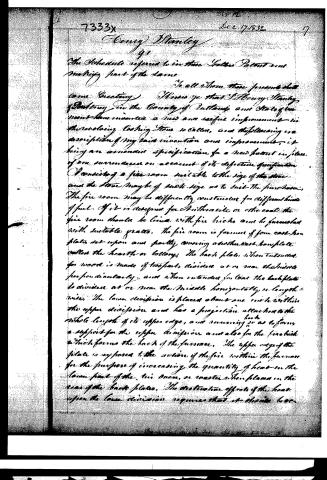
The Schedule referred to in these Letters Patent and making part of the same.
To all whom these presents shall come Greeting. Know ye that Henry Stanley of Pontypridd in the County of Glamorgan and State of Glamorgan has invented a new and useful improvement in the revolving Cooking Stove so called, and the following is a description of my said invention and improvement, it being an amended specification for a new patent in place of an surrender on account of its defective specification.
I consisting a fire room suitable to the size of the stove and the stove maybe of such size as to suit the purchaser. The fire room may be differently constructed for different kinds of fuel. If it is designed for Anthracite or other coal the fire room should be lined with fire bricks and be furnished with suitable grates. The fire room is formed of four cast iron plates set upon and partly covering another cast iron plate called the hearth or bottom. The back plate when intended for wood is made of two parts divided at or near the middle perpendicularly and when intended for coal the back plate is divided at or near the middle horizontally or lengthwise. The lower division is placed about one inch within the upper division and has a projection attached to the whole length of its upper edge, and covering so as to form a support for the upper division and also for the fire brick which forms the back of the furnace. The upper edge of the plate is exposed to the action of the fire within the furnace for the purpose of increasing the quantity of heat in the lower part of the fire room, or roaster when placed in the rear of the back plates. The destructive effects of the heat upon the lower division requires that it should be
Page 3.
occasionally removed and to avoid the expense and trouble of removing the entire plate, an opening is made at one near the upper edge of about two-thirds the length and one-third the width of the plate. This opening is filled with another movable plate which may be removed and renewed at pleasure. In the hearts or bottom plates is made an air- or ash-pit partly covered by the fire room, and partly by a sliding plate which acts as a damper and regulates the heat. A large circular plate is placed over the fire room, in such a manner that a segment of about one-third the diameter of the circular plate is occupied by the fire room. This circular plate is covered by another plate in diameter something larger which seals the upper top of the stove, the latter being raised above the former about one inch by ribs forming a groove on the upper side of the lower circular plate and a corresponding rib on the under side of the upper circular plate forming a tongue to enter into said groove on which tongue the upper plate rests.
On the center of the under plate is a small elevation in the form of a cone with a perpendicular orifice into which a pinion projects from the upper plate in order to fix the center of the revolution. The revolution is caused by a crank and pinion. The cogs of the pinion work in corresponding ones attached to the under side of the upper plate near, the edge which projects beyond the ribs. Through the lower circular plate and directly over the fire room is an opening through which the heat and smoke pass. The dimensions of the opening being described by that part of the fire room which comes within the circular ribs upon the edge of the under circular plate.
Through the fire room and through the cover plate is an other opening through which the smoke passes into the chimney flue to which the pipe is attached to convey the smoke into the chimney.
Page 4.
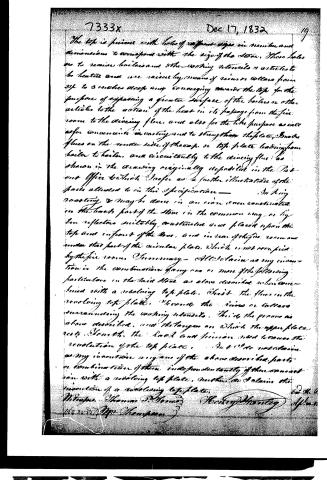
The top is provided with holes of different sizes in number and dimensions to correspond with the size of the stove. These holes are to receive boilers and other working utensils or articles to be heated and are raised by means of rims or collars from 2½ to 3 inches deep and converging towards the top for the purpose of exposing a greater surface of the boilers or other articles to the action of the heat in its passage from the fire room to the drying flue, and also for the like purpose as well as for convenience in casting and to strengthen the plate. Some flues on the under side of the top or top plate leading from boiler to boiler, and circuitously to the drying flue, as shown in the drawing originally deposited in the Patent Office with this paper as a further illustration of the parts alluded to in this specification.
In casting, it may be done in an iron oven constructed in the back part of the stove in the common way or by iron reflectors suitably constructed and placed upon the top and in front of the stove, and in rear of the fire room and under that part of the circular plate which is not occupied by the fire room.
Published accounts: journal notice
Notice in the monthly list of patents, with remarks
Journal of the Franklin Institute, new ser., vol. 11 (1833), p. 380 · View the page
We do not fully understand the description of this wheel, although it is accompanied by a drawing better executed than many which pass in the patent office. It is termed, on the head of the drawing, a Coaction-wheel, and we suppose that, like No. 16, it is to be coacted upon by gravity, impulse, and reaction. A vertical cylinder, surrounded by buckets, which appear to form radii with it, runs in a hollow cylinder, which has four openings in it directing the water tangentially on the wheel, and thus propelling it. The buckets, we are told, are to be curved, but whether this is for the purpose of giving them a helical twist upon the cylinder, we do not know. There is no claim made. 23. For a Cooking Stove; Henry Stanley, Poultney, Rutland county, Vermont, December 17.
Remarks. The part of this stove which is to contain the fuel is of a square form, and made of cast iron. Instead of the kind of top usually employed there is to be a circular plate of such size that only about onethird of its area will lie over the fire chamber, or body of the stove, the remaining two-thirds projecting beyond it. This is covered by a second plate, supported by a rim, which rises it from the first circular plate. By means of cogs upon the edges of the upper plate, it may be turned round, whilst the lower plate remains stationary, a pinion and crank being fixed for that purpose. A chamber, for smoke and heated air, exists between the two plates; and these are conducted off through an opening in the lower plate and in the rim. The upper plate is perforated to receive pots, kettles, and other cooking apparatus, and a large tin cover, operating as a reflector, is provided to cap the climax. The claim is to the revolving top plate for receiving the various cooking fixtures.
Published accounts: journal notice
Notice in the monthly list of patents
Journal of the Franklin Institute, new ser., vol. 18 (1836), p. 38 · View the page
10. For a Revolving Cooking Stove; Henry Stanley, Poultney, Rutland county, Vermont. First patented December 17, 1832.
About this record
- Patentee
- DATAMP
- Date
- the Name and Date index of patents, DATAMP, USPTO records
- Invention
- DATAMP
- Listed in
- the Name and Date index of patents, DATAMP, USPTO records, Jim Shaw's X-patent list, the Journal of the Franklin Institute, Burke's List of Patents (1847)
- Burke's 1847 Patent Office list gives the same patent.