

Drawings and documents
National Archives restored drawings: drawing
Henry Crenshaw's Patent Drawing for a Means of Multiplied Water Power

National Archives, Restored Patent Drawings (Record Group 241) · Full-size scan at the National Archives · Catalog record
Show the text on the drawing Hide (93 words)
Words on the drawing as machine-read by the National Archives; not checked. Useful mainly for searching.
Heyd apps- Heyd / Henry brenshaw. / Multiplied Water Power. / Vol 14 pg 325. / 7340X / Patented Dec.28. 1832. / lp ME M KEIT HEM HI / Reference a head water if feet high. B inclined zace 100fect long. from 25 to 100 in number. d the large shaft, ethe large band. / zzzzzzzzzzz bands. / Patent office Dear 7.1841- th / made under the direction of the mifrioner of Intent / ch.d.c ,fleisch first. / in can formity with not of 3d March 1857 / nd Su month / milsione of Patents
USPTO scan
The patent as scanned by the USPTO
-
 Page 1
-
 Page 2
-
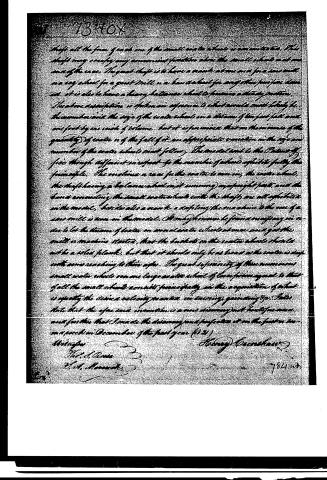 Page 3


U.S. Patent and Trademark Office · Google Patents
Show the transcription Hide (833 words)
Machine transcription (LightOnOCR) of the pages as scanned by the USPTO, most of them the handwritten copies made when the records were restored after the 1836 fire. Not checked; it can misread handwriting, so compare it with the scan.
Page 1.
7340X
H. Crenshaw,
Water Wheel,
Patented Dec. 28, 1832.
Page 2.
7340X
Dec. 28, 1832
Henry Greenhow
Letters Patent
The declarant refers to his two Letters Patent and making part of the same containing a description in the words of the said Henry Greenhow himself, of his Improvement in Machinery, consisting in the repeated application of water to a number of wheels in succession called "Greenhow's Multiplex Water Power."
To all to whom these presents shall come: He it known that I Henry Greenhow of the District of Hudson in the State of New York have invented a new and useful improvement in machinery consisting in the repeated application of water to a number of wheels in succession the name of which invention may be "Greenhow's Multiplex Water Power" and that the following description of the construction and operation of the said Machinery as invented by me is as full as may be to illustrate the invention which consists rather in the principle of the repeated use of water on different wheels than in any peculiar or novel construction in machinery. The object of the invention is to convert small streams of water into use in varying all sorts of machinery as sawing, grinding, and the like. To illustrate as near as possible the application of the principles of the Multiplex Water Power, let it be supposed that we have a volume of water one foot wide and one inch deep having a fall of ten feet perpendicular. This fall of ten feet will enable this volume of water one foot by one inch to be carried down an inclined plane for about one hundred feet in length. This inclined plane may be a race in which are to be placed small wheels varying from a foot to four feet in diameter, the velocity of the wheels being inversely as the size of them. The wheels are to run on their axles attached to upright posts or to the sides of the trough or race. They are to have buckets or plain planes fitted so that they may fill the race say one foot wide. In a fall of ten feet making an inclined plane of about one hundred feet, there may be from twenty-five to one hundred of these small water wheel wheels carried by the weight of force of the water descending the race. Let a band pass from every one of these wheels to a shaft, to which
Page 3.
73404
shaft all the force of each one of the small water wheels is one and the same. This shaft may occupy any convenient position where the small wheels and one arm of the race. The great shaft is to have a crank at one end for a saw mill or a cog wheel for a grist mill, or a hand wheel for any other purpose desired. It is also to have a heavy balance wheel to preserve a steady motion.
The above description is given in reference to what would most likely be the number and size of the water wheels in a stream of ten feet fall and one foot by one inch of volume, but it is far easier that on the increase of the quantity of water or of the fall of it an opposite ratio variation in the size and number of the water wheels must follow. The model and to the Patent Office though different in respect to the number of wheels exhibits fully the principle. The incline a race for the water to run in, the water wheel, the shaft having a balance wheel (not running) on a right foot and the bands connecting the small water wheels with the shaft, are all exhibited in the model, besides also a crank, adapting the machine to the use of a saw mill is seen in the model. A millstone may be found on any mill or due to let the stream of water on several water wheels at once and get the mills or machines started, that the buckets on the water wheel should not be a solid plank, but that it should only be as broad as the water is deep with arms reaching to their sides. The great superiority of these numerous small water wheels over one large water wheel of less force is equal to that of all the small wheels consists principally in the acquisition of what is equally the desired velocity wanted in sawing, painting, &c.
Note that the above said invention is a new discovery and not of me, and further that I made the discovery and perfected it on the first or second in December of the past year (1831).
Wilmington
Robney Greenhaw
Wm. S. Bane
W. H. Monmouth
7841
Published accounts: journal notice
Notice in the monthly list of patents, with remarks
Journal of the Franklin Institute, new ser., vol. 11 (1833), p. 383 · View the page
29. For an improvement in Water Wheels; Henry Crenshaw, Anderson District, South Carolina, December 28.
Remarks. The patentee calls his invention a multiplied water power, and says that it consists in "the repeated application of water to a number of wheels in succession." Instead of allowing the water of a given head to act upon a single wheel, the patentee proposes to carry the water down an inclined plane, in the form of a trough, and to have a succession of undershot, or flutter wheels, one behind the other. He supposes, by way of exemplification, that there is a fall of ten feet, and states that there may be then an inclined plane of one hundred feet in length; on such a plane from twenty-five to one hundred wheels may be placed, as they may vary from one to four feet in diameter. From the shaft of each wheel, bands are to be extended to a main shaft carrying a fly wheel. The superiority of this plan over that of a single wheel is said to be that the desired velocity for sawing, grinding, &c. may be at once obtained. We could scarcely think of a more certain mode of diminishing the power of falling water than by dividing it in this way; its own friction against the plane or trough, the friction of so many axles, the bending of so many bands, and the keeping of so many parts in order, will consign this invention to early oblivion, excepting the outlay which it may occasion should, for a time, serve as a momento that such a thing once was. In point of novelty, we will remark that the using of wheels in succession, and the gearing them so that they shall concur with each other, have been repeatedly done, although not in the mode prescribed by the present patentee. It has been adopted principally where there has been a high fall, and a small quantity of water, rendering it impossible, or inconvenient, to make a wheel of sufficient diameter to apply the whole power at once.
About this record
- Patentee
- DATAMP
- Date
- the Name and Date index of patents, DATAMP, USPTO records
- Invention
- DATAMP
- Listed in
- the Name and Date index of patents, DATAMP, USPTO records, Jim Shaw's X-patent list, the Journal of the Franklin Institute, Burke's List of Patents (1847)
- Burke's 1847 Patent Office list gives the same patent.