

Drawings and documents
USPTO scan
The patent as scanned by the USPTO
-
 Page 1
-
 Page 2
-
 Page 3
-
 Page 4


U.S. Patent and Trademark Office · Google Patents
Show the transcription Hide (1,149 words)
Machine transcription (LightOnOCR) of the pages as scanned by the USPTO, most of them the handwritten copies made when the records were restored after the 1836 fire. Not checked; it can misread handwriting, so compare it with the scan.
Page 2.
United States Patent
Patent No.: X7357
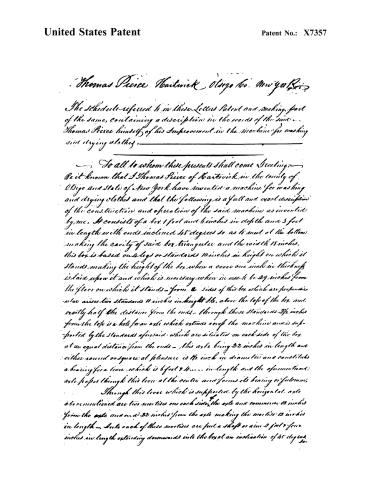
Thomas Pierce Hartwick, Otsego Co. New York
The Schedule referred to in these Letters Patent and making part of the same, containing a description in the words of the said Thomas Pierce himself of his Improvement in the machine for washing and drying clothes.
To all to whom these presents shall come Greeting:
Be it known that I Thomas Pierce of Hartwick in the county of Otsego and State of New York have invented a machine for washing and drying clothes and that the following is a full and exact description of the construction and operation of the said machine as invented by me. It consists of a box 1 foot and 6 inches in depth and 3 feet in length with ends inclined 45 degrees so as to meet at the bottom making the cavity of said box triangular and the width 18 inches. This box is based on legs or standards 10 inches in height on which it stands making the height of the box when a cover one inch in thickness is laid upon it and which is necessary when in use to be 29 inches from the floor on which it stands — from 2 sides of this box which are perpendicular rise two standards 11 inches in height etc. above the top of the box and exactly half the distance from the ends — through these standards 2½ inches from the top is a hole for an axle which extends across the machine and is supported by the standards aforesaid which are situated on each side of the box at an equal distance from the ends — this axle being 22 inches in length and either round or square at pleasure is ½ inch in diameter and constitutes a bearing for a lever which is 6 feet 7 4/10 inches in length and the aforementioned axle passes through this lever at the center and forms its bearing or fulcrum.
Through this lever which is supported by the horizontal axle above mentioned are two mortises one each side of the axle and commence 10 inches from the axle and end 22 inches from the axle making the mortises 12 inches in length — into each of these mortises are put a shaft or arm 2 feet 7 four inches in length extending downwards into the box at an inclination of 45 degrees.
Page 3.
United States Patent
Patent No.: X7357
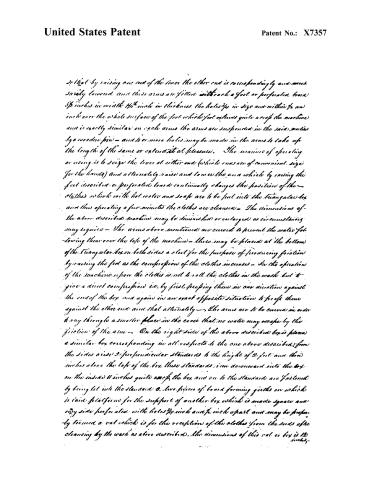
So that by raising one end of the lever the other end is correspondingly and merely lowered, and these arms are fitted with each a foot or perforated board 1½ inches in width 1½ inch in thickness, the holes ½ inch in size and within ½ an inch over the whole surface of the foot which foot extends quite over the machine and is exactly similar on each arms the arms are suspended in the said motion by a wooden pin — and 4 or more holes may be made in the arms to take up the length of the same or extend at pleasure. The manner of operating or using is to seize the lever at either end (which ends are of convenient size for the hands) and alternately raise and lower the end which by raising the feet described or perforated board continually changes the position of the clothes which with hot water and soap are to be put into the triangular box and thus operating a few minutes the clothes are cleansed. The dimensions of the above described machine may be diminished or enlarged as circumstances may require — The arms above mentioned are curved to prevent the water following them over the top of the machine — there may be placed at the bottom of the triangular box on both sides a slot for the purpose of producing friction by raising the feet as the compression of the clothes increases — In the operation of the machine upon the clothes is not to roll the clothes in the wash but to give a direct compression i.e. by first pressing them in one direction against the end of the box and again in an exact opposite situation to press them against the other end and that alternately — The arms are to be curved in order to pass through a smaller place in the cover that no water may escape by the friction of the arm — On the right side of the above described box is placed a similar box corresponding in all respects to the one above described, from the sides arise 2 perpendicular standards to the height of 2 feet and then inches above the top of the box these standards run downward into the box on the inside 11 inches quite over the box and on to the standards are fastened by being let into the standards 6. two pieces of board forming girdles on which is laid a platform for the support of another box which is made square and every side perforated with holes ½ inch and ½ inch apart and may be properly formed a vat which is for the reception of the clothes from the said after cleansing by the wash as above described, the dimensions of this vat or box is 12 inches.
Page 4.
United States Patent
Patent No.: X7357
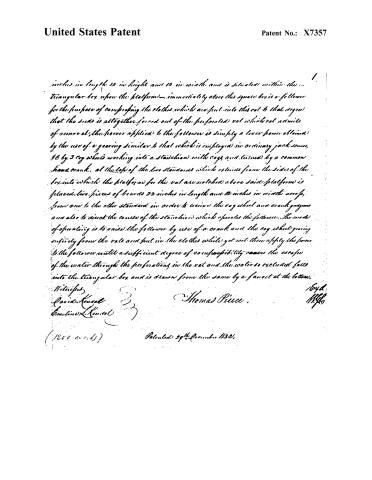
inches in length 12 in height and 12 in width and is situated within the ... triangular box upon the platform—immediately above this square box is a follower for the purpose of compressing the clothes which are put into this vat to that degree that the water is altogether forced out of the perforated vat which vat admits of removal; the power applied to the follower is simply a lever power obtained by the use of a gearing similar to that which is employed in ordinary jack screws, 16 by 3 cog wheel working into a stationary mill cog and turned by a common hand crank, at the top of the two standards which extend from the sides of the box into which the platform for the vat are notched above said platform is placed two pieces of boards 22 inches in length and 12 inches in width across, from one to the other standard in order to secure the cog wheel and crank gears and also to direct the course of the stationary which operates the follower. The mode of operating is to raise the follower by use of a crank and the cog wheel gearing entirely from the vat and put in the clothes while yet wet then apply the power to the follower until a sufficient degree of compressibility causes the escape of the water through the perforations in the vat and the water so excluded falls into the triangular box and is drawn from the same by a faucet at the bottom.
Witnesses
David Kendall
Cincinnatus Kendall
Thomas Price.
(1200 words)
Patented 29th December 1821.
Published accounts: journal notice
Notice in the monthly list of patents, with remarks
Journal of the Franklin Institute, new ser., vol. 11 (1833), p. 390 · View the page
, (See specification.) 48. For a Machine for Washing and Drying Clothes; Thomas Pierce, Hartwick, Otsego county, New York, December 29.
Remarks. The trough of this machine is triangular within, the horizontal cover forming one of its sides; the ends of the trough, which meet together at the bottom, form the other two sides of the triangle. A lever working on a fulcrum above the trough, and extending beyond its two ends, has two curved pieces mortised into it which descend into the box, and pass through slots in its top; each of them is about a quadrant of a circle. Each of them has a flat board perforated with holes, fixed upon its lower end, and extending along the whole width of the box. When the lever is forced down at one end, the board upon its quadrant will have its face brought into contact with the opposite side of the triangular box, and so of the other end. The clothes placed in this trough, with a due portion of soap suds, are alternately squeezed by these boards against the opposite sides of the trough. This kind of action upon them is undoubtedly better than that of many other washing machines. What is called the drying part of the apparatus, is one which is a substitute for wringing. A square box perforated with holes receives the wet clothes, and a follower is brought down upon them by means of a rack and pinion. There is no claim made, and how far the whole apparatus may be considered as new, we leave to the judgment of those concerned.
About this record
- Patentee
- DATAMP
- Date
- the Name and Date index of patents, DATAMP, USPTO records
- Invention
- DATAMP
- Listed in
- the Name and Date index of patents, DATAMP, USPTO records, Jim Shaw's X-patent list, the Journal of the Franklin Institute, Burke's List of Patents (1847)
- Burke's 1847 Patent Office list gives the same patent.