

Drawings and documents
National Archives restored drawings: drawing
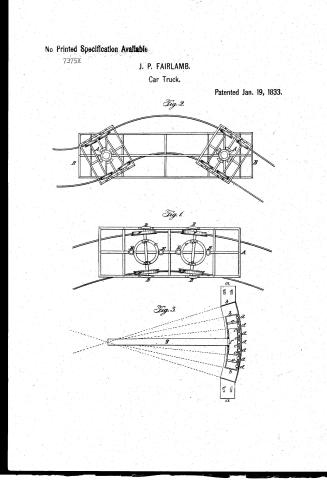
Jonas P. Fairlamb's Patent Drawing for Improvements in Constructing Rail Road Cars

National Archives, Restored Patent Drawings (Record Group 241) · Full-size scan at the National Archives · Catalog record
Show the text on the drawing Hide (381 words)
Words on the drawing as machine-read by the National Archives; not checked. Useful mainly for searching.
01$250 / tricks / Jour Wherl as / curve adju adding / Storts / arces / Drawings / Trucks / Curvo / Meferences / EALUTION / Axles, tadial. / of / Tothe the drawings ,Ionas PFairlamb's improvements in constructing / [122] / Rail Road bars. / Jonas PFairlamb's Improvements in constructing Rail Road / Fig: 1. / bars"." / Rail / A.A. Bollom frame the bar bed. B.B.B.B. Boxes.plates, and bearings (See / Fig: 2. / CLASSIFICATION / c.c. Circular Rings D.D.D.D. Boxes. E. E.E.E. Friction rolers / F.F.F.F.F car wheels / 7375 / Fig:2. / DIVISION. / A.A. The circular amgs or Plates as may be attached to two common barrs, / or improved bars, connected by a Long bodied carbe B.B. / B. / B. / Fig:5. / a.a. Plate or outside Box in which the above Boxes Frames and Conical / rolers vibrate. / Fail. / b.b. strong frame in which the Iournals ofthe Rolers revolve / C.G.C.C.C.C Horizontal conical rollers, d. d. a.d d.d.d. vertical rolers. / N. B. all these drawings, except the Rail ways, are / tahen from the under side ofthe bars, for the purpose of giving / e.e.e.e appertures for both to basten the said outred Box or plate to car. / the best exposition. / f. Box in which the Sournal of the Exle revolves. Half an axle: / Jonas P. Fairlamb Patent Ian. 19. 1833 / by / Fig.1. / vol. 17. page 97, / This drawn Dec affer a 22. Sign 1837- / B. / :/ / at / E. / HEH / E. / E. / A. / City of hiladelphia / 17. / F. / State of Pormsy wania / It: / 1: / on this Second / day of 5.683% / B. / B. / a. / Before me the Si bscriber one ofthe abtermen of the said bity personally / appeared Ionas PLAIR lamb bivil Engineer, oftherbity of Chiladelphia / aforesand and made solemn aath that he is interested asinventor, / Γypa in ta Patents for an improvement in constructing Rail Road bars" / found him the said Ionas PFairlamb and dated the nineteenth / b. / day of Sanuary A. D. one thousand eight hundred am thirty three / Fig.3. 3. / and that the above and foregoing drawings and References thereto / are ashe verily believes a true dilincation of invention as described / in the san l Letters Patent Witness my hand and seal the dayandyear / aforisaid / d. / John hompun / d. / aldn / d. / il
USPTO scan
The patent as scanned by the USPTO
-
 Page 1
-
 Page 2
-
 Page 3
-
 Page 4


U.S. Patent and Trademark Office · Google Patents
Show the transcription Hide (925 words)
Machine transcription (LightOnOCR) of the pages as scanned by the USPTO, most of them the handwritten copies made when the records were restored after the 1836 fire. Not checked; it can misread handwriting, so compare it with the scan.
Page 1.
No Printed Specification Available
7375X
J. P. FAIRLAMB.
Car Truck.
Patented Jan. 19, 1833.
Fig. 2.
Fig. 1.
Fig. 3.
Page 2.
1/19/1833 7375x
Jan. 19 1833 97
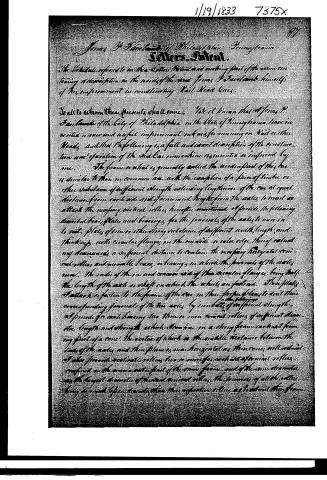
Jonas P. Fairlamb of Philadelphia, Pennsylvania
Letters Patent.
The Schedule referred to in these Letters Patent and making part of the same containing a description in the words of the said Jonas P. Fairlamb himself of his improvement in constructing Rail Road Cars.
To all to whom these presents shall come. Ye it known that I Jonas P. Fairlamb of the City of Philadelphia in the State of Pennsylvania have invented a new and useful improvement in cars for running on Rail road Roads, and that the following is a full and exact description of the construction and operation of the said Car or machine as invented or improved by me.
The frame or what is generally called the under part of this car is similar to those in common use with the exception of a piece of timber or other substance of sufficient strength extending lengthwise of the car at equal distances from each side and from end to end, to insert or attach the necessary vertical rollers hereafter mentioned, and provide the following described bearing plates and bearings for the journals of the axles to move in to suit, plates of iron or other strong substance of sufficient width, length, and thickness, with circular flanges on the outside or outer edge thereof extending downwards a sufficient distance to contain the necessary horizontal circular rollers and necessary braces or bearings in which the journals of the axles move. The radii of the inner and outer sides of these circular flanges being half the length of the axle or shaft on which the wheels are fastened. These plates or attach or fasten to the frame of the car in their proper places to suit their corresponding journals of the two axles by irons or bolts of sufficient strength.
I provide for each bearing two three or more circular rollers of sufficient diameter, length and strength which are borne in a strong frame each set forming part of a cone, the vertex of which is the middle distance between the ends of the axles and their planes is machined horizontal as their cones will admit. I also provide vertical rollers two or more for each set of horizontal rollers, confined in the same outer part of the same frame, and of the same diameter as the largest diameter of the said vertical rollers, the journals of all the rollers being so much larger than the diameter of their respective rollers as to admit their free
Page 3.
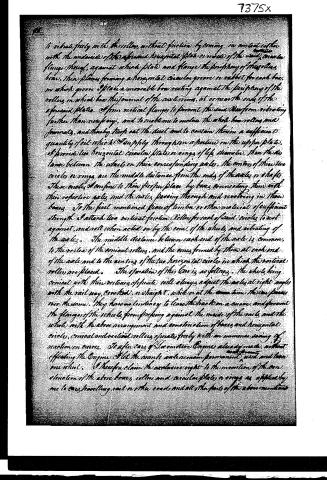
to vibrate freely with the rollers without friction by coming in constant contact with the underside of the aforesaid horizontal plate or inside of the said conical flange thereof, against which plate and flange the periphery of the rollers bear, their planes forming a horizontal circular groove or rabbet for each box in which groove I place a movable box resting against the periphery of the rollers on which box the journal of the axles turns, at or near the ends of the aforesaid plates. A firm vertical flange to prevent the said box from vibrating further than necessary, and to enable me to enclose the whole box rollers and journals, and thereby keep out the dust and to contain therein a sufficient quantity of oil which I supply through an aperture in the upper plate.
I provide two horizontal circular plates or rings of less diameter than the distance between the wheels on their corresponding axles, the centres of these two circles or rings are the middle distance from the ends of the axles or shafts. These circles or rings are then for their place by boxes connecting them with their respective axles and the axles passing through and revolving in these boxes. To the first mentioned piece of timber or other material of sufficient strength I attach two vertical friction rollers for each of said circles to act against, and not when acted on by the cone of the wheels and vibrating of the axles. The middle distance between each end of the axle is common to the vertex of the conical rollers, and the cones formed by them at each end of the axle and to the centres of the two horizontal circles in which the vertical rollers are placed.
The operation of this Car is as follows. The wheels being conical with their vertices opposite will always adjust the axles at right angles with the railway, crooked, or straight, while at the same time the car passes over the same. They have no tendency to leave the track on a curve, and prevent the flanges of the wheels from pressing against the inside of the rails and the whole with the above arrangement and construction of boxes and horizontal circles, conical and vertical rollers operate freely with an immense saving of friction on curves.
To the cars of locomotive Engines already made, without affecting the Engine I let the axles and remain permanent, with and leave one wheel. I therefore claim the exclusive right to the invention of the construction of the above boxes, rollers and circular plates or rings as applied by me to cars travelling rail or other roads and all the parts of the above mentioned
Published accounts: journal notice
Notice in the monthly list of patents, with remarks
Journal of the Franklin Institute, new ser., vol. 12 (1833), p. 24 · View the page
16. For an improvement in constructing Cars for Rail-roads; Jonas P. Fairlamb, city of Philadelphia, January 10.
Remarks. In this car the wheels are to be conical, in the manner of those for which a patent was obtained by Mr. James Wright of Columbia, Pennsylvania, in September, 1829, the specification of which is published in vol. iv. p. 272. Mr. Wright's invention consisted in the combination of a cone on the tread of the wheels, with a capacity of vibration in the axle, to allow of their adjusting themselves to the radius of any curve upon which they may run. If Mr. Wright's patent is valid, the law will not admit of the present patentee making use of it, even if he has made a real improvement in the mode of applying it. In the self-adapting rail-road car, with conical wheels, the axle must be allowed to vibrate as above noticed, and Mr. Fairlamb's invention consists in a mode of supporting the ends of the axles in vibrating boxes on the frame of the car. The journals project beyond the wheels, and run in vibrating boxes, which are segments of circles, of which the middle of the axis is the centre. The boxes bear against two or three horizontal conical friction rollers, and against two which are vertical, so as to allow of an easy asy lateral motion; the arrangement appears to be a good one, but still it is altogether only subservient to the action of the conical wheels, embraced in the patent of Mr. Wright. The claim is to "the construction of the above boxes, rollers, and circular plates, or rings; and all other parts of the above mentioned and described car not heretofore used or known." Since the foregoing notice was written a long depending suit between Mr. James Wright and the Baltimore and Ohio Rail-road Company has been brought to an issue in the Circuit Court of the United States, and the validity of Mr. Wright's claim has been fully sustained by the jury. It is probable that the case will be carried up to the Supreme Court by the defendants; in the mean time those who use the combination will do so at their peril. How far Mr. Fairlamb, or any other person, has a right to use journals which project beyond the wheels, is a point which also admits of doubt. By turning to p. 135, vol. ix, it will be seen that on the 20th of July, 1831, Mr. Ross Winans obtained a patent in which he claims the "extending the axles each way outside of a pair, or pairs, of wheels, far enough to form external gudgeons to receive the bearing box of the loaded body."
About this record
- Patentee
- DATAMP
- Date
- the Name and Date index of patents, DATAMP, USPTO records
- Invention
- DATAMP
- Listed in
- the Name and Date index of patents, DATAMP, USPTO records, Jim Shaw's X-patent list, the Journal of the Franklin Institute, Burke's List of Patents (1847)
- The Franklin Institute's journal gives a different date.
- Burke's 1847 Patent Office list gives the same patent.