

Drawings and documents
National Archives restored drawings: drawing
Silas Watrous' Patent Drawing for a Paint Mill

National Archives, Restored Patent Drawings (Record Group 241) · Full-size scan at the National Archives · Catalog record
Show the text on the drawing Hide (32 words)
Words on the drawing as machine-read by the National Archives; not checked. Useful mainly for searching.
83. MILLS. / 61- / Grinding Mills. / Paint. / of / CLASSINDATION / 7393. X / SILAS WATROUS / DIVISION. / Paint Mill, / Patented 26th Jannuary 1833
USPTO scan
The patent as scanned by the USPTO
-
 Page 1
-
 Page 2
-
 Page 3


U.S. Patent and Trademark Office · Google Patents
Show the transcription Hide (594 words)
Machine transcription (LightOnOCR) of the pages as scanned by the USPTO, most of them the handwritten copies made when the records were restored after the 1836 fire. Not checked; it can misread handwriting, so compare it with the scan.
Page 1.
7393X
NO PRINTED SPECIFICATION AVAILABLE
S. Watrous.
Paint Mill.
Patented Jan. 26, 1833.

Page 2.
7393 X Jan 26, 1833 427
Silas Nations, Griston, New London County, Ct.
Letters Patent.
The Schedules referred to in these Letters Patent, and making part of the same, containing a description in the words of the said Silas Nations himself of his improvement in the Mill for grinding White Lead, Spanish & Paris White, in its dry state.
To all to whom these presents shall come, Be it known that Silas Nations of the Town of Griston, County of New London, and State of Connecticut, have invented a new and useful improvement in a Mill for grinding White Lead, Spanish & Paris White in its dry state, and that the following is a full and exact description of the construction and operation of said Mill, as invented or improved by me.
This mill consists of the following parts viz:
A. Frame made of plank of any convenient width, height & thickness with a top & bottom to it, with a partition in it just the middle as may be seen by a front view of the subjoined drawing marked a, a. thru this plank frame runs an iron shaft marked A. on which iron shaft, in one of the apartments between the planks or frame of said Mill, is hung a Mill Stone of a cylindrical form and hung on said iron shaft, exactly the same as a common grind Stone is hung on its crank, and calculated to run in the same manner as will appear by an end view of said mill & Stone marked B. this mill Stone is to be made of sharp granite Stone, and the outward circumference or surface to be nearly smooth, this mill Stone runs in a bed Stone made exactly to fit the outer circumference of the runner as may be seen by an end view of said bed Stone marked C. and extending about one third of the distance round the runner, under this bed Stone is a key made of wood marked D. the use of which is to key the bed Stone close to the runner (this runner maybe of any convenient diameter & suit the situation & business where the mill is to be placed, on one side of this mill is a hopper marked E. into which the paint is fed
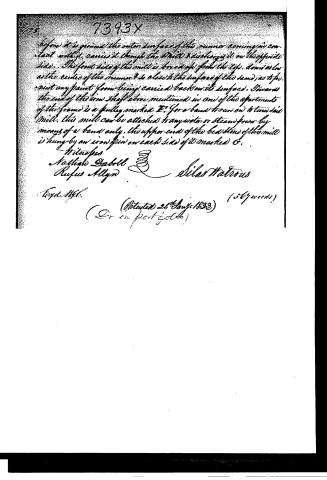
Page 3.
before it is ground the outer surface of the runner coming in contact with it, carries it through the Mill & sculpts it on the opposite side. The front side of the mill is braced up from the top, down as low as the center of the runner & is close to the surface of the sand, so to prevent any paint from being carried back on its surface. Towards the end of the iron shaft above mentioned in one of the apartments of the frame is a pulley marked F, for a band to run on to turn said mill. This mill can be attached to any water or steam power by means of a band only. The upper end of the bevel stone of this mill is hung by an iron pin on each side of it marked G.
Witnesses
Nathaniel Daboll
Reuben Allyn
Silas Matrous
Copy. Mfg.
(Patented 21st Aug. 1833)
(See in part 3000)
(567 words)
Published accounts: journal notice
Notice in the monthly list of patents, with remarks
Journal of the Franklin Institute, new ser., vol. 12 (1833), p. 30 · View the page
33. For a Mill for Grinding Paint; Silas Watrous, Groton, New London county, Connecticut, January 26.
Remarks. This paint mill consists of a cylindrical stone, running on a shaft like a grind stone, and of a concave bed stone passing nearly one-third of the way round it at its lower part. The mill is merely described, nothing being said about the portion of it which the patentee has invented. The only novelty which we find in the description is the information given to us by the patentee, that "the mill stone runs in a bed stone made convex," and even this part we have taken the liberty of reversing in the foregoing notice, as it really appears to us that the periphery of a round mill stone, must, if it runs in any thing, run in a concave. We could point out twenty books in which such a mill is described and figured.
About this record
- Patentee
- DATAMP
- Date
- the Name and Date index of patents, DATAMP, USPTO records
- Invention
- DATAMP
- Listed in
- the Name and Date index of patents, DATAMP, USPTO records, Jim Shaw's X-patent list, the Journal of the Franklin Institute, Burke's List of Patents (1847)
- Burke's 1847 Patent Office list gives the same patent.