

Drawings and documents
National Archives restored drawings: drawing
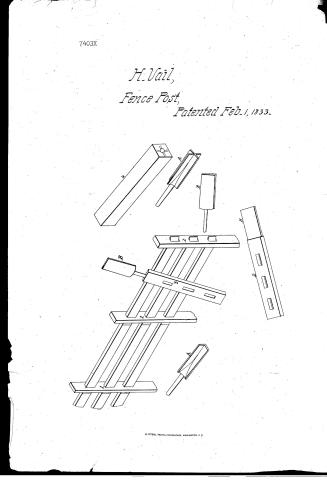
Henry Vail's Patent Drawing for Fence Posts

National Archives, Restored Patent Drawings (Record Group 241) · Full-size scan at the National Archives · Catalog record
Show the text on the drawing Hide (80 words)
Words on the drawing as machine-read by the National Archives; not checked. Useful mainly for searching.
39. FENCES. / 410 / [52] Fence Pos / Henry Vail / 11- / Fence Posts, / Patented 1ˢᵗ Feb1833, / classi. ication / 7403 X / 3.+ / B. / References, / Airon for gate posts r. / Biron iron for fence posts. / 1. posts set, 2. post with iron in, / 3, " with iro n parthy thy in / 2. / Patent Office / 4. gate post withoutiron, / Made under the direction of the Commiproner of Patents / in couf ormity with act of Congrefs 30 March 1837 / Comm ipioner of Patents
USPTO scan
The patent as scanned by the USPTO
-
 Page 1
-
 Page 2


U.S. Patent and Trademark Office · Google Patents
Show the transcription Hide (394 words)
Machine transcription (LightOnOCR) of the pages as scanned by the USPTO, most of them the handwritten copies made when the records were restored after the 1836 fire. Not checked; it can misread handwriting, so compare it with the scan.
Page 1.
7403X
H. Vail,
Fence Post,
Patented Feb. 1, 1833.
N. PETERS, PHOTO-LITHOGRAPHER, WASHINGTON. D.C.
Page 2.
7403X
Oct 1, 1833
Henry Vail
Patent
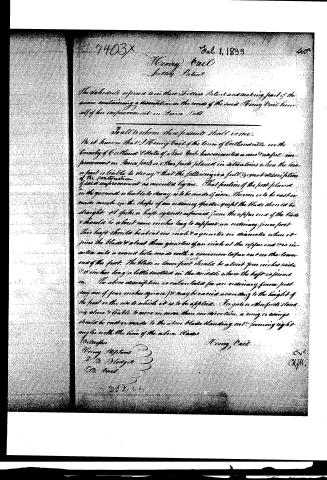
The schedule referred to in these Letters Patent and making part of the same containing a description in the words of the said Henry Vail himself of his improvement on Stone Posts.
To all to whom these presents shall come.
Be it known that I Henry Vail of the town of Cortlandville in the County of Cortland State of New York have invented a most useful improvement on Stone Posts or other posts placed in situations where the lower part is liable to decay; that the following is a full & exact description of the construction of said improvement as invented by me. That portion of the post placed in the ground or liable to decay is to be made of iron. The iron is to be cast or made much in the shape of an ordinary spade except the blade there to be straight & at the a haft extends upwards from the upper end of the blade & should be about nine inches long to support an ordinary force post. This haft should be about one inch & a quarter in diameter where it joins the blade & about three quarters of an inch at the upper end & is inserted into a round hole made with a common tapper cut in the lower end of the post. The blade or lower part should be about four inches wide & 15 inches long a little rounded in the middle where the haft is joined to. The above description is calculated for an ordinary force post (say one of four inches square) & may be varied according to the height of the post or the use to which it is to be applied. For gate or other posts standing alone & liable to move in more than one direction, a wing or wings should be cast or made to the above blade standing out & forming right angles with the line of the above blade.
Witnesses
Henry Stephens
H.B. Blagden
C.B. Atee
Henry Vail
3024 10 13
Published accounts: journal notice
Notice in the monthly list of patents, with remarks
Journal of the Franklin Institute, new ser., vol. 12 (1833), p. 84 · View the page
2. For Fence Posts; Harry Vail, Cortlandville, Cortland county, New York, February 1.
Remarks. This is no wooden contrivance, although it appertains to fence posts. Pieces to form the bottoms of posts, in those situations where they are liable to decay, are to be made of cast iron, and driven into the ground, to form the foundation of the post. The pieces of iron are to be somewhat in the form of the blade of a spade, with a shank projecting up to the height of about nine inches. This shank may be an inch and a quarter in diameter at its lower, and three-quarters of an inch at its upper end. A hole bored into the lower end of the post, receives this shank. For gate posts the iron is to be larger, and the lower part is to be furnished with wings, something like those of winged gudgeons. We apprehend that in loose soils it would be necessary to make the blade much longer than that of a spade, or the fence would soon be prostrated. There is no drawing accompanying the patent, and although it can be understood well enough without one, still as "the nature of the case admits of drawings," the terms of the law are not complied with.
About this record
- Patentee
- DATAMP
- Date
- the Name and Date index of patents, DATAMP, USPTO records
- Invention
- DATAMP
- Listed in
- the Name and Date index of patents, DATAMP, USPTO records, Jim Shaw's X-patent list, the Journal of the Franklin Institute, Burke's List of Patents (1847)
- Burke's 1847 Patent Office list gives the same patent.