

Drawings and documents
USPTO scan
The patent as scanned by the USPTO
-
 Page 1
-
 Page 2
-
 Page 3


U.S. Patent and Trademark Office · Google Patents
Show the transcription Hide (703 words)
Machine transcription (LightOnOCR) of the pages as scanned by the USPTO, most of them the handwritten copies made when the records were restored after the 1836 fire. Not checked; it can misread handwriting, so compare it with the scan.
Page 2.
United States Patent
Patent No.: X7430
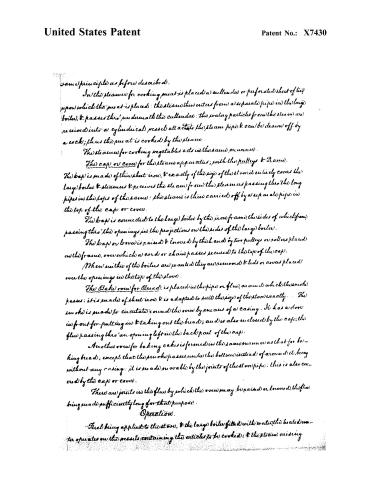
same principle as before described.
In the steamer for cooking meat is placed a cullender or perforated sheet of tin upon which the meat is placed: the steam then enters from a separate pipe in the large boiler, & passes through underneath the cullender: the soiling particles from the steam are received into a cylindrical vessel attached to the steam pipe & can be drawn off by a cock; thus the meat is cooked by the steam.
The steamer for cooking vegetables acts in the same manner.
The cap or cover for the steam apparatus; with the pulleys & frame.
The cap is made of thin sheet iron, & exactly of the size of the stove; it entirely covers the large boiler & steamer & receives the steam from the steamer passing through the long pipes in the tops of the same: the steam is then carried off by a separate pipe in the top of the cap or cover.
The cap is connected to the large boiler by the iron frame, the sides of which frame passing through the openings in the projections on the sides of the large boiler.
The cap or cover is raised & lowered by the hand by two pulleys or rollers placed on the frame, over which a cord or chain passes secured to the top of the cap.
When neither of the boilers are wanted they are removed & lids or covers placed over the openings in the top of the stove.
The Bake oven for Bread, is placed in the pipe or flue, around which the smoke passes: it is made of sheet iron & is adapted to suit the size of the stove exactly. The smoke is made to circulate round the oven by means of a casing. It has a door in front for putting in & taking out the bread; and is also enclosed by the cap; the flue passing through an opening left in the back part of the cap.
Another oven for baking cakes is formed in the same manner as that for baking bread; except that the smoke passes under the bottom instead of around it, being without any casing: it is made movable by the joints of the stove pipe: this is also covered by the cap or cover.
There are joints in the flue by which the oven may be raised or lowered, the flue being made sufficiently long for that purpose.
Operation.
Fuel being applied to the stove, & the large boiler filled with water, the heat thus operates on the vessels containing the articles to be cooked: & the steam arising
Page 3.
United States Patent
Patent No.: X7430
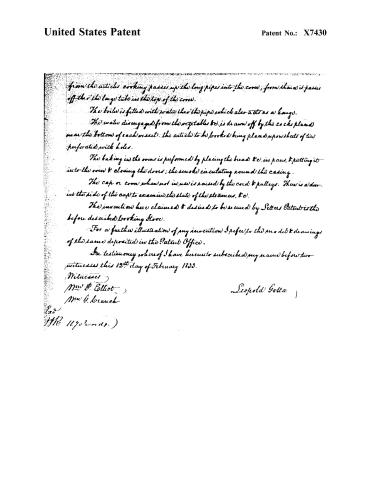
from the article cooking passes up the long pipe into the cover, from thence it passes off the large tube in the top of the cover.
The boiler is filled with water thru the pipe which also acts as a gauge.
The water disengaged from the vegetables &c. is drawn off by the cocks placed near the bottom of each vessel; the articles to be cooked being placed upon sheets of tin perforated with holes.
The baking in the ovens is performed by placing the bread &c. in pans, & putting it into the oven & closing the doors; the smoke circulating round the casing.
The cap or cover when not in use is raised by the cord & pulleys. There is a door in the side of the cap to examine the state of the steamer, &c.
The invention here claimed & desired to be secured by Letters Patent is the before described cooking stove.
For a further illustration of my invention I refer to the models & drawings of the same deposited in the Patent Office.
In testimony whereof I have hereunto subscribed my name before two witnesses this 12th day of February 1833.
Witnesses
Mrs. P. Elliot
Mrs. G. Branch
Leopold Gotta
Exo
J.H.C. 1170 words.)
Published accounts: journal notice
Notice in the monthly list of patents, with remarks
Journal of the Franklin Institute, new ser., vol. 12 (1833), p. 95 · View the page
28. For a Cooking Stove for Wood or Coal; Leopold Gotta, Huntingdon, Huntingdon county, Pennsylvania, February 18.
Remarks. The merit of this stove, if merit it may be called, consists in the great number of its contrivances, intended to accommodate it to a great variety of purposes. The stove, as shown in the drawing, is round; the body of it, immediately above the fire, constitutes a boiler for containing water. A steam vessel for cooking meat stands with its lower part within the boiler, a steam pipe from which also enters its interior. Other steam chambers for vegetables, &c. may be similarly placed, each having pipes to discharge the redundant steam. For baking bread and cakes, there is an oven within a kind of drum in the flue, surrounded by the heated air from the combustion. The stove is surmounted by a cover which encloses the steaming apparatus. This cover is to be raised from the stove by cords and pulleys when the viands are to be placed in, or removed from, the steamers. From this cover a general waste pipe ascends, to carry off the vapours arising from the steamers, and the articles contained in them. The claim is to "the before described stove;" a claim which of course limits the patentee to the exact mode of arrangement given in the specification; this, we apprehend, is perfectly proper, as there is -nothing new in it, excepting the particular mode of construction. The main objection to it appears to be its complexity, a circumstance which in the hands of ordinary servants destroys the usefulness of any apparatus, however good it may be in those of a person who is intelligent, careful, and interested.
About this record
- Patentee
- DATAMP
- Date
- DATAMP, USPTO records
- Invention
- DATAMP
- Listed in
- the Name and Date index of patents, DATAMP, USPTO records, Jim Shaw's X-patent list, the Journal of the Franklin Institute, Burke's List of Patents (1847)
- The sources give different dates; the date shown is the one most of them agree on.
- The Franklin Institute's journal confirms the date shown.
- Burke's 1847 Patent Office list gives the same patent.