

Drawings and documents
National Archives restored drawings: drawing
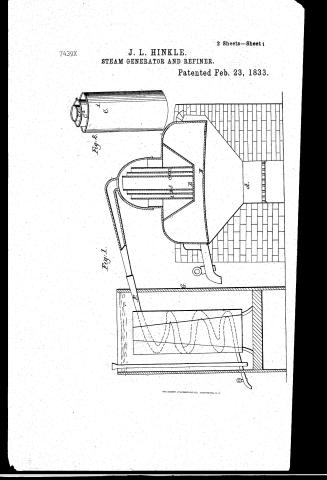
John L. Hinkle's Patent Drawing for a Steam Generator and Refiner


National Archives, Restored Patent Drawings (Record Group 241) · Full-size scan at the National Archives · Catalog record
Show the text on the drawing Hide (355 words)
Words on the drawing as machine-read by the National Archives; not checked. Useful mainly for searching.
Sheet 1. 195. ALCOHOL. / Distilled Spirits. / Apparatus. / John L Hinkle- / Vol.16p 263 / Stills. / $20 / Leam Generator Refener / classs ITALPION / Patented Yeb23, 1833, / 7439-X / DIVISION. / Fig.2, / Fur1 / Roferences. / Fid.1. virtical section through the / Patent Offin / still and condinsive / Fif.2. cylinders detached / Made under the direction of the Comminism of atuts / Mazch 11.1842. / A.formace. B. still. C.C.C.C. cylinders. / in conformity with act of bougrep 3 March 1837, / D, crop bar, E. cap. E.worm, G cooling tub, / HL Sumoith / Commision of Patents,
Sheet 2. 195. ALCOHOL. / $360, / Distilled Spirits. / I.L. Kinkles / Apparatus. / Stills. / Steam Generator S5 Refener. / CLASSI FICATION / Patented Feb. 23ed1833 / 7439-+ ISION. / References / A. Ileam generator composed, of tubes N°1,hand 3 placed within / / cachother leaving spaces between them. / B. feet of Doing / o. Handle of Do: / D. Generator without feet, hung in the still. / E Pulleys and cord to raise 30:00 / F'. Singling still with the generator shewn by dotted lines. / H. Common boiler / G. Dubling still. generator shewn by dotted lines. / I. Another form of generator app lied to steam boat boiler / K. The height of the waterin the boilers shown by dotted lina / L. Iteam boat boiler with the generator I within it. / If / K. / N°1 / N°1 / AD
Sheet 3. 195. ALCOHOL. / Distilled Spirits. / Apparatus. / Stills. / CLASSIFICATION / 7439 DIVISION. / References / A.A. Itam boilers LIft long and 30 inches in diameter within Generators and refiners placed within / B. Iteam Generaton and between refiner with tubes As 1.2 $3 also she ewing bottoms hinges No 13 in. Nh. 16 in.No. 19 in.hig h. / E Transfere Crop bars on top of querator a nd befiner to braco its in steam boilers to keeb in frow mooorng halfin. squard 22 in. long. / D. Brop made firm d to resp generators & Refirress upon, in steam m broad and half. in. in. thick. RAin. long two bass sin. apart. / O. Bars hung Bars to hinges Genera I tord and refiners to keep them steady made of shut crow VC. 13 in wide strops revetted ow. / F. new of boilers with ginerator and refiner placed with ind with cropbass and bracd / The hight of water in boilers.
USPTO scan
The patent as scanned by the USPTO
-
 Page 1
-
 Page 2
-
 Page 3
-
 Page 4
-
 Page 5
-
 Page 6


U.S. Patent and Trademark Office · Google Patents
Show the transcription Hide (1,196 words)
Machine transcription (LightOnOCR) of the pages as scanned by the USPTO, most of them the handwritten copies made when the records were restored after the 1836 fire. Not checked; it can misread handwriting, so compare it with the scan.
Page 1.
7439X
2 Sheets—Sheet 1
J. L. HINKLE.
STEAM GENERATOR AND REFINER.
Patented Feb. 23, 1833.

THE ECKERT LITHOGRAPHING CO., WASHINGTON, D. C.
Page 2.
7439X
J. L. HINKLE.
STEAM GENERATOR AND REFINER.
Patented Feb. 23, 1833.
2 Sheets—Sheet 2.
THE ECKERT LITHOGRAPHING CO., WASHINGTON, D. C.
Page 3.
v. 11 7439X
Feb 23, 1833 263.
John L. Winkle. Hanover P. M.
Letters Patent.
The Schedule referred to in these Letters Patent, and making part of the same, containing a description in the words of the said John L. Winkle himself, of his improvement called the Steam Generator & Refiner.
To all to whom these presents shall come.
Be it known that I, John L. Winkle of the Borough of Hanover in the County of York and State of Pennsylvania have invented a new and useful improvement in Generating and refining Steam, called the Steam Generator and Refiner, and that the following is a full and exact description of the construction and also the shape and size the same may be made and constructed to suit all purposes whatsoever, where generating and refining steam is the object, and also the operation of the same, as invented or improved by me. The great advantages derived from the use of the newly invented Steam Generator & Refiner, consists principally, in the power to increase and refine the steam— In kettles for distilling spirituous liquors, it will reduce the firing flavor, refine and mellow the liquor as if it had age, save fuel, and produce more spirits from the same mass; and in less time than by the present mode of proceeding. In a still kettle measuring twenty eight inches from the top of the neck to the bottom, and fourteen inches wide at the neck, place the Steam Generator & Refiner in the center of the doubling still. The Steam Generator and Refiner may be made in the following manner viz:
Three cylinder tubes are placed within each other, made of sheet copper, brass, tin, iron, lead, pewter, or wood.
Drawing
Page 4.
264. 7439 X
wooden, in sheets or bars.
Tube No. 1, say the outer, maybe ten inches wide and twenty-one inches high, open at both ends, resting on four strong feet, one inch high, & rivetted thereto; and at the same end where the feet are, a strong bar of one inch broad may also be rivetted to them. cylinder for the other two open tubes to rest upon. Tube say No. 2, seven inches wide and twenty-three inches high and Tube No. 3, four inches wide, and twenty-five inches high; the height of each tube may be varied from two to fifteen and more inches; the tubes should be rivetted to the ends of No. 1, at equal distances from the circumference of each, and also rivetted at the top of each, to keep it regular with a handle. This steam generator and refiner may be put in the doubting still because on the old system, when the fluid begins to boil, and circulate, it rises on the outer part of it, and throws it into the center, which is lower than the outer part, & buries the steam, but when the steam-generator and refiner is placed in the center of the still, it will rise, throw it up and produce a rapid generation of steam. It will also impede the violent action of circulation, occasioned by too much heat from the furnace, which destroys the spirit in the still, and produces bad liquor. This steam generator and refiner refines it, produces more, and can be taken out and set or hung in the still, at every running off, or may remain in it; but the size of the steam generator & refiner should be regulated nearly to the size of the still and its height. In singling stills where, wheat, rye, corn, malt, molasses, sugar, honey, &c. being the component parts is distilled, it is necessary to stir the mass before and at the time it begins to boil, as the heavy parts frequently settle to the bottom, and if not stirred will burn fast injure the still and
Page 5.
and make bad liquor. In order to avoid this difficulty, the steam generator & refiner may be made on the same plan with a slight variation, about ten inches shorter from below, without feet, and the cross bars turned upwards, hung at the handle in the center of the still on a cross bar, resting on braces in the neck of the still, so as to give ten inches space between the steam generator and refiner and the bottom, which will leave room for stirring the mass, or there may be a strong copper or other wire attached to the top of the handle of steam-generators and refiners, and run the same through a small hole, made through the top of the cap of the still, and fixed to a pulley, by which it may be raised into the cap, clear from the mass or beer in the still, to give sufficient room for stirring.
When the fluid begins to run from the worm, then lower the steam generator and refiner into the mass or beer, so that the inner tube from the top will be from five to nine inches in the cap; this must be regulated by the pulley at the time it is put in, which will save the trouble of removing the cap from the singling still at every running off, and a little part around the wire at the place it passes the cap, will prevent the steam from passing out.
The steam-generator and refiner may also be made with one, two or any number of tubes or bars, of any of the above or other materials, either triangular, square, or octagonal, or any other shape or size, be it hollow or solid, and if placed in the center of the still, it will have nearly the same effect; the worm of the stills should be two inches wide, with five or six turns, in a large tub holding a good body of water, in order to cool and condense the steam.
The steam-generator and refiner may be made in any shape or size to lie, stand or hang, when placed in the center
Page 6.
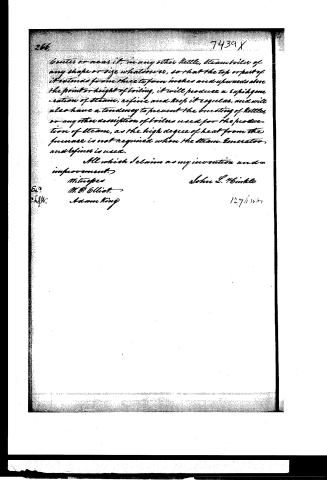
266
7439 X
outer or near it, in any other kettle, steam boiler of any shape or size whatsoever, so that the top or part of it extends from three to four inches and upwards above the point or height of boiling, it will produce a rapid generation of steam, refine and keep it regular, and will also have a tendency to prevent the bursting of kettles, or any other description of boilers used for the production of steam, as the high degree of heat from the furnace is not required when the steam generator and refiner is used.
All which I claim as my invention and improvement.
Witnesses
M. B. Elliot
Adam King
John L. Binkley
127/1187
Published accounts: journal notice
Notice in the monthly list of patents, with remarks
Journal of the Franklin Institute, new ser., vol. 12 (1833), p. 100 · View the page
38. For an apparatus called a Steam Generator and Refiner; John L. Hinkle, Hanover, York county, Pennsylvania, February 23.
Remarks. This "generator and refiner" of steam, may, it appears, be applied to kettles and boilers of various descriptions, but is peculiarly applicable in the art and mystery of distilling ardent spirits, in which its merits are so great that, according to the patentee, it has " power to increase and refine the steam in kettles for distilling spirituous liquors; it will reduce the fiery flavour; refine and mellow the liquor, as if it had age; save fuel, and produce more spirits from the same mass, and that in less time than by the present mode of proceeding." Besides all the foregoing advantages, we are informed that although the steam is more rapidly generated, it will have less tendency to burst the boilers, the generation being effected at a reduced temperature. It generally happens that in great inventions we are as much surprised at the simplicity of the means employed, as we are gratified by the utility of the effect produced, and should the patentee not have deceived himself in the present instance, his invention will serve to confirm this sentiment. If so, however, there must be something more in it than meets the eye, something occult, or at least so recondite, that to discover it demands more knowledge, and better optics than we possess; although the mode in which his apparatus is to produce such effects may be inscrutable, its construction, however, is so simple, that of this we can give a perfect idea without the assistance of a drawing, and thus enable each of our readers to form his own judgment of the thing, which may be attended with the further advantage of inducing some of them to throw light upon the subject. Supposing the generator and refiner to be applied in a still, it is to consist of three concentric tubes, one placed within the other, open at both ends, and leaving a space between each; the following dimensions are given in the specification as an example of what may be their sizes. In a still kettle twenty-eight inches in height from the bottom to the top of the neck, and there fourteen inches wide, the outer tube may be ten inches in diameter, and twenty-one long; the second tube, seven inches by twenty-three, and the inner one four inches by twenty-five. These are to be so connected as to be concentric, and to stand vertically in the still, having feet which keep them an inch from the bottom. The tubes may be made either of metal or of wood, so that, it seems, their being good conductors of heat is not necessary to the exercise of their generating and refining powers. Similar tubes are to be laid longitudinally in horizontal cylindrical steam engine boilers, or the tubes may be varied in their forms, to suit the purpose to which they are applied.
About this record
- Patentee
- DATAMP
- Date
- DATAMP, USPTO records, Burke's List of Patents (1847)
- Invention
- DATAMP
- Listed in
- the Name and Date index of patents, DATAMP, USPTO records, Jim Shaw's X-patent list, the Journal of the Franklin Institute, Burke's List of Patents (1847)
- The sources give different dates; the date shown is the one most of them agree on.
- The Franklin Institute's journal confirms the date shown.
- Burke's 1847 Patent Office list gives the same patent.