

Drawings and documents
National Archives restored drawings: drawing
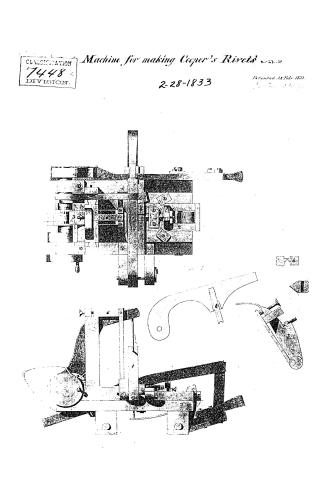
Timothy Allen's Patent Drawing for a Machine for Making Cooper's Rivets

National Archives, Restored Patent Drawings (Record Group 241) · Full-size scan at the National Archives · Catalog record
Show the text on the drawing Hide (45 words)
Words on the drawing as machine-read by the National Archives; not checked. Useful mainly for searching.
10, METAL WORKING, / Bolts and Rivets, Making. / TIMOTHY ALLEN'S / C.L. ASSIS ATION / Machine for making Cooper's Rivets / 7448.x / Patented 28 Febr. 1833 / DI V ISION. / sheard / 11 / of shears / OIR
USPTO scan
The patent as scanned by the USPTO
-
 Page 1
-
 Page 2
-
 Page 3


U.S. Patent and Trademark Office · Google Patents
Show the transcription Hide (534 words)
Machine transcription (LightOnOCR) of the pages as scanned by the USPTO, most of them the handwritten copies made when the records were restored after the 1836 fire. Not checked; it can misread handwriting, so compare it with the scan.
Page 1.
CLASSIFICATION
7448
DIVISION.
Machine for making Cooper's Rivets
2-28-1833
Patented 28 Feb. 1833.
Page 2.
X 148
Feb 28 1833
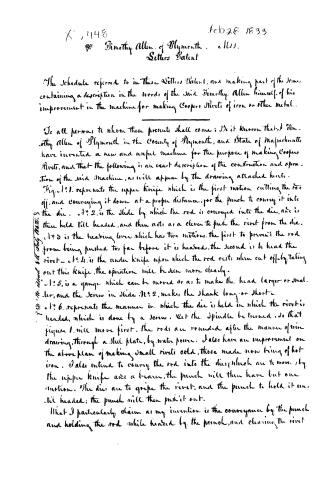
Timothy Allen, of Plymouth, Mass.
Letters Patent
The Schedule referred to in these Letters Patent, and making part of the same, containing a description in the words of the said Timothy Allen himself, of his improvement in the machine for making Coopers Rivets of iron or other metal.
To all persons to whom these presents shall come: Be it known that I Timothy Allen of Plymouth in the County of Plymouth, and State of Massachusetts have invented a new and useful machine for the purpose of making Coopers Rivets, and that the following is an exact description of the construction and operation of the said Machine, as will appear by the drawing attached hereto.
Fig. 1. represents the upper knife which is the first motion cutting the rod off, and conveying it down at a proper distance, for the punch to convey it into the die. No. 2. is the slide by which the rod is conveyed into the die, and is there held till headed, and then acts as a clevis to push the rivet from the die. No. 3 is the heating lever which has two motions, the first to prevent the rod from being pushed too far before it is headed, the second is to head the rivet. No. 4. is the under knife upon which the rod rests when cut off, by taking out this knife, the operation will be seen more clearly.
No. 5. is a gauge which can be moved so as to make the head larger or smaller, and the screw in slide No. 2, makes the shank long or short.
No. 6. represents the manner in which the die is held in which the rivet is headed, which is done by a screw. Let the spindle be turned, so that figure 1. will move first. The rods are rounded after the manner of iron drawing, through a steel plate, by water power. I also have an improvement on the above plan of making small rivets cold, those made now being of hot iron. I also intend to convey the rod into the die, which are to move, by the upper knife and a lever, the punch will then have but one motion. The dies are to grip the rivet, and the punch to hold it until headed: the punch will then push it out.
What I particularly claim as my invention is the conveyance by the punch and holding the rod while headed by the punch, and clearing the rivet
Page 3.
X7448
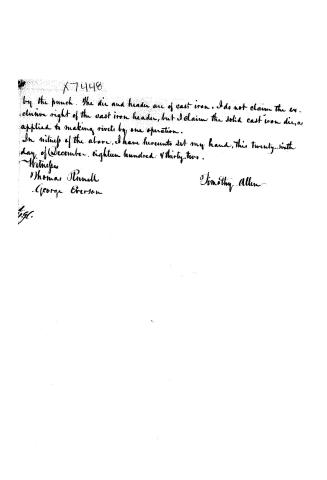
by the punch. The die and header are of cast iron. I do not claim the exclusive right of the cast iron header, but I claim the solid cast iron die, as applied to making rivets by one operation.
In witness of the above, I have hereunto set my hand, this twenty-sixth day of December, eighteen hundred & thirty-two.
Witnesses
Thomas Pinell
George Everson
Timothy Allen
E.G.
Published accounts: journal notice
Notice in the monthly list of patents, with remarks
Journal of the Franklin Institute, new ser., vol. 12 (1833), p. 105 · View the page
49. For a Machine for Making Cooper's Rivets; Timothy Allen, Plymouth, Plymouth county, Massachusetts, February 28.
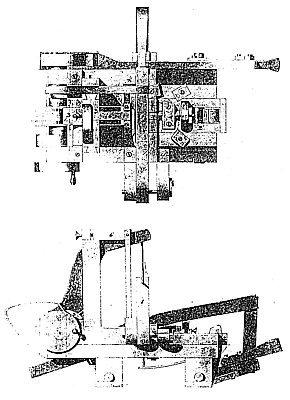
Remarks. This is a machine for cutting off the wires, or rods, into proper lengths for a rivet, and impressing the heads upon them by suitable dies. The operation of the machine is not rendered clear by the description and drawing, but it manifestly resembles, in several particulars, other machines for heading rivets and screws; there possibly may be some novelties of arrangement sufficient to entitle this to the character of a new machine, but, if so, they are not made plain. The claims are to "the conveyance by the punch, and holding the rod whilst headed by the punch. The solid cast iron die is applied to making rivets by one operation."
DATAMP: illustration
Illustrations from DATAMP

DATAMP (Directory of American Tool and Machinery Patents), via the Internet Archive · Archived DATAMP page
About this record
- Patentee
- DATAMP
- Date
- DATAMP, USPTO records
- Invention
- DATAMP
- Listed in
- the Name and Date index of patents, DATAMP, USPTO records, Jim Shaw's X-patent list, the Journal of the Franklin Institute, Burke's List of Patents (1847)
- The sources give different dates; the date shown is the one most of them agree on.
- The Franklin Institute's journal confirms the date shown.
- Burke's 1847 Patent Office list gives the same patent.
- Burke's 1847 Patent Office list gives a slightly different date; the date shown follows the standard lists.