

Drawings and documents
National Archives restored drawings: drawing
Chas F. Fisher's Patent Drawing for a Machine for Edging or Grooving Tin Plate, Sheet Iron, etc.

National Archives, Restored Patent Drawings (Record Group 241) · Full-size scan at the National Archives · Catalog record
Show the text on the drawing Hide (67 words)
Words on the drawing as machine-read by the National Archives; not checked. Useful mainly for searching.
its. SHEET-METAL WARE, MAKING, / Edging Sheets. / Edging Shuts Edging Shuts / 'NOISIAIT / Chas: Fo Fisher's / 74 7451-1 51-x / Edging Sheets. / NOILVOISISSVTO / 113. SHEET-METAL WARE, MAKING, / Edging / Machine for edging or grooving Tin plate, Sheet-iron, Sc. / Patented: 28 Febry 1833. / OE / y/o / Paid Feb.28, 28, 1833, / lekas F, Fisher / Patch / B.B.del. / Sun back / no more,
USPTO scan
The patent as scanned by the USPTO
-
 Page 1
-
 Page 2
-
 Page 3


U.S. Patent and Trademark Office · Google Patents
Show the transcription Hide (691 words)
Machine transcription (LightOnOCR) of the pages as scanned by the USPTO, most of them the handwritten copies made when the records were restored after the 1836 fire. Not checked; it can misread handwriting, so compare it with the scan.
Page 1.
7451X
C. F. Fisher,
Edging Sheet-Metal.
Patented Feb. 28, 1833.

Page 2.
Feb 28 1833
No 51X Charles T. Fisher.
Letter Patent.
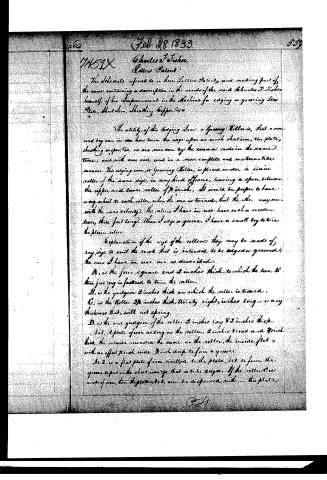
The schedule refers to in these Letters Patent, and making part of the same containing a description in the words of the said Charles T. Fisher himself, of his Improvement in the Machine for edging or grooving Tin Plate, Sheet Iron, Sheathing Copper &c.
The utility of his hedging down or grooving Roller is, that a man and boy can in one hour turn the edge upon as much sheet iron, tin plate, sheathing copper, &c. as six men can by the common mode in the same time; and with more ease, and in a more complete and workmanlike manner. This edging iron or grooving Roller, is placed under a plain roller of the same size, in any kind of frame, leaving a space between the upper and lower roller of 3/4 inch. It would be proper to have a cog wheel to each roller, when the one is turned, that the other may move with the same velocity. The rollers I have in use have such a wooden lever, three feet long. When I edge or groove, I have a small boy to turn the plain roller.
Explanation of the size of the rollers: they may be made of any size to suit the work that is intended to be edged or grooved; the ones I have in use are as described.
A, is the four square end 2 inches thick, to which the lever is three feet long is fastened to turn the roller.
B, is the yudgen 2 inches thick on which the roller is turned.
C, is the Roller 3/4 inches thick, twenty eight inches long - or any thickness that will not spring.
D, is the end yudgen of the roller 2 inches long & 2 inches thick.
1st. A plate of iron as long as the roller, 2 inches broad and 3/4 inch thick the outside rounded the same as the roller, the inside flat & with an offset 3/4 inch wide 3 inch deep to form a groove.
2d. is a flat plate of iron rivetted to the plate 1st to form the groove to put in the sheet iron &c that is to be edged. If the roller be made of iron, then the plate 2d. can be dispensed with. - this plate
Page 3.
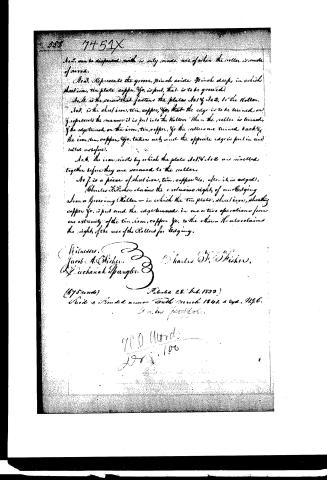
No 2. can be employed with or only made use of when the roller is made of iron.
No 3. Represents the groove, 3/4 inch wide 3/4 inch deep, in which sheet iron, tin plate, copper, &c. is put, that is to be grooved.
No 4. is the screw that fastens the plates No 1 & No 2, to the roller.
No 5. is the sheet iron, tin, copper, &c. that the edge is to be turned on.
G represents the manner it is put into the roller. When the roller is turned, the edge turned on the iron, tin, copper, &c. the rollers are turned back by the iron, tin, copper, &c. taken out and the opposite edge is put in and rolled as before.
No 6. the iron rivets by which the plate No 1 & No 2 are rivetted together before they are screwed to the roller.
No 7. is a piece of sheet iron, tin, copper &c. after it is edged.
Charles Fisher claims the exclusive right of and lodging iron a grooving roller - in which the tin plate, sheet iron, sheet copper &c. is put and the edge turned in one or two operations from one extremity of the tin, iron, copper &c. to the other. He also claims the right of the use of the rollers for bedding.
Witnesses.
Jacob A. Fisher.
Mechanial Spangler.
Charles H. Fisher.
(675 words)
Filed 28. Feb. 1839
Filed & Recorded in the Clerk's Office of the District Court of the U.S. for the D. of Mass. March 1841. Vol. 2 Page 466.
700 Words
1968. 100
Published accounts: journal notice
Notice in the monthly list of patents, with remarks
Journal of the Franklin Institute, new ser., vol. 12 (1833), p. 106 · View the page
52. For an Edging Iron, or Grooving Roller, for Grooving Tin Plates, and other sheet metal; Charles Fisher, York, York county, Pennsylvania, February 28.
Remarks. Two rollers are to turn in a frame, like flatting mill rollers. They may be made wholly of iron, or with the exception of the grooving part, wholly of wood. Along one of the rollers a groove is made of about one-eighth of an inch in width, and three-eighths in depth. The groove does not point to the centre, but is like a kerf along the roller, which would be made by a saw intended to cut off a thin segment of the roller. The claim is to "the exclusive right of an edging iron, or grooving roller, in which the tin plate, sheet iron, sheathing copper, &c. is put, and the edge turned, in one or two operations, from one extremity of the tin, iron, copper, &c. to the other; and also the right to the use of the rollers for edging." Various grooving irons have been made, and are extensively used for the above purpose; no general claim, therefore, to such an instrument can be valid, although the particular construction of a machine differing from the others would be a good subject for a patent.
About this record
- Patentee
- DATAMP
- Date
- the Name and Date index of patents, DATAMP, USPTO records
- Invention
- DATAMP
- Listed in
- the Name and Date index of patents, DATAMP, USPTO records, Jim Shaw's X-patent list, the Journal of the Franklin Institute, Burke's List of Patents (1847)
- Burke's 1847 Patent Office list gives the same patent.