

Drawings and documents
National Archives restored drawings: drawing
William Hind's Patent Drawing for a Machine for Punching and Bending Wheel Tires

National Archives, Restored Patent Drawings (Record Group 241) · Full-size scan at the National Archives · Catalog record
Show the text on the drawing Hide (93 words)
Words on the drawing as machine-read by the National Archives; not checked. Useful mainly for searching.
P. / 62 / 152. METAL WORKING, / William Hinds / Wagon Tires & Fellies, Making / 1. / Punching's Bending Wheel Teres, / Patented yth March 1833. / CLASSIFICATION / 7467-+ / DIV ISION. / References. / Fid'1 punching machine, / Fig.2. base. A. base, B.guide. / C. die. D. tire E. punches. / Fift Fig. 3. bending machine. / parts detached / A.timber base, B. stud, C.pin, D.lever, / E.segment. Esterrup, Golt, / ell / Patert Offin Deefg.. 1841 / Made undu the direction of the Commision of Patrutsin / conformity with act of bong rip 3 March 183%
USPTO scan
The patent as scanned by the USPTO
-
 Page 1
-
 Page 2
-
 Page 3
-
 Page 4


U.S. Patent and Trademark Office · Google Patents
Show the transcription Hide (450 words)
Machine transcription (LightOnOCR) of the pages as scanned by the USPTO, most of them the handwritten copies made when the records were restored after the 1836 fire. Not checked; it can misread handwriting, so compare it with the scan.
Page 1.
7467X
W. Hinds,
Punching and Bending Tires,
Patented Mar. 7, 1833.
Page 2.
William Hinds Springfield N.Y.
Sellers Patent
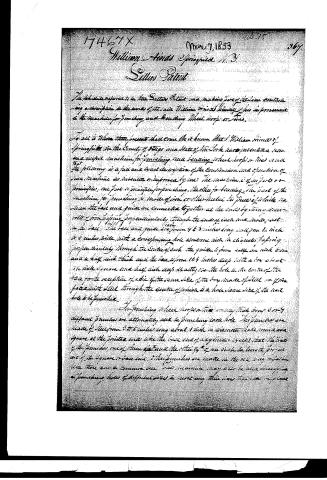
The above is referred to in the Letters Patent and making part of the same containing a description in the words of the said William Hinds himself of his improvement to the Machine for punching and bending sheet metal or tins.
To all to whom these presents shall come, be it known that I William Hinds of Springfield in the County of Otsego and State of New York have invented a new and useful machine for punching and bending sheet metal or tins and the following is a full and exact description of the construction and operation of said machine as invented or improved by me: The machine is of two parts or principles, one part or principle for punching, the other for bending. The part of the machine for punching is made of iron or other metal two pieces of which are made the base and guides connected together at the ends by strong iron rods or iron piping perpendicularly through the ends of each such metal part in the base. The base and guides are from 4 to 5 inches long and from 1 to 1 1/2 to 2 inches wide, with a corresponding hole about one inch in diameter piping perpendicularly through the center of each. The guides are from 1 inch to 1 1/2 and a half inch thick and the base is from 1 to 1 1/2 inches deep with a box about 1 1/2 inches square and a half inch deep exactly over the hole in the center of the base for the reception of the face of the same disc of the box made of steel or iron plate with steel through the center of which is a hole same size of the box hole to be punched.
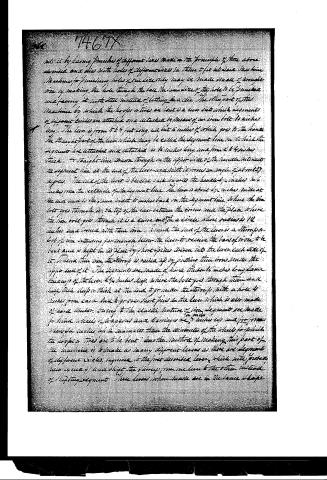
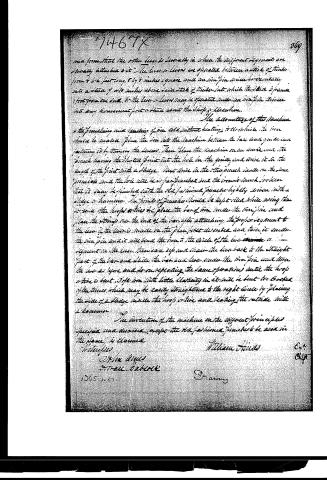
The punching wheel not being of any fixed form or any different punches are alternately set in punching each hole. The punches are made of steel from 3 to 5 inches long about 1 inch in diameter holes round and square at the pointed end like the base end of a cylinder except that the ends of the punches are of them set with the other 1/4 to 3/8 inch in length to project out of the box or base end. The punches are made in the old way of plain steel. There are no common use. The machine may also be used punching or punching holes of different sizes to suit any thing that can be punched.
Published accounts: journal notice
Notice in the monthly list of patents, with remarks
Journal of the Franklin Institute, new ser., vol. 12 (1833), p. 171 · View the page
11. For a Machine for punching and bending Wheel Hoops or Tires; William Hinds, Springfield, Otsego county, New York, March 7.
Remarks. The punching machine is merely a bed, to receive a piece of steel with a hole of the size required, and a second piece of iron perforated to serve as a guide to the punches to be used. The bending apparatus is intended to bend the tire without heating it. This consists merely of a lever, one end of which is placed under a staple, or stirrup, which is its fulcrum. The lower side of the lever, close to the fulcrum is to be made convex, or, to have convex pieces attached to it. The bed of the machine is of wood, and the iron to be bent is passed between the convex part of the lever and the wooden bed, where it will be bent by depressing the lever. "The invention of the machine, on the different principles specified and described, is claimed."
About this record
- Patentee
- DATAMP
- Date
- the Name and Date index of patents, DATAMP, USPTO records
- Invention
- DATAMP
- Listed in
- the Name and Date index of patents, DATAMP, USPTO records, Jim Shaw's X-patent list, the Journal of the Franklin Institute, Burke's List of Patents (1847)
- Burke's 1847 Patent Office list gives the same patent.