

Drawings and documents
National Archives restored drawings: drawing
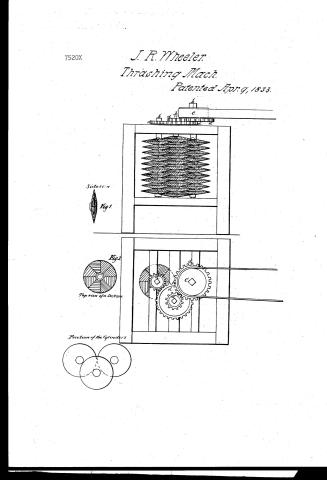
John R. Wheeler's Patent Drawing for a Thrashing Machine

National Archives, Restored Patent Drawings (Record Group 241) · Full-size scan at the National Archives · Catalog record
Show the text on the drawing Hide (132 words)
Words on the drawing as machine-read by the National Archives; not checked. Useful mainly for searching.
130. THRASHING. / Entered / Thrashing Machines. / A. Cylinder Machines. / 2- / John R. Whuler / CLASSIFICATION / 7520- X / LIVISION. / Thrashing Machine. / Vol.17. pg. 411 / Patented april 9. 1833. / Preferences. / Tig. 1. Sideview of Fig 2 Top view of a / Side view / castiron plate or ung, a section of the Cylinder. / a. a.a bylinders, composed of sections / o.ig.i. / as seenin Fig. 1 2.2. / b. b.b. their shafts / c the receiving cylinders with bardwheel. / d.d d d cogsoheels to duce the / to / increased motion. / 410 / Tig.2. / Topview of a section / Side-view. / this / Position of the cylinders. / nnh / Patent office / made under the direction of the Commisioner of Patents / -> / in conformity with act of 3 murch 1837 / FLE / Commitioner of Patents. / ch. L. Slischmann W: / Jop-view.
USPTO scan
The patent as scanned by the USPTO
-
 Page 1
-
 Page 2
-
 Page 3


U.S. Patent and Trademark Office · Google Patents
Show the transcription Hide (691 words)
Machine transcription (LightOnOCR) of the pages as scanned by the USPTO, most of them the handwritten copies made when the records were restored after the 1836 fire. Not checked; it can misread handwriting, so compare it with the scan.
Page 1.
7520X
J. R. Wheeler
Thrashing Mach.
Patented Apr. 9, 1833.

Side view
Fig. 1
Top view of a Section
Fig. 2
Position of the Cylinders
Page 2.
April 9, 1833
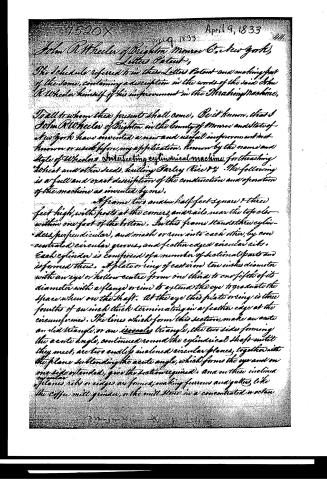
John R. Wheeler of Brighton, Monroe Co., New York,
Letters Patent,
The Schedule referred to in these Letters Patent and making part of the same, containing a description in the words of the said John R. Wheeler himself of his improvement in the Washing Machine.
To all to whom these presents shall come, Be it known, that I John R. Wheeler of Brighton in the county of Monroe and state of New York have invented a new and useful improvement not known or used before, my application, known by the name and style of Wheeler's Intersecting cylindrical machine for threshing wheat and other seeds, hulling barley, rice, etc. The following is a full and exact description of the construction and operation of the machine as invented by me.
A frame two and a half feet square & three feet high, with posts at the corners, and rails near the top also within one foot of the bottom. In this frame stand three cylinders perpendicular, and mesh or run into each other, by an intersected circular groove, and feather edged circular ribs. Each cylinder is composed of a number of sectional parts and is formed thus. A plate or ring of cast iron two inches diameter with an eye or hollow centre from one third to one fifth of its diameter with a flange or rim to extend the eye to granulate the space when on the shaft. At the eye this plate or ring is three fourths of an inch thick terminating in a feather edge at the circumference. The lines which form this section, make an acute or obtuse triangle, or an isosceles triangle, the two sides forming the acute angle, continued round the cylindrical shaft until they meet, are two endless inclined circular planes, together with the plane subtending the acute angle, which forms the eye and on one side extended, give the section required, and on these inclined planes ribs or ridges are formed, making furrows and gutters like the coffee mill grinders, or the mill stone in a concentrated motion.
Page 3.
regular tangential ridges and grooves. Each cylinder is composed of a number of the above sections, and when closely connected on the shaft are parallel among themselves forming equal channels or ridges. These cylinders may be increased to any size or length, that fancy may dictate, the one adapted is from 1 foot to fifteen inches long, the smallest for practical use. Two of these cylinders are placed to run side to side and so close as not to interfere. The third must intersect its beveled edge side, with the channels of both the other equally leaving room only between the beveled groove and side for the grain to pass without breaking it. These cylinders when in operation should equally move without interfering one with another when geared by cog and spur wheel, to graduate their several movements, so that when the power is applied either by water, steam, horse, or otherwise to one of the receiving cylinders, the other will move as soon as the third which receives the straw after it passes the others, moves as soon as one with the second.
All the above I claim together with the privilege of varying the proportion of the said machine in construction or making the cylinders of wrought or cast iron, or changing them from a perpendicular to a horizontal position as my fancy may dictate provided always I keep within the principles of my invention. In testimony whereof I the said John A. Wheeler have hereunto set my hand and seal this twenty-fifth day of March one thousand eight hundred and thirty-two.
Witnesses
J. L. D. Mathias
William Whiting
John A. Wheeler
Filed May 6.
Patented 9th Apr 1833
(6 yr. unites)
Published accounts: journal notice
Notice in the monthly list of patents, with remarks
Journal of the Franklin Institute, new ser., vol. 12 (1833), p. 237 · View the page
15. For a Thrashing Machine; John R. Wheeler, Brighton, Monroe county, New York, April 9.
Remarks. This is called an intersecting cylinder thrashing machine, and it has the rare merit of differing entirely in its construction not only from the great mass of those which have been patented, but, we believe, from the whole of them. We are not, however, prepared to speak with equal confidence of its superior utility, as upon this point we entertain strong doubts. Disks of cast iron are to be made, which may be ten inches in diameter, three-fourths of an inch thick in the middle, tapering regularly on each side from the centre towards the edge, so as to form a feather edge. Each of the sides is to be furnished with angular grooves, or ridges, radiating from the centre to the periphery. A shaft is passed through holes in the centre of these disks, such number of them being put on as to form a cylinder of fifteen, or more, inches in length. Of these cylinders there are to be three, which are to be so mounted on their gudgeons as that the disks shall interlock without touching; the shafts occupying the position of the three angles of an equilateral triangle. The cylinders are to revolve with different velocities, and between them the straw to be thrashed is to be passed. We can very well perceive how the disks of two of the cylinders may interlock, but how those of the third one, behind them, is to do so with the two others we cannot very well understand; it appears, however, that some how or other it is to be done. The specification is drawn up with some show of learning. There is much said about angles and triangles, and "two endless, inclined, circular planes, together with the planes subtending the acute angle which forms the eye on one side extended, gives the action required."
About this record
- Patentee
- DATAMP
- Date
- the Name and Date index of patents, DATAMP, USPTO records
- Invention
- DATAMP
- Listed in
- the Name and Date index of patents, DATAMP, USPTO records, Jim Shaw's X-patent list, the Journal of the Franklin Institute, Burke's List of Patents (1847)
- Burke's 1847 Patent Office list gives the same patent.