

Drawings and documents
National Archives restored drawings: drawing
Joseph Ross' Patent Drawing for a Machine for Shelling Corn

National Archives, Restored Patent Drawings (Record Group 241) · Full-size scan at the National Archives · Catalog record
Show the text on the drawing Hide (123 words)
Words on the drawing as machine-read by the National Archives; not checked. Useful mainly for searching.
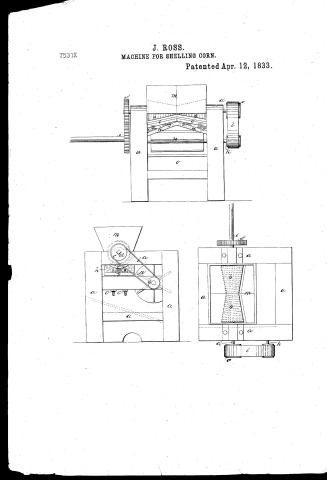
130. / 130. THRASHING. / [59] / Corn Shellers. / Breast and Cylinder. / $30 / Joseph Ross. / Br+cyl of / CLASSIFICATION / 7531.x / Nachine for Thelling born. / DIV ISION. / Nol.17. ps. 285 / Patented april 12th 1833. / "R / References. a. a.a.a frame. 66. cones covered with pins. C.C. concave bcds. d'o'regulating Prant offier March 11- 1842. / screws. daxle e whire K. cagwhel g.g.g.g. springs. hh board for the beds made under th direction the Commitionerat / to ust upon. i cograhed from driving power. k whire of the fan / band. - Patents IN conforming with act of 3.4 March 1837 / m Hopper .n fan. o inclined board. / nd Eunorth / ched, Michmann froit / Commin. oner of Patents.
USPTO scan
The patent as scanned by the USPTO
-
 Page 1
-
 Page 2
-
 Page 3


U.S. Patent and Trademark Office · Google Patents
Show the transcription Hide (738 words)
Machine transcription (LightOnOCR) of the pages as scanned by the USPTO, most of them the handwritten copies made when the records were restored after the 1836 fire. Not checked; it can misread handwriting, so compare it with the scan.
Page 1.
7531X
J. ROSS.
MACHINE FOR SHELLING CORN.
Patented Apr. 12, 1833.

Page 2.
April 12, 1833
7531X Joseph Ross
Letters Patent.
The schedule referred to in these Letters Patent, and making part of the same, containing a description in the words of the said Joseph Ross, himself, of his improvement in the Machine for shelling corn.
To all whom it may concern, Be it known that J. Joseph Ross, of Bountbrook, Somerset County, New Jersey, have made an improvement in the machine for shelling corn which is described as follows. This Machine consists of the following principal parts, viz. The frame which supports, and contains the Machinery, the two frustums of cones, covered with pins or projections; the cone and beds, covered with sheet iron, in which the cones work; the spring for pressing the beds towards the cones; and the gearing by which the Machinery is turned. The frame is constructed by mortising and tenoning together four posts, two side pieces, two end pieces, and a frame around the top so as to produce a square, or parallelogram figure, of sufficient size, to receive the several parts of the Machinery. The two frustums of cones are placed with their apexes joined in the center, and they are covered all over with pins or projections, at a proper distance apart for rubbing out the corn; they turn on an axle, supported in boxes in the frame. This axle is prolonged to receive a wheel, and any wheel taken hereafter desired, these frustums of cones may be made of wood, and covered with cast iron plates, having projections on them instead of pins, driven into it as before described; or it may be cast wholly of iron and projections or teeth, on its outer surface. A cone bed is placed against each cone of the same elevation as the cone, and intended to admit of its turning freely in its two or more springs, and placed behind said bed, which press it against the cone. The support of these cone and beds, consists of two broad pieces of timber, placed in a slanting position from the center of the machine, having
Page 3.
having a number of openings through them, to admit the grains of corn to fall through; which pieces of timber with the cones are brought nearest to, or farther from the cones by screw bolts, passing through their ends, and the side pieces of the frame. The gearing for turning the Machinery, is a small cogwheel, and a wheel, placed on the same axle, with the cones. This cogwheel works into another cogwheel, placed on the axle of the driving power; another wheel is placed on an axle, at the hinder end of the frame, for turning a panning mill;—a band proper round this wheel and that, upon the axle of the double cone. A Hopper is placed in the centre, and above the double cone, for receiving the ears of corn. An inclined board, is placed below the double cone, and beds, to receive the corn as it is shelled, and to conduct it to the end of the Machine, where the pan is placed. The winnowing Machine, is made, and acts in the usual manner. Operation:—The Hopper being filled, and the Machine put in Motion by any convenient power, the ears descend between the cones, and beds where the grains are rubbed off, by the projections or pins. The grain, descending down the inclined plane, to the winnowing Machine, and the chaff flying out at the sides of the Machine. The invention here claimed, and devised to be secured by Letters Patent, consists, of the combination and arrangement of the several parts of the before described Machine for shelling corn; but particularly the two frustums of cones, united in the centre, and armed with teeth, or projections. No claim is made to the other parts of the Machine taken separately. For a further illustration of my invention, I refer to the model and drawing of the same deposited in the Patent Office. In testimony whereof, I hereunto subscribe my name, this 6th day of April 1833.
Witnesses,
William P. Collett
Thomas A. Collett
Joseph Ross
(Granted April 10, 1833.)
Published accounts: journal notice
Notice in the monthly list of patents, with remarks
Journal of the Franklin Institute, new ser., vol. 12 (1833), p. 241 · View the page
22. For a machine for Shelling Corn; Joseph Ross, Boundbrook, Somerset county, New Jersey, April 12.
Remarks. The corn is to be put into a hopper, against the open end of which there revolves on its axis a sheller, set with spikes, which is in the form of a double cone, truncated, and joined together at its smaller ends. A concave is borne up against each of these cones, by appropriate springs, and between these and the cones, the corn is to be shelled, the grain falling through suitable openings, and the cobs passing off at either end. The chaff is to be blown away by a wind wheel. The claim is to the combination of the several parts of the machine, and particularly to the two frustrums of cones united in the centre; no separate part, with the exception of this, being claimed. The machine, as represented, appears to us to possess one great defect, and this is in the feeding part; the corn is to be put into a hopper, and we see nothing to prevent its passing in endways instead of longitudinally, the only way in which the shelling can be effected.
About this record
- Patentee
- DATAMP
- Date
- the Name and Date index of patents, DATAMP, USPTO records
- Invention
- DATAMP
- Listed in
- the Name and Date index of patents, DATAMP, USPTO records, Jim Shaw's X-patent list, the Journal of the Franklin Institute, Burke's List of Patents (1847)
- Burke's 1847 Patent Office list gives the same patent.