

Drawings and documents
National Archives restored drawings: drawing
Thomas P. Codman's Patent Drawing for a Machine for Harnessing Air, Water, and Animal Power


National Archives, Restored Patent Drawings (Record Group 241) · Full-size scan at the National Archives · Catalog record
Show the text on the drawing Hide (188 words)
Words on the drawing as machine-read by the National Archives; not checked. Useful mainly for searching.
Sheet 1. CLASS 103. PUMPS, / I. P. Codman / Sheet3-3 Sheets, / Solid Reciprocating / p.4 / .3. / to / Multiple / 148] / Air: Water and Animal Pawer / Patented Apr:20 1833 / Class 103 PUMPS. / CLASSIFICATION / youble Cylinder. / 7548. / DIV ISION. / Fif.3. / Fiff.4.
Sheet 2. CLASS 103. PUMPS, / 10303 / Solid Reciprocating Piston, / TION / Multiple Cylinder / I.P.Codman / Sheet 2-3 Sheets - P.499 / 4548-X / ON. / Air Water and Animal Power / Patented Apr, 20, 1833 / Fided, / 10 / 11 / OC
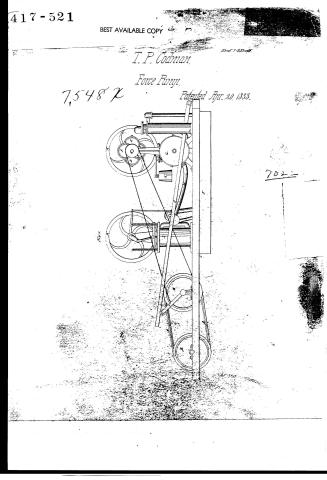
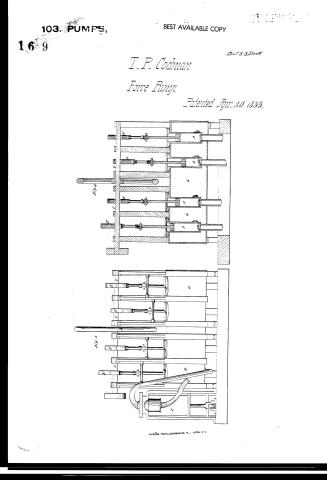
Sheet 3. CLASS 103 PUMPS, / 9. / ating Piston, / MultiplerCynnaer / Thomas P. Codman / Sheet 1. 3Sheets. / Vol.L6.p.499. / the / CLASSIFI CATION / Air Water and and Animal Power. / 7548-X / Patented / IIV ISION. / References, / Fift. Side view, / Fidid. Top view, Fid.3, front view of Pumps, / Fid. 4; Section of Pamps & / Fift / B. Drums. CHorizontal shapt. D. foring pumps, / A.Horse power or avolving pla Hom, / E. excentries, Ecistern, a. cylinder H tabe from / cylinder G. to working cylinder I.-K. / Is. an air pump- M.Safety value. Noright / O. lever to work air pinnp. / E, / THE / Patent Office March 11 1842 / Made under the direction of the Commispioner of Fatuls / in conformity with act of Congreps Ii March 1837 / IL Sumorth / of Patents,
USPTO scan
The patent as scanned by the USPTO
-
 Page 1
-
 Page 2
-
 Page 3
-
 Page 4
-
 Page 5


U.S. Patent and Trademark Office · Google Patents
Show the transcription Hide (561 words)
Machine transcription (LightOnOCR) of the pages as scanned by the USPTO, most of them the handwritten copies made when the records were restored after the 1836 fire. Not checked; it can misread handwriting, so compare it with the scan.
Page 1.
417-521
BEST AVAILABLE COPY
T. P. Codman,
Force Pump,
7,548 X
Patented Apr. 20, 1833.
Sheet 1-3 Sheets
702
Page 2.
103. PUMPS,
169
BEST AVAILABLE COPY
Sheet 2 of 2 Sheets
T. P. Codman
Force Pump
Patented Apr. 20, 1833.
Fig. 2
A. PETERS, PHOTO-LITHOGRAPHER, WASHINGTON D.C.
Page 3.
103. PUMPS.
BEST AVAILABLE COPY
Sheet 3 of 3 Sheets
T. P. Codman
Force Pump
Patented Apr. 20, 1833.

Page 4.
7548X Apr 20, 1833 499
Thomas P. Edman
Letters Patent
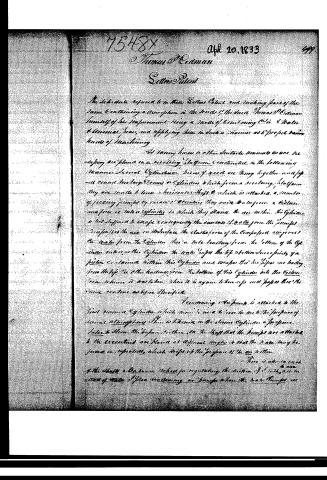
The scheme referred to in these Letters Patent and making part of the same containing a description in the words of the said Thomas P. Edman himself of his improvement being a mode of executing Cylinders & Water & Steam Engines, and applying them in such a manner as to propel various kinds of Machinery.
As many letters or other patents remain as are necessary are placed in a revolving platform constructed in the following manner. Several Cylindrical boxes of wood are hung together and fastened round the large domes or Cylinders which form a revolving platform. They are attached to a horizontal shaft to which is attached a number of screwing pins by means of which they raise the platform a certain number of inches or into a cylinder in which they stand. The air within the cylinders is not suffered to escape consequently the vacuum of water from the principle disposes the air on the surface. The elastic force of the compressed air forces the water from the Cylinder into a tube leading from the bottom of the Cylinder into another Cylinder. The water pushes the top & bottom surfaces of a piston contained within this Cylinder and escapes this two pipes are leading from the top & the bottom from the bottom of this Cylinder into the bottom from whence it was taken, then it is again taken up and passes through the same routine as before specified.
The revolving platform is attached to the first named Cylinder which serves to raise & lower the air to the purpose of several atmospheres. There is likewise on the same Cylinder a pressure lever to draw the platform within the shaft that the pumps are attached to the eccentric are placed at different angles so that the water may be forced in repeatedly which keeps up the pressure of the air within.
There is also on each of the shafts a Brass valve for regulating the suction. If I wish to use the water I place the platform containing the pumps where the water pumps are
Page 5.
15484
situated in a ship's frame with the Water Pump & Water the Air acting in the Cylinder the Steam on the Water, Any Machine the propeller may be attached either by Gears or Belts to the piston rod or a Shaft of the kind named Cylinder & the Velocity may be increased or decreased by increasing or decreasing the size of the Steam that the Bands run on.
That I claim as my improvement & necessary to the invention herein described & consisting & also of varying the herein specified forms & as a proper various kinds of Machinery
Thomas P. Coleman
Witnesses
Charles Hushaw 3
John Hushaw 3
5074 0585
Published accounts: journal notice
Notice in the monthly list of patents, with remarks
Journal of the Franklin Institute, new ser., vol. 12 (1833), p. 248 · View the page
41. For apparatus for Propelling various kinds of machinery; Thomas L. Codman, Boston, Massachusetts, April 20.
Remarks. Among the powers employed by the mechanician to give motion to instruments of various kinds, those of air, water, and animal strength, stand conspicuous; but, in general, he uses only but one of these at a time, as it is, in most cases, a thing of no small difficulty to bring them into accordance with each other, in the production of a single effect. It is the province of genius, however, to bring together, in harmonious conjunction, things which common minds would consider as incompatible, and therefore scarcely dream of placing in juxtaposition. Such a rare combination has been effected in the machine, or concatenation of machines, which is the subject of the patent before us. Horses, water, and air, and sometimes manual power also, are each to furnish their quota in making up the sum total of the power which is to be engendered. Some parts of the affair, as described, appear, it is true, rather enigmatical; but at this we ought not to be greatly surprised, as it is no new thing to assume this style in the first introduction of new and important truths. Being fearful of undertaking to epitomize the patentee's description in any considerable degree, we will give his own account of the thing, in nearly his own words. As many horses, or other animals, as may be desired, are to be placed upon an inclined movable floor, causing a shaft and drum to revolve in the usual way. The shaft is to turn a number of eccentrics, each of which is to operate upon a forcing pump, by which water is to be raised from a cistern, and forced into a cylinder. The air in the cylinder must not be allowed to escape, but is to become condensed by the continued forcing in of the water. The air, so compressed, is to force the water from the cylinder through a tube leading from the bottom of the first into the bottom of a second cylinder; in this it is alternately to compress the bottom and top of a piston, and is to escape therefrom through two pipes, one leading from the top and the other from the bottom of this second cylinder, by both of which it is to be returned into the cistern from which it was first taken, and to be there in readiness to pass again through the same routine. To the first named cylinder, which is represented in the drawing as standing horizontally, like those of steam engine boilers, a condensing pump is to be attached to force in air, the pressure of which may be made equal to that of several atmospheres. The eccentrics before named, operating as cranks, are to be placed on one common shaft, so as to act alternately, to keep the supply of water, and the pressure equal. Fly wheels are to be employed to regulate the motion. When air alone is to be used, the water pumps are to operate as condensing air pumps, " the air acting in the cylinder the same as the water." The machine to be propelled may be attached to the shaft, or piston rod of the second cylinder, drums and bands being used to increase or decrease the velocity, by varying their size. The claim is to the " manner herein described of combining and applying the herein specified powers so as to propel various kinds of machinery."
About this record
- Patentee
- DATAMP
- Date
- the Name and Date index of patents, DATAMP, USPTO records
- Invention
- DATAMP
- Listed in
- the Name and Date index of patents, DATAMP, USPTO records, Jim Shaw's X-patent list, the Journal of the Franklin Institute, Burke's List of Patents (1847)
- Burke's 1847 Patent Office list gives the same patent.