

Drawings and documents
National Archives restored drawings: drawing
Strong and Moody's Patent Drawing for a Rice Machine

National Archives, Restored Patent Drawings (Record Group 241) · Full-size scan at the National Archives · Catalog record
Show the text on the drawing Hide (69 words)
Words on the drawing as machine-read by the National Archives; not checked. Useful mainly for searching.
83. MILLS. / K Faci / Grain Scourers. / STRONG & MOODY S / 12- / Disk Face. / Rice-Ma. / april 26. / Patented 1833. / CLASSIFICATION / 7556.+ / DIVISION. / coverew mits / x10 / Schoolms anbalance / mery on ther / covered with / may / RICE MACHINE. / A. The References. upper cast iron Cylinder. / Wooden sheathing ng covered on its surface with some sharp Substance. / DRAWN BY / W.F.PRATT.
USPTO scan
The patent as scanned by the USPTO
-
 Page 1
-
 Page 2
-
 Page 3
-
 Page 4


U.S. Patent and Trademark Office · Google Patents
Show the transcription Hide (958 words)
Machine transcription (LightOnOCR) of the pages as scanned by the USPTO, most of them the handwritten copies made when the records were restored after the 1836 fire. Not checked; it can misread handwriting, so compare it with the scan.
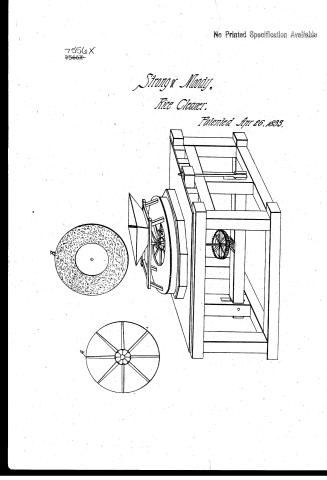
Page 1.
No Printed Specification Available
7556X
566X
Strong & Moody,
Rice Cleaner.
Patented Apr 26, 1833.
Page 2.
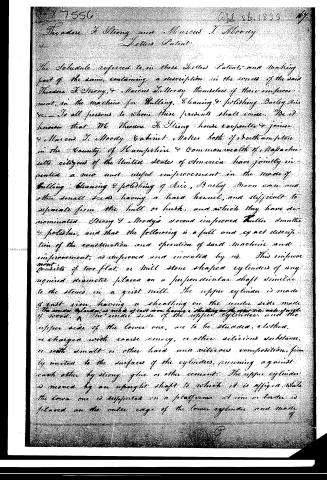
Theodore H. Strong and Marcus T. Moody
Letters Patent
The Schedule referred to in these Letters Patent, and making part of the same, containing a description in the words of the said Theodore H. Strong, & Marcus T. Moody themselves of their improvement, in the machine for Hulling, Cleaning & polishing Barley, Rice, &c.—To all persons to whom these presents shall come. Be it known that We Theodore H. Strong house carpenter & joiner & Marcus T. Moody Cabinet Maker both of Southampton in the County of Hampshire & Commonwealth of Massachusetts citizens of the United States of America have jointly invented a new and useful improvement in the mode of hulling, cleaning & polishing of Rice, Barley, Brown corn and other small seeds having a hard kernel, and difficult to separate from the hull or husk, and which they have denominated Strong & Moody’s second improved Huller, Smutter & polisher, and that the following is a full and exact description of the construction and operation of said machine and improvement, as improved and invented by us. This improvement consists of two flat, or Mill Stone shaped cylinders of any required diameter placed on a perpendicular shaft similar to the stones in a quist mill. The upper cylinder is made of cast iron, having a sheathing on the under side made of wood. The under cylinder is made of cast iron having a sheathing on the upper side made of wood. The under side of the upper cylinder, and the upper side of the lower one, are to be studded, clothed, or charged with coarse emery, or other silicious substance, or with smalt or other hard and vitreous composition, firmly united to the surfaces of the cylinders, pressing against each other by strong glue or other cement. The upper cylinder is moved by an upright shaft to which it is affixed, while the lower one is supported on a platform or rim or border is placed on the outer edge of the lower cylinder and made
Page 3.
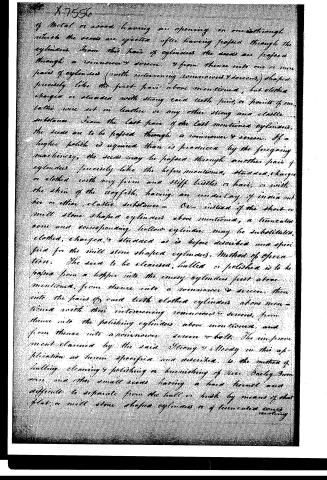
of metal or wood having an opening on one end through which the seeds are ejected after having passed through the cylinders. From this pair of cylinders the seeds are passed through a winnower & screen, & from thence into one or more pairs of cylinders (with intervening winnowers & screens) shaped precisely like the first pair above mentioned, but either charged or studded with strong cord teeth, pins, or points of metallic wire set in leather or any other strong and elastic substance. From the last pair of the last mentioned cylinders, the seeds are to be passed through a winnower & screen. If a higher polish is required than is produced by the foregoing machinery, the seeds may be passed through another pair of cylinders precisely like the before mentioned, studded, charged, or clothed with any firm and stiff bristles or hair, or with the skin of the dogfish, having an underlay of india rubber or other elastic substance. Or instead of the short or mill stone shaped cylinders above mentioned, a truncated cone and corresponding hollow cylinder may be substituted, clothed, charged, & studded as is before described and specified for the mill stone shaped cylinders. Method of Operation. The seed to be cleansed, hulled, or polished is to be passed from a hopper into the empty cylinders first above mentioned, from thence into a winnower & screen, then into the pairs of cord tooth clothed cylinders above mentioned with their intervening winnowers & screens, from thence into the polishing cylinders above mentioned, and from thence into a winnower screen & bolt. The improvement claimed by the said Strong & Moody in this application as herein specified and described, is the method of hulling, cleaning & polishing or hussing of rice, barley, corn, and other small seeds having a hard hull and difficult to separate from the hull or husk by means of flat, or mill stone shaped cylinders, or of truncated cones revolving.
Page 4.
K7356
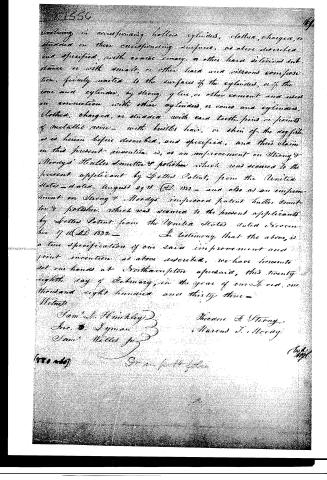
including in corresponding hollow cylinders, clothes, charges, or slivers on their corresponding surfaces, as above described and specified, with coarse emery, or other hard silicious substance or with small, or other hard and vitreous composition, firmly united to the surface of the cylinders, or of the cone and cylinder, by strong glue, or other cement and also in connection, with other cylinders, or cones and cylinders, clothed, charged, or slivered with each teeth, pins or points of metallic wire, with bristles hair, or thin of the agafite, as is herein before described, and specified, and their claim in this present invention, is, as an improvement on Strong & Morry's Huller Smutter & polisher which was secured to the present applicant by Letters Patent, from the United States—dated, August 29th A.D. 1832—and also as an improvement on Strong & Morry's improved patent huller smutter & polisher, which was secured to the present applicants by Letters Patent from the United States dated September 17th A.D. 1832—
In testimony that the above, is a true specification of our said improvement and joint invention as above described, we have hereunto set our hands at Southampton aforesaid, this twenty-eighth day of February, in the year of our Lord one thousand eight hundred and thirty-three—
Witness
Sam'l. S. Hinckley
Geo. O. Symon
Sam'l. Meller Jr.
Theodore A. Strong
Mareus J. Morry
(770 mds)
Dr. my fath folio
Published accounts: journal notice
Notice in the monthly list of patents, with remarks
Journal of the Franklin Institute, new ser., vol. 12 (1833), p. 252 · View the page
48. For Hulling and Cleaning Rice, Barley, Broom Corn, and other small seeds; Theodore F. Strong, and Marcus T. Moody, Northampton, Hampshire county, Massachusetts, April 26.
Remarks. This patent is said to be taken for an improvement upon Strong and Moody's Huller, Smutter, and Polisher, patented on the 17th of November, 1832. The seeds are to be sent first through two revolving rubbers, in the form of mill stones, which are to be disks of cast iron, faced with wood, upon which is glued emery, or other hard substance; after this, through a similar apparatus, covered with card teeth, or something analogous; and then through another covered with bristles. Suitable sieves, or riddles, are also provided, and employed after each of these operations. Instead of rubbers in the mill stone form, it is proposed sometimes to use a truncated cone, and a corresponding hollowed piece, to be covered, however, as above described. The whole apparatus is very much like that referred to as the subject of the former patent, and although this is said to be for an improvement thereon, we are not informed in what the improvement consists; nor is there any drawing of the improved parts. Now, as the patent appears to be for the instrument used, this ought to have been delineated; it can scarcely be pretended that the patent is for a process merely, for there is nothing new in the simple fact of cleaning small seeds, although there may be in the mode of doing it; but this mode must be by particular machinery, which "admits of drawings."
About this record
- Patentee
- DATAMP
- Date
- the Name and Date index of patents, DATAMP, USPTO records
- Invention
- DATAMP
- Listed in
- the Name and Date index of patents, DATAMP, USPTO records, Jim Shaw's X-patent list, the Journal of the Franklin Institute, Burke's List of Patents (1847)
- Burke's 1847 Patent Office list gives the same patent.