

Drawings and documents
National Archives restored drawings: drawing
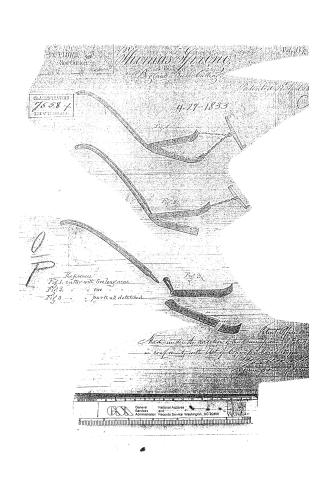
Thomas Spring's Patent Drawing for Bog Cane and Bush Cutting

National Archives, Restored Patent Drawings (Record Group 241) · Full-size scan at the National Archives · Catalog record
Show the text on the drawing Hide (74 words)
Words on the drawing as machine-read by the National Archives; not checked. Useful mainly for searching.
97, PLOWS, / Sod Cutters. / Thomas Spring: / Vol. 16.70.107, / Bogane Bush Cutting: / Patented 27th April 1833, / CLASSIFICATION / 7558-X / DIVISION. / Fig.1. / 000 / Fig.2. / 2, / References. / Fid 3, Fid, 3, / Fig1, cutter with two longarms. arms. / Fig.2. / one / Fig3 " : parts all detatched / Patent Offin Mar17. 1842 / Mad under the direction of the Commision of Patrent / in couf onnity with act of boyrep March 1837, / ML Ellmorth / Commision of Pathets,
USPTO scan
The patent as scanned by the USPTO
-
 Page 1
-
 Page 2
-
 Page 3


U.S. Patent and Trademark Office · Google Patents
Show the transcription Hide (694 words)
Machine transcription (LightOnOCR) of the pages as scanned by the USPTO, most of them the handwritten copies made when the records were restored after the 1836 fire. Not checked; it can misread handwriting, so compare it with the scan.
Page 1.
Thomas Spring
Boston, Mass.
Patented 4-27-1833
Fig. 1
Fig. 2
Fig. 3
References:
Fig. 1, cutter with two long arms.
Fig. 2, " " one " "
Fig. 3, " " parts all detached
Made under the direction of the Commissioner of Patents
in conformity with the Act of Congress March 3, 1831.
General Services
Administration
National Archives
Records Service
Washington, DC 20408
Page 2.
X7558
Thomas Spring, of Granby (Conn.)
Letters Patent
The schedule referred to in these Letters Patent, and making part of the same, containing a description in the words of the said Thomas Spring himself of his improvement in the machine for cutting up & destroying logs & brush.
To all to whom these presents shall come: Be it known that I, Thomas Spring of Granby, in the County of Hartford & State of Connecticut, have invented a new & useful improvement in cutting up & destroying logs & brush, called the American bush & log cutter, & that the following is a full & exact description of the construction & operation of the said machine, as invented by me. This machine or instrument is formed by two blades or cutters, made of steel & iron or steel only with the edges turned inwards of convenient lengths & connected by screws at one end & diverging so that the two blades in form resemble the letter V. The diverging ends are bent or curved upwards near the extremities so as to elevate them above the surface of the ground having therein loops or holes to which the propelling power may be connected.
At the converging end of one of the cutters, there is made a socket bending upwards for the insertion of the handle by which to direct & apply the instrument. The other blade or cutter is like this, except that it is made without a socket, whole or in two pieces united by screws. This is attached to the other blade or cutter, between the socket & the edge by screws. Several holes are made at the point of junction & at various distances, from the sides of the blades or cutters so that by shifting the screws into them the distance between the blades or cutters may be increased or diminished, & their position be made more or less diverging. The upper end of the blade or cutter which consists of two parts united by screws or rivets may be taken off at pleasure. & the instrument will be drawn or impelled by power applied to the end of the longest blade, instead of the ends of both.
Drawing
Page 3.
108. X 7558
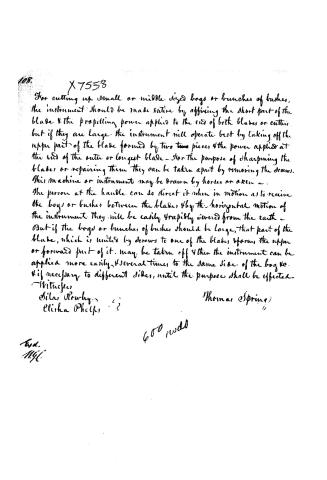
For cutting up small or middle sized bogs or bunches of bushes, the instrument should be made entire by affixing the short part of the blade & the propelling power applied to the end of both blades or cutters. but if they are large, the instrument will operate best by taking off the upper part of the blade formed by two pieces & the power applied at the end of the outer or longest blade. For the purpose of sharpening the blades or repairing them they can be taken apart by removing the screws. This machine or instrument may be drawn by horses or oxen.
The person at the handle can so direct it when in motion as to receive the bogs or bushes between the blades & by the horizontal motion of the instrument they will be easily & rapidly severed from the earth.
But if the bogs or bunches of bushes should be large, that part of the blade, which is united by screws to one of the blades & forms the upper or forward part of it, may be taken off & then the instrument can be applied more easily, & several times to the same side of the bog & if necessary to different sides, until the purpose shall be effected.
Witnesses
Silas Rowley
Elisha Phelps
Thomas Spring
600 rods
End.
M.H.
Published accounts: journal notice
Notice in the monthly list of patents, with remarks
Journal of the Franklin Institute, new ser., vol. 12 (1833), p. 253 · View the page
51. For a Machine for Cutting Bogs and Bushes; Thomas Spring, Granby, Hartford county, Connecticut, April 27.
Remarks. We thought that bogs were bogs, and that bushes were bushes; that the latter might be cut, and that the former might be drained; but it seems, by the specification before us, that bogs are bushes, and bushes are bogs; or, in other words, that the terms are convertible, and that both of them may be cut by a patented instrument. This instrument is to be in the form of the letter V, the two branches consisting of blades, or knives, with their cutting edges inwards. To the ends of these, horses or oxen are to be attached, and when drawn forward, the bogs, or bushes, collected between them are to be cut down. A handle, or guide, is to be fixed in a socket, leading back from the angular point. The blades are made capable of being set nearer together, or wider apart, being furnished with screws at the angular junction, for that purpose.
About this record
- Patentee
- DATAMP
- Date
- the Name and Date index of patents, DATAMP, USPTO records
- Invention
- DATAMP
- Listed in
- the Name and Date index of patents, DATAMP, USPTO records, Jim Shaw's X-patent list, the Journal of the Franklin Institute, Burke's List of Patents (1847)
- Burke's 1847 Patent Office list gives the same patent.