

Drawings and documents
National Archives restored drawings: drawing
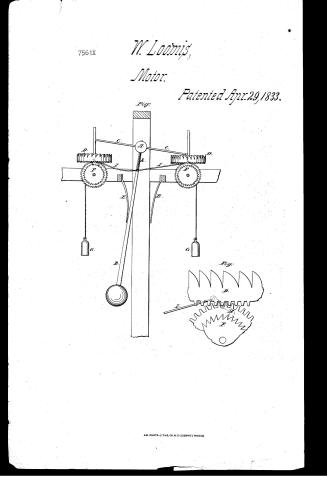
W. Loomis' Patent Drawing for a Machine for Helping Power

National Archives, Restored Patent Drawings (Record Group 241) · Full-size scan at the National Archives · Catalog record
Show the text on the drawing Hide (84 words)
Words on the drawing as machine-read by the National Archives; not checked. Useful mainly for searching.
POWERS / 185. MECHANICAL Weight. MOTORS. / W. LOOMIS / Helping Power / Patented 29 / CLASSIFICATION / Apr.29,1833 / 4561- X / DIV ISION / Detail / A Arbor / B. Pendulum / C. Arms / D. CTOWN Wheels / E. springs / F! Ratchet Wheels Pinious / MANA / G. Weights / H. Dog / I Chain or Rod / K. pin 07 Bolt / Strickland Del's / Patent Office sep 2.183, / Made under the dinetion of the commissioner of Datiats / in conformity with act of 3 March 1837 / HenryL Sumorth / Commigiouer faturts
USPTO scan
The patent as scanned by the USPTO
-
 Page 1
-
 Page 2
-
 Page 3


U.S. Patent and Trademark Office · Google Patents
Show the transcription Hide (430 words)
Machine transcription (LightOnOCR) of the pages as scanned by the USPTO, most of them the handwritten copies made when the records were restored after the 1836 fire. Not checked; it can misread handwriting, so compare it with the scan.
Page 1.
7561X
W. Loomis,
Motor.
Patented Apr. 29, 1833.
Fig.

Fig.

AM. PHOTO-LITHO. CO. N.Y. (OSBORNE'S PROCESS)
Page 2.
William Loomis 7561X 4-29-1833
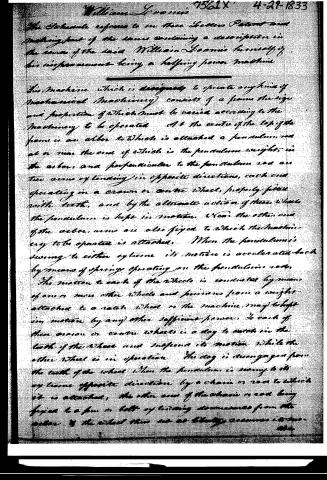
The following reference is in the Letters Patent and making part of the same containing a description in the name of the said William Loomis himself of his improvement being a helping power machine.
This machine which is designed to operate any kind of mechanical machinery consists of a frame the size and proportion of which must be varied according to the machinery to be operated. At the center of the top of the frame is an arbor to which is attached a pendulum rod at or near the end of which is the pendulum weight; in the arbor, and perpendicular to the pendulum rod are two arms extending in opposite directions, each one operating in a crown or center wheel, properly fitted with teeth, and by the alternate action of these wheels the pendulum is kept in motion. Near the other end of the arbor, arms are also fixed to which the machinery to be operated is attached. When the pendulum is swung to either extreme its motion is accelerated back by means of springs operating on the pendulum rod.
The motion to each of the wheels is conducted by means of one or more other wheels and pinions from a weight attached to a rack wheel in the machine, may be kept in motion by any other sufficient power. To each of these crown or center wheels is a dog to catch in the teeth of the wheel and suspend its motion while the other wheel is in operation. The dog is swung from the teeth of the wheel when the pendulum is swung to its extreme opposite direction by a chain or rod to which it is attached, the other end of the chain or rod being fixed to a pin or bolt of levers descending from the center of the wheel thus we are thereby assured of no
Page 3.
Motion of the wheel is again held in check by the stay. Thus by the alternate action of the wheels, the motion communicated to the pendulum is continued until the weight is run down.
Witnesses
H.B. William P. Elliot
Wm. Charles Duffnich Jr
William Loomis
(Or in Portfolio)
(390 units)
Published accounts: journal notice
Notice in the monthly list of patents, with remarks
Journal of the Franklin Institute, new ser., vol. 12 (1833), p. 254 · View the page
The structure of the claim is such as to confine the right to the general arrangements, substantially, as in this must be found whatever of novelty the machine may possess. The following quotation will serve as an exemplification. "And this applicant, hereby claiming his patent for the combination described, as included in one frame, substantially as the same is above described, hereby further declares that he purposes taking a patent for each of the several parts of his said improvement, or combination; that is, for the combination nation of the sweep with the perpendicular saw, or saws, and the scales therewith used, constructing and operating substantially as above described," &c. &c. When these separate patents are obtained, they will afford the proper opportunity of remarking upon whatever may be considered as essentially novel in principle, as regards the inventions of the patentee, and until then we necessarily postpone any such investigation. 54. For a Helping Power Machine; William Loomis, Ashford, Windham county, Connecticut, April 29.
Remarks. We are determined to speak a word in good time on behalf of the patentee of this invention, who will certainly, at an early period, require more help should he attempt to carry his scheme into operation; for, without some extraneous aid, his machine will not only itself stop, but will actually arrest or retard the motion of any other machinery to which it may be applied; or in the words of an old song of an inhabitant of the Emerald Isle, it will "Help the work forward with backward assistance now." A pendulum, with a heavy weight on its end, is to be suspended to a horizontal shaft, and this pendulum is to be aided in its oscillations by two springs against which its rod is to strike, in passing either way. Two ratchet or escapement wheels, upon the pendulum shaft, acting in reversed directions, are to have maintaining weights, which when wound up are to keep the pendulum in motion, and the power thus obtained is to be applied from the pendulum shaft to the propelling of other machinery.
About this record
- Patentee
- DATAMP
- Date
- the Name and Date index of patents, DATAMP, USPTO records
- Invention
- DATAMP
- Listed in
- the Name and Date index of patents, DATAMP, USPTO records, Jim Shaw's X-patent list, the Journal of the Franklin Institute, Burke's List of Patents (1847)
- Burke's 1847 Patent Office list gives the same patent.