

Drawings and documents
National Archives restored drawings: drawing
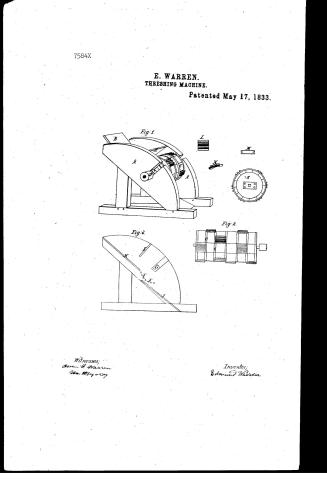
Edmund Warren's Patent Drawing for a Segment Beater Thrashing Machine

National Archives, Restored Patent Drawings (Record Group 241) · Full-size scan at the National Archives · Catalog record
Show the text on the drawing Hide (166 words)
Words on the drawing as machine-read by the National Archives; not checked. Useful mainly for searching.
130. THRASHING. / Entered / Thrashing Machines. / Jiie.2 2 / A. Cylinder Machines. / Harren's sigment beater Theashing Machine / $950 / Cyl / Patented 17th May 1833. / CLASSIFICATION / 7584-X / DIVISION. / Fig.1 / Fig.3 / Description of the Traught. / Fig.1 Berspective view of the entire machine A The Frame B The Hopper / C The Cylinder D The whirl E' The Guard board Fig. 2 sigle view of the Cyhnder / Fig. 3 One of the sides. F Holes for the Concave bars G The box in which the cy linder runs / H Groove for the Hopper -I for the buard board J for the Consuctor K End of the cyhinder / L Face of one of the Segments- M edge of the same N perspective view 0 The hoops. / Signed impresence of us / The above is a correctrepresentation of my segment beater Thrashing Machine / Quen G. Warren / Edmind Warren / Swom to before me this 28th day of Feb 1838. at the County state of New York / bow Deed
USPTO scan
The patent as scanned by the USPTO
-
 Page 1
-
 Page 2
-
 Page 3


U.S. Patent and Trademark Office · Google Patents
Show the transcription Hide (520 words)
Machine transcription (LightOnOCR) of the pages as scanned by the USPTO, most of them the handwritten copies made when the records were restored after the 1836 fire. Not checked; it can misread handwriting, so compare it with the scan.
Page 1.
7584X
E. WARREN.
THRESHING MACHINE.
Patented May 17, 1833.
Fig. 1.
Fig. 2.
Fig. 3.
Witnesses:
Owen J. Warren
John M. Squirey
Inventor:
Edmund Warren
Page 2.
7584X May 17, 1833 245
Edmund Warren
Letters Patent
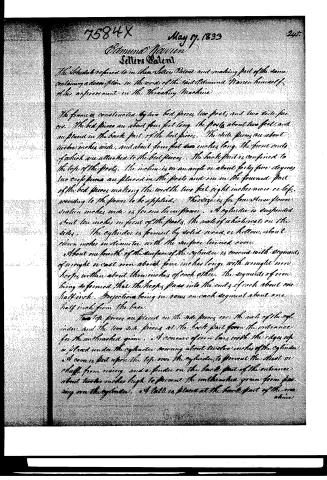
The Schedule referred to in these Letters Patent and making part of the same containing a description in the words of the said Edmund Warren himself of his improvement in the Threshing Machine.
The frame is constructed by two bed pieces, two posts and two side pieces. The bed pieces are about four feet long, the posts about two feet, and are placed in the back part of the bed pieces. The side pieces are about twelve inches wide, and about four feet two inches long, the front ends of which are attached to the bed pieces. The back part is confined to the top of the posts. The incline is on an angle of about forty-five degrees, two cross pieces are placed in the posts and one in the foremost part of the bed pieces, making the width two feet eight inches more or less, according to the power to be applied. This size is for four horse power; sixteen inches wide is for one horse power. A cylinder is suspended about ten inches in front of the posts, the ends of which rest on the sides. The cylinder is formed by solid wood, or hollow, about sixteen inches in diameter with the surface turned even. About one fourth of the surface of the cylinder is covered with segments of wrought or cast iron about four inches long with wrought iron hoops within about three inches of each other, the segments of iron being so formed that the hoops pass into the ends of each about one half inch. Projections being in rows on each segment about one half inch from the base.
Two top pieces are placed on the side pieces over the ends of the cylinder, and the two side pieces at the back part form the entrance for the unthreshed grain. A concave of iron bars with the edges up is placed under the cylinder running about twelve inches of the cylinder. A cover is put upon the top over the cylinder, to prevent the dust or chaff from rising, and a fender on the back part of the entrance about twelve inches high to prevent the unthreshed grain from passing over the cylinder. A table is placed at the back part of the machine.
Page 3.
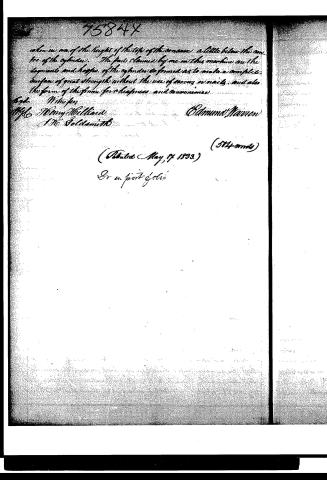
when in use, of the height of the top of the canoes a little below the centre of the cylinder. The parts claimed by me in this machine are the segments and hoops of the cylinder so formed as to make a complete surface of great strength without the use of screws or nails, and also the form of the frame for cheapness and convenience.
Edmund Naven
(514 words)
(Patented May 17, 1853.)
Or in port folio
Published accounts: journal notice
Notice in the monthly list of patents, with remarks
Journal of the Franklin Institute, new ser., vol. 12 (1833), p. 319 · View the page
22. For a Thrashing Machine; Edmund Warren, city of New York, May 17.
Remarks. The cylinder of this machine is to be made of wood; the beaters or teeth consist of separate pieces of cast iron, notched across, and are to be fastened, in rows, on to the cylinder by means of iron hoops, notches being cast in them to receive the hoops. The concave is of iron bars, and the frame is in the form of a rectangular triangle, or rather of the quadrant of a circle, standing on one of its straight sides. The claim is to the segments and hoops of the cylinder, and the form of the frame for cheapness.
About this record
- Patentee
- DATAMP
- Date
- the Name and Date index of patents, DATAMP, USPTO records
- Invention
- DATAMP
- Listed in
- the Name and Date index of patents, DATAMP, USPTO records, Jim Shaw's X-patent list, the Journal of the Franklin Institute, Burke's List of Patents (1847)
- Burke's 1847 Patent Office list gives the same patent.