

Drawings and documents
National Archives restored drawings: drawing
P.I. Clute's Patent Drawing for a Boiler Furnace

National Archives, Restored Patent Drawings (Record Group 241) · Full-size scan at the National Archives · Catalog record
Show the text on the drawing Hide (133 words)
Words on the drawing as machine-read by the National Archives; not checked. Useful mainly for searching.
122. STEAM. / 2. / [149] BONERS. Purnaces. clute / $3- V,17-pri257 / Patented 20th May Humans / Trig 3. / Explanation of Frigures / shigi. / Is a Plan of the grates. a larg front / 66 smaller gratis, i' chimmey place, / it door of ashpit, el piers. / CLASSIFICATION / sing / 7586.x / Is a side Elevation of furnace. / DIV ISION. / aa apatures for heating Iron, 66 char= / yers, cc wrehambees shut, dd blow / pipes, ee main blowpipe, f chine / ney, yg citizender Thig.3. boiter. / Fig2 / front Elevation of furnace. / Fing 4. / a charger, 6 receiver of blowpips / C C Boiler Blowpipes, d door of ashpit, / Tiny 4. / Section at h see Fig2. a furnace / b grate, e airchamber, d Blow bipe / e briler. / P.I. CLUTE, PATENTEE. / SCHENBUTADA, / N.Y. / e. / K.Klein, dei.
USPTO scan
The patent as scanned by the USPTO
-
 Page 1
-
 Page 2
-
 Page 3
-
 Page 4


U.S. Patent and Trademark Office · Google Patents
Show the transcription Hide (1,034 words)
Machine transcription (LightOnOCR) of the pages as scanned by the USPTO, most of them the handwritten copies made when the records were restored after the 1836 fire. Not checked; it can misread handwriting, so compare it with the scan.
Page 1.
7586X
P. I. Clute,
Steam-Boiler Furnace,
Patented May 20, 1833.
![Diagram of Steam-Boiler Furnace with labeled figures Fig. 1, Fig. 2, Fig. 3, and Fig. 4 showing various views and components of the furnace structure.]
Page 2.
Patent No. 7586X 257
May 20, 1833
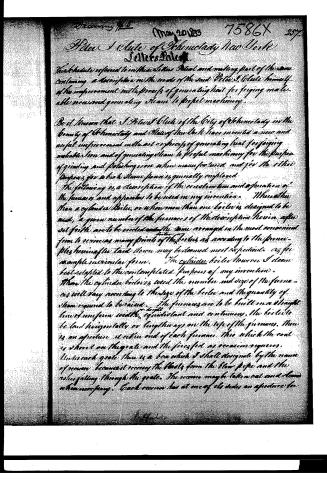
Peter S. Clute of Schenectady New York
Letters Patent.
This schedule referred to in the Letters Patent and making part of the same containing a description in the words of the said Peter S. Clute himself of his improvement in the process of generating heat for forging malleable iron and generating steam to propel machinery.
Be it known that I Peter S. Clute of the City of Schenectady in the County of Schenectady and State of New York have invented a new and useful improvement in the art or process of generating heat for forging malleable iron and of generating steam to propel machinery for the purpose of grinding and polishing iron when manufactured and for the other purposes for which steam power is generally employed.
The following is a description of the construction and operation of the furnaces and apparatus to be used in my invention. Wherever than a cylinder Boiler, or wherever more than one boiler is designed to be used, a given number of the furnaces of the description herein after set forth are to be erected and the same arranged in the most convenient form to receive as many points of the boilers as according to the principles herein after laid down may be deemed most expedient, as for example in circular form. The cylinder boiler however I deem best adapted to the contemplated purposes of my invention.
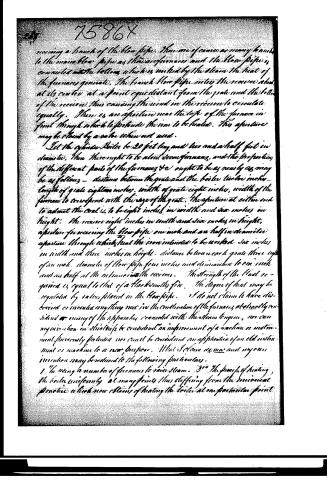
Where the cylinder boilers are used the number and size of the furnaces as well may according to the size of the boiler and the quantity of steam required to be raised. The furnaces are to be built in a straight line of uniform width, equal distant and continuous, the boiler to be laid horizontally or lengthways on the top of the furnaces. There is an aperture at either end of each furnace into which the coal is shoveled on the grate and the fires fed as occasion requires. Under each grate there is a box which I shall designate by the name of receiver because it receives the blasts from the blow pipe and the ashes falling through the grate. The receiver may be taken out and cleaned when necessary. Each receiver has at one of its sides an aperture for
Page 3.
receiving a branch of the blow pipe. There are of course as many branches to the main blow pipe as there are furnaces and the blow pipe is connected with the bellows which is worked by the steam the heat of the furnaces generate. The branch blow pipe enters the receiver about at its centre at a point equi-distant from the grate and the bottom of the receiver thus causing the wind in the receiver to circulate equally. There is an aperture near the top of the furnace in front through which to introduce the iron to be heated. This aperture may be closed by a valve when not used.
Let the cylinder boiler be 20 feet long and two and a half feet in diameter, then there ought to be about seven furnaces, and the proportion of the different parts of the furnaces &c ought to be as nearly as may be as follows - distance between the grate and the boiler twelve inches - length of grate eighteen inches, width of grate eight inches, width of the furnace to correspond with the size of the grate. The aperture at either end to admit the coal is to be eight inches in width and six inches in height. The receiver eight inches in width and six inches in height, aperture for receiving the blow pipe one inch and a half in diameter aperture through which to heat the iron intended to be worked six inches in width and three inches in height - distance between each grate three and a half feet. diameter of blow pipe four inches and diminishing to one inch and a half at the entrance into the receiver. The strength of the blast required is equal to that of a blacksmith's fire. The degree of heat may be regulated by valves placed in the blow pipe. I do not claim to have discovered or invented anything new in the construction of the furnaces abstractly considered or many of the apparatus connected with the steam engine, nor can my invention or strictness be considered an improvement of a machine or instrument severally patented nor could be considered an application of an old instrument or machine to a new purpose. What I claim as new and my own invention may be reduced to the following particulars.
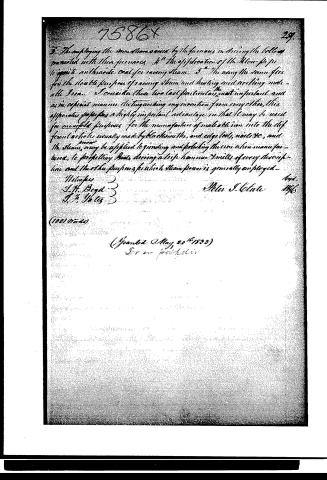
1. The using a number of furnaces to raise steam. 2. The process of heating the boiler uniformly at many points thus differing from the common practice which now obtains of heating the boiler at one particular point.
Page 4.
7586X
27.
3. The employing the same steam raised by the furnaces in driving the bellows connected with their furnaces. 4th. The application of the blow pipe to ignite anthracite coal for saving steam. 5th. The using the same fire for the double purpose of raising steam and heating and working metallic iron. I consider these two last particulars most important and as in especial manner distinguishing my invention from every other, this apparatus possesses a highly important advantage in that it may be used for manifold purposes. For the manufacture of malleable iron into the different articles usually made by blacksmiths, and edge tools, nails &c., and the steam may be applied to grinding and polishing the iron when manufactured, to polishing boats, driving a high hammer in mills of every description and the other purposes for which steam power is generally employed.
Witnesses
L. H. Boyd
J. H. Yates
Peter S. Colate
(1000 words)
(Granted May 20th 1833)
Iron patent
Published accounts: journal notice
Notice in the monthly list of patents, with remarks
Journal of the Franklin Institute, new ser., vol. 12 (1833), p. 320 · View the page
25. For apparatus for Generating Heat for the Forging of Malleable Iron, and of Steam for driving machinery; Peter J. Clute, city of Schenectady, New York, May 20.
Remarks. A steam boiler is to have under it a number of furnaces, which are to be used for the double purpose of heating iron and of generating steam. The kind of boiler preferred is the ordinary cylindrical boiler, and the furnaces stand in a row, transversely to the boiler, the furnace doors being at the sides of the stack by which it is supported. As regards the number of furnaces to each boiler, the following is given as an example. If the boiler be twenty feet long, and thirty inches in diameter, there may be seven furnaces, which may be of the following dimensions, or proportions. Distance of the grate from the boiler, one foot; length of grate eighteen inches, width eight inches; the width of the furnace must be governed by the grate. There is to be to each furnace an aperture at either end, of eight inches in width, and six in height, for the admission of coal. The distance between each grate, it is said, is to be three-eighths of an inch; this, we suppose, means the distance between the bars of the grate, as we cannot perceive how seven grates, each eight inches wide, can be made to extend twenty feet, if they are only three-eighths of an inch apart. Under each grate there is to be a box, called a receiver, by the patentee; this is to serve as an ash box, and a receiver for a blast of wind, which is to be blown into each furnace. A blowing cylinder is to be worked by a steam engine supplied from the boiler, and each furnace has a pipe which terminates in the box below the grate, all of which pipes are fed from one common main. An aperture, six inches in width, and three in height, is left, at each furnace, for the introduction of the iron to be heated, valves closing them when not employed. Whether the furnaces are to be divided from each other by a partition wall, or whether there is to be any particular arrangement of the flue, or flues, are circumstances not alluded to in any way. The claims are to the using a number of furnaces to raise steam; the heating the boiler at many different points; the employment of the steam raised by these furnaces to the blowing of the bellows; the application of the blow-pipe to ignite anthracite for raising steam; the using the same fire for the double purpose of heating iron and raising steam, this latter being considered as the most important feature of the invention. Among the things enumerated to which this apparatus may be applied, is the propelling of boats; but if the distinguishing feature of using the furnace for heating malleable iron, whilst the heat generates steam for driving machinery, be retained, there must be a travelling smithy on board the boat, a thing which some passengers might not approve. The claims are certainly too general, "the using a number of furnaces to raise steam," is a thing which has been repeatedly done, or proposed. The surrendered patent of Mr. Disbrow, noticed at No. 6, in the present list, was for using a number of furnaces to raise steam. The employment of a portion of the steam power to blow the bellows, does not carry with it the idea of originality, however original it may be with the patentee.
About this record
- Patentee
- DATAMP
- Date
- the Name and Date index of patents, DATAMP, USPTO records
- Invention
- DATAMP
- Listed in
- the Name and Date index of patents, DATAMP, USPTO records, Jim Shaw's X-patent list, the Journal of the Franklin Institute, Burke's List of Patents (1847)
- Burke's 1847 Patent Office list gives the same patent.