

Drawings and documents
USPTO scan
The patent as scanned by the USPTO
-
 Page 1
-
 Page 2
-
 Page 3


U.S. Patent and Trademark Office · Google Patents
Show the transcription Hide (957 words)
Machine transcription (LightOnOCR) of the pages as scanned by the USPTO, most of them the handwritten copies made when the records were restored after the 1836 fire. Not checked; it can misread handwriting, so compare it with the scan.
Page 1.
7591X
D. Williams.
Tailors' Measure.
Patented May 22, 1833
No.
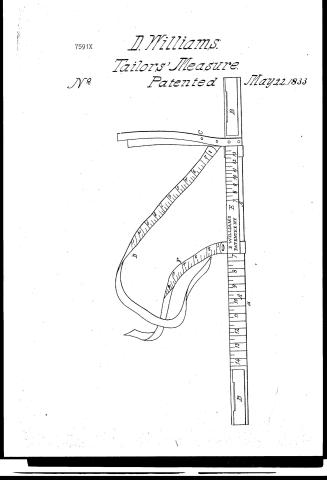
![Diagram of a tailor's measure with labeled parts A, B, C, D, E, F, and a vertical scale marked from 0 to 14. The device includes a flexible tape and a vertical ruler with markings. The text "D. WILLIAMS PATENTED NY" is visible on the vertical ruler.]
Page 2.
7591X May 22, 1833 259
Daniel Williams of the City of New York
Letters Patent May 22, 1833.
The Schedule referred to in these Letters Patent and making part of the same containing a description in the words of the said Daniel Williams himself in the art of Tailoring.
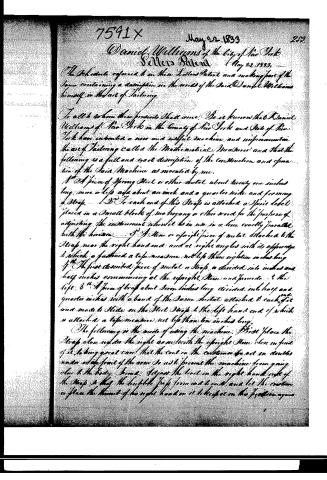
To all to whom these presents shall come, Be it known that Daniel Williams of New York in the County of New York and State of New York have invented a new and useful machine and improvement in the art of Tailoring called the Mathematical Measure and that the following is a full and exact description of the construction and operation of the said Machine as invented by me.
1st. A piece of Spring Steel or other metal about twenty-one inches long, more or less and about an inch and a quarter wide and forming a Strap.
2nd. To each end of this Strap is attached a Spirit Level placed in a small block of mahogany or other wood for the purpose of adjusting the instrument whether to be in use in a line exactly parallel with the horizon.
3rd. A Stem or upright piece of metal attached to the Strap near the right hand end and at right angles with its upper edge to which is fastened a tape measure not less than eighteen inches long.
4th. The first described piece of metal or Strap is divided into inches and half inches commencing at the upright Stem and proceeding to the left.
5th. A piece of strap about seven inches long divided into half and quarter inches with a band of the same metal attached to each end and made to slide on the Steel Strap to the left hand end of which is attached a tape measure not less than ten inches long.
The following is the mode of using the machine: First place the Strap close under the right arm with the upright Stem close in front of it taking great care that the coat on the customer be not in doubt under or in front of the arm so as to prevent the machine from going close to the body. Second, Adjust the level on the right hand end of the Strap so that the bubble may from end to end and let the customer or place the thumb of his right hand on it to keep it in his position again.
Page 3.
7591X
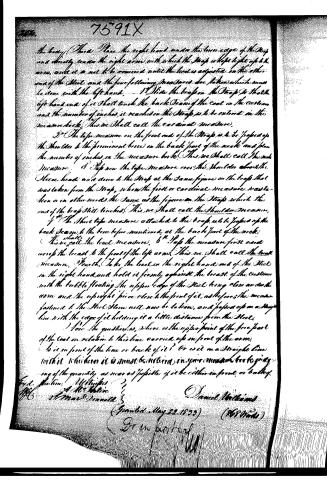
the body. Third. Place the right hand under the lower edge of the strap and directly under the right arm, with which the strap is kept tight up to the arm, and let it so not to be removed until the level is adjusted on the other end of the stick and the four following measures are taken, which must be done with the left hand. 1st Slide the strap on the strap so that the left hand end of it shall touch the back seam of the coat on the custom and the number of inches it reaches on the strap is to be entered in the measure book. This we shall call the cardinal measure.
2nd The tape measure on the front end of the strap is to be passed up the shoulder to the prominent bone on the back part of the neck and then the number of inches in the measure book. This we shall call the neck measure. 3rd Pass now the tape measure over the shoulder about the sleeve head and down to the strap at the same figure on the strap that was taken from the strap, when the first or cardinal measure was taken or in other words the same as the figure on the strap which the end of the strap still touched. This we shall call the shoulder measure.
4th The short tape measure attached to the strap is to be passed up the back seam to the bone before mentioned at the back part of the neck. This we call the back measure. 5th Pass the measure first used across the breast to the front of the left arm. This we shall call the breast measure. Fourth. Take the level in the right hand end of the stick in the right hand and hold it firmly against the breast of the custom with the bubble floating the upper edge of the stick being close under the arm and the upright piece close to the front of it, as before, the measure fastened to the stick. Now will now be taken, and passed up on a straight line with the edge of it holding it a little distance from the stick.
Now the question is, where is the upper point of the fore part of the coat in relation to this line carried up in front of the arm, is it in front of the line or back of it? Or is it on a straight line with it, whichever it is must be written in your measure book, giving of the quantity as near as possible if it be either in front or back of the line.
Evd. the line. M. M. M. M. M. M. M. M. …
Published accounts: journal notice
Notice in the monthly list of patents, with remarks
Journal of the Franklin Institute, new ser., vol. 12 (1833), p. 321 · View the page
26. For a Mathematical Measurer for the use of Taylors; Daniel Williams, city of New York, May 22.
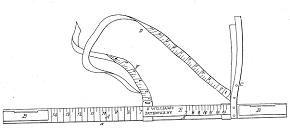
Remarks. When Dr. Gregory published his " Mathematics for Practical Men," we were apprehensive that he was more liberal than correct in taking it for granted that all mechanics understood algebra; we have now, however, so many mathematical measures introduced by one class of mechanics as to afford a presumption that the estimate of the Doctor had some foundation in fact. As we have already put in the plea of non-compos, when the art of cutting cloth in such a way as to adapt it to the various contours of the human form, is the subject of discussion, we shall not attempt to give a particular description of this new instrument for the laying down of plain and spherical triangles for this purpose; we will remark, however, that the base of the instrument is a straight scale, having spirit levels at each end, to place it horizontally upon the back, or elsewhere; and that there are two measures divided into inches, rising rectangularly from it, intended to ascertain the latitude, longitude, or declination of the body terrestrial. We presume that there is much of novelty in the affair; and the patentee appears to think it altogether new, as he has not made any claim, either particular or general.
DATAMP: illustration
Illustrations from DATAMP
DATAMP (Directory of American Tool and Machinery Patents), via the Internet Archive · Archived DATAMP page
About this record
- Patentee
- DATAMP
- Date
- the Name and Date index of patents, DATAMP, USPTO records
- Invention
- DATAMP
- Listed in
- the Name and Date index of patents, DATAMP, USPTO records, Jim Shaw's X-patent list, the Journal of the Franklin Institute, Burke's List of Patents (1847)
- Burke's 1847 Patent Office list gives the same patent.