

Drawings and documents
National Archives restored drawings: drawing
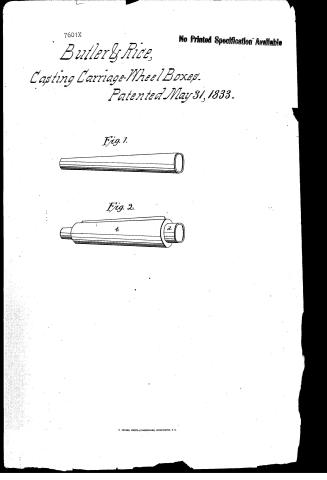
William Butler and E. B. Rice's Patent Drawing for Castiong Carriage Wheel Boxes

National Archives, Restored Patent Drawings (Record Group 241) · Full-size scan at the National Archives · Catalog record
Show the text on the drawing Hide (142 words)
Words on the drawing as machine-read by the National Archives; not checked. Useful mainly for searching.
22. METAL FOUNDING. / my / IN MOLDED MOLDS. / molds theres / Hollow Ware. / ting / Boxes Strem / CLASSI ICATION / 760/- X / haller / W m BUTLER & E.B.RICE. / DIVISION. / Casting Carriage Wheel Boxes. / Patented 31 may 1833. / Patented Thagont 1833 / Fig 1. / follow usen con in Lend mauca / Wi make use of the tube because / when oh metal as prined uhun it / Fig 2. / it becomes seally heated and / expanses f being bollow th and is / a. / The bolino mm and / permitted L ponso freely through / with a bire cush upon it / cools vt queko than / advacted a metal Geermy / Referenees / Fig the tube / Fig2. the tube a with a lox l upon it / Patent Office 30" June 1898, / Made Made under the direction of the Commipioner of / Patents in conformity with act 30 March 1837 / with
USPTO scan
The patent as scanned by the USPTO
-
 Page 1
-
 Page 2
-
 Page 3


U.S. Patent and Trademark Office · Google Patents
Show the transcription Hide (701 words)
Machine transcription (LightOnOCR) of the pages as scanned by the USPTO, most of them the handwritten copies made when the records were restored after the 1836 fire. Not checked; it can misread handwriting, so compare it with the scan.
Page 1.
7601X
No Printed Specification Available
Butler & Rice,
Casting Carriage-Wheel Boxes.
Patented May 31, 1833.
Fig. 1.
Fig. 2.
H. PETERS, PHOTO-LITHOGRAPHER, WASHINGTON, D.C.
Page 2.
May 31, 1839
William Butler & Edward B. Rice
Letters Patent
The Schedule referred to in these Letters Patent and making part of the same containing a description in the words of the said William Butler and Edward B. Rice themselves of their improvement in the method of casting Boxes for wheels of Carriages.
To all people to whom these presents shall come.
Be it known that We William Butler, Founder & Edward B. Rice Blacksmiths both of Worcester in the County of Worcester & commonwealth of Massachusetts have invented a new and useful improvement in the method of casting Boxes for the wheels of carriages by means of a hollow iron Core & that the following is a full and exact description of the construction of the same as invented or improved by us.
Many attempts have been made to cast wheel Boxes in such a way as to have the inside of the Box hard and smooth but thus far it is believed that all devices to accomplish so desirable an object have utterly failed. The common method is to cast them in sand which generally leaves the inside of the Box so rough & uneven that before the axle tree is put in the Box is removed or bored out. And if the iron be hard this method of making it smooth is allowed with very considerable expense & to avoid this difficulty, soft iron is selected for the casting and the result is that the Boxes are very soon worn out.
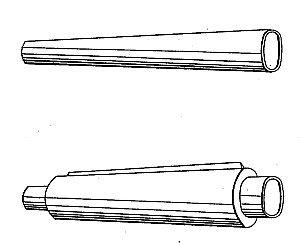
The object of our improvement is so to cast the Box that the inside surface of it shall be both hard and smooth. Instead of making the core which forms the opening whole thro' the Box for the axle tree of sand we make the use of an iron tube. The tube may be made of iron or any composition of metals that will not melt when the melted iron is poured around it. The tube is large or small according to the size of the box & wheel. The one we have made is of thick steel iron and the outside surface made smooth.
Page 3.
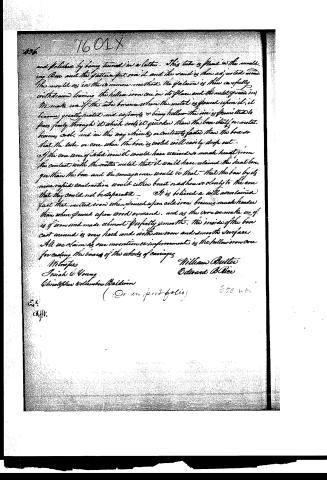
and solidified by being turned in a lathe. This tube is placed in the moulding box and the pattern put on it and the sand is then adjusted around the mould as in the common method. The pattern is then carefully withdrawn leaving the hollow iron core in its place and the metal poured in. We make use of the tube because when the metal is poured upon it, it becomes greatly heated and expands, and being hollow the air is permitted to pass freely through it which cools it quicker than the box itself or metal becomes cool, and in this way shrinks or contracts faster than the box so that the tube or core when the box is cooled will easily drop out.
If the core was of solid iron it would have received so much heat from the contact with the molten metal that it would have retained the heat longer than the box and the consequence would be that the box by its more rapid contraction would either burst or draw so closely to the core that they could not be separated. It is believed a well-ascertained fact that melted iron when poured upon cold iron becomes much harder than when poured upon wood or sand, and as the core we make use of is of iron and made almost perfectly smooth, the inside of the box cast around is very hard and within an even and smooth surface.
All we claim as our invention or improvement is the hollow iron core for casting the boxes of the wheels of carriages.
Witnesses
William Butler
Edward Aldice
Josiah C. Young
Christopher Columbus Baldwin
(Or an imperfect copy) 650 words
Published accounts: journal notice
Notice in the monthly list of patents, with remarks
Journal of the Franklin Institute, new ser., vol. 12 (1833), p. 326 · View the page
39. For an improvement in the method of Casting Boxes for Carriage Wheels; William Butler, and Edward B. Rice, Worcester, Worcester county, Massachusetts, May 31.
Remarks. The object in view is to make cast iron boxes which shall be hard and smooth in the inside, so as to be durable, and not to require boring, or rimming out. The method of attaining the end, for which this patent is obtained, is the using of a hollow metal core: that which the patentees have employed being strong sheet iron, truly turned. The sheet iron, it is said, heats readily by the pouring of the metal upon it, and thus becomes expanded; whilst, by its cooling more rapidly than the body of the box, it contracts, and is readily detached from it, when the work is taken from the flask. With a solid core this is not the case, the metal being set before the core has undergone much expansion, which causes the box to crack, or to adhere so firmly to the core that it cannot be removed.
DATAMP: illustration
Illustrations from DATAMP

DATAMP (Directory of American Tool and Machinery Patents), via the Internet Archive · Archived DATAMP page
About this record
- Patentee
- DATAMP
- Date
- the Name and Date index of patents, DATAMP, USPTO records
- Invention
- DATAMP
- Listed in
- the Name and Date index of patents, DATAMP, USPTO records, Jim Shaw's X-patent list, the Journal of the Franklin Institute, Burke's List of Patents (1847)
- Burke's 1847 Patent Office list gives the same patent.