

Drawings and documents
National Archives restored drawings: drawing
Matthias W. Baldwin's Patent Drawing for Wheels for Locomotive and Railroad Cars

National Archives, Restored Patent Drawings (Record Group 241) · Full-size scan at the National Archives · Catalog record
Show the text on the drawing Hide (117 words)
Words on the drawing as machine-read by the National Archives; not checked. Useful mainly for searching.
White / $250 / TS / what / Matthias W.Baldwin / 108. Railway Rolling Stock,' / Wheels, Spokes, / Metallic, Detachable, / CLASSIFICATION / Wheels for Locomotions and Railwad Cars. / Vol.it. ps. 403. / 7611- X / DIVISION. / Tig.1. / Tiy.2. / Sig.3. / Patented June 29th 1833. / Shokes of wood are metal / Jy.5. Tig. / Inferences. / Fig.1. Whell cast of handened brafs. / Tig.2 Lideview. / Ty.3 Lection. / Jigh Rim of hardened brap. / 6' / a aaaaa &. logements / b. spokes of wood / 6' spoke of iron or other metal. / Patent office becomy / Jy:5 Lection of zim. / made under the direction of the / Commificater of Patents in conformity with Ast of / b. / 3 march 183% / ML. sumoth / ch.d, / Commin ioner of Patents. / Jy.4.
USPTO scan
The patent as scanned by the USPTO
-
 Page 1
-
 Page 2
-
 Page 3


U.S. Patent and Trademark Office · Google Patents
Show the transcription Hide (513 words)
Machine transcription (LightOnOCR) of the pages as scanned by the USPTO, most of them the handwritten copies made when the records were restored after the 1836 fire. Not checked; it can misread handwriting, so compare it with the scan.
Page 2.
7611X June 29, 1833
Matthias W Baldwin of Philadelphia
Letters Patent
The Schedule referred to in these Letters Patent and making part of the same containing a description in the words of the said Matthias W Baldwin himself of his improvement in the manufacture of wheels for Locomotive Engines and cars to run upon Rail Roads.
To all whom it may concern, Be it known, that I Matthias W Baldwin of the city of Philadelphia, have invented a new and useful manufacture of wheels for Locomotive Engines and cars to run upon rail roads, and that the following is a full and exact description of my said Invention.
Instead of making the wheels for the carriages of Locomotive Engines and of other cars or carriages to be used upon rail roads of cast iron or of a combination of cast and wrought iron, or of wood combined with cast or wrought iron or with both as they have been heretofore made, I cast the rims of such wheels as well in most instances as the spokes and hubs or navels in one piece with the rims of a composition of metal known to workmen under the name of hardened brass or gun metal. It is not necessary for me to designate the proportions in which the respective metals are mixed, which form the hardened brass or gun metal, as these will vary with the degree of hardness desired in the rims or broad of the wheel in a manner well known to those conversant with the casting of brass and its compounds.
When it is desirable to increase the adhesion between the rail and the wheel it may be found necessary to make the wheels proportionally softer by decreasing the quantity often entering into the composition of them or even to cast them of soft brass or copper entirely. I do not intend to confine myself to any particular
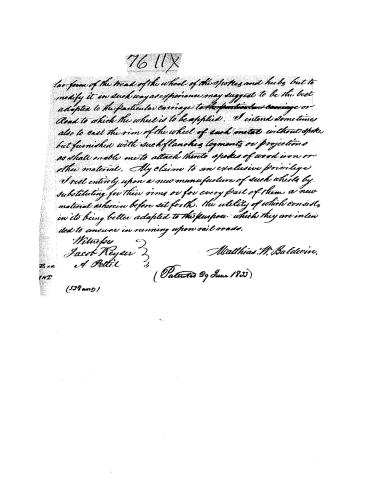
Page 3.
7611X
far from of the tread of the wheel of the spokes and hubs but to modify it in such way as experience may suggest to be the best adapted to the particular carriage to the particular carriage or road to which the wheel is to be applied. I intend sometimes also to cast the rim of the wheel of each metal without spokes but furnished with such flanches, logments or projections as shall enable me to attach thereto spokes of wood, iron or other material. My claims to an exclusive privilege I rest entirely upon a new manufacture of such wheels by substituting for their rims or for every part of them a new material as herein before set forth. The utility of which consists in its being better adapted to the purpose which they are intended to answer in running upon rail roads.
Witness
Jacob Reyer
A. Petit
Matthias H. Baldwin.
(Patented 29 June 1833)
(528 and 5)
Published accounts: specification
Specification printed in the Journal of the Franklin Institute
Journal of the Franklin Institute, new ser., vol. 12 (1833), p. 425 · View the page
Text of the specification as printed in the Journal, from OCR; not proofread.
Specification of a patent for a new manufacture of Wheels for Locomotive Engines and Cars, to run upon Rail-roads. Granted to MATTHIAS W. BALDWIN, city of Philadelphia, June 29, 1833. To all whom it may concern, be it known, that I, Matthias W. Baldwin, of the city of Philadelphia, have invented a new and useful manufacture of wheels for locomotive engines and cars, to run upon rail-roads, and that the following is a full and exact description of my said invention. VOL. XII.-No. 6.-DECEMBER, 1833. 54 BREED'S Manufacture of Hose. Instead of making the wheels for the carriages of locomotive engines, and of other cars, or carriages, to be used upon rail-roads, of cast iron, or of a combination of cast and wrought iron, or of wood combined with cast or wrought iron, or with both, as they have been heretofore made, I cast the rims of such wheels, as well as in most instances the spokes and hubs, or naves, in one piece with the rims, of a composition of metal known to workmen under the name of hardened brass, or gun metal. It is not necessary for me to designate the proportions in which the respective metals are mixed which form the hardened brass or gun metal, as these will vary with the degree of hardness desired in the rim, or tread, of the wheel, in a manner well known to those conversant with the casting of brass and its compounds. Where it is desirable to increase the adhesion between the rail and the wheel, it may be found necessary to make the wheel proportionably softer, by decreasing the quantity of tin entering into the composition of them, or even to cast them of soft brass or of copper entirely. I do not intend to confine myself to any particular form for the tread of the wheel, or for the spokes and hub; but to modify it in such way as experience may suggest to be the best adapted to the particular carriage or road to which the wheel is to be applied. I intend sometimes also, to cast the rim of the wheel of such metal without spokes, but furnished with such flanches, lodgements, or projections, as shall enable me to attach thereto, spokes of wood, iron, or other material. My claim to an exclusive privilege I rest entirely upon a new manufacture of such wheels, by substituting for their rims, or for every part of them, a new material as hereinbefore set forth, the utility of which consists in its being better adapted to the purposes which they are intended to answer in running upon rail-roads. MATTHIAS W. BALDWIN.
Published accounts: journal notice
Notice in the monthly list of patents, with remarks
Journal of the Franklin Institute, new ser., vol. 12 (1833), p. 413 · View the page
54. For a New manufacture of Wheels for Rail-road Cars; Matthias W. Baldwin, city of Philadelphia, June 29.
Remarks. (See the specification.)
Published accounts: journal notice
Notice in the monthly list of patents, with remarks
Journal of the Franklin Institute, new ser., vol. 12 (1833), p. 426 · View the page
I do not intend to confine myself to any particular form for the tread of the wheel, or for the spokes and hub; but to modify it in such way as experience may suggest to be the best adapted to the particular carriage or road to which the wheel is to be applied. I intend sometimes also, to cast the rim of the wheel of such metal without spokes, but furnished with such flanches, lodgements, or projections, as shall enable me to attach thereto, spokes of wood, iron, or other material. My claim to an exclusive privilege I rest entirely upon a new manufacture of such wheels, by substituting for their rims, or for every part of them, a new material as hereinbefore set forth, the utility of which consists in its being better adapted to the purposes which they are intended to answer in running upon rail-roads. MATTHIAS W. BALDWIN. Specification of a patent for manufacturing Hose for Fire Engines, and for the Foundations of Machine Cards. Granted to SAMUEL D. BREED, city of Philadelphia, June 29, 1833.
Remarks. To all whom it may concern, be it known, that I, Samuel D. Breed, of the city of Philadelphia, have invented a new and useful mode or method of manufacturing, from cloth, the hose used for fire engines, and for the conveyance of water or other fluids for various purposes; and also of so preparing the same material by a similar process, as to serve as a foundation for machine and other cards to be set with wire teeth; both of which articles have usually been made of leather. And I do hereby declare that the following is a full and exact description of my said invention. The cloth employed for either of the above purposes is to consist of two or more thicknesses, saturated with, and cemented together by, a solution of caoutchouc, sometimes called gum elastic, or India Mode of Cleansing Wool. rubber. I dissolve the caoutchouc in rectified spirits of turpentine, naphtha, oil of sassafras, or any of the other menstrua in which that substance is soluble; to which solution I sometimes add resinous substances, or drying oils, should I deem such addition to be necessary; always depending however upon the properties possessed by caoutchouc, and allowing it to form the main body of the solution or varnish. When hose is to be made, I cut the cloth into strips, and wind it spirally round a cylinder of metal, wood, or any other suitable material of the proper size; saturating it either before or after it is wound with the prepared solution, or varnish. I cut the cloth of such a width as to allow it to lap over in winding, one or two inches, or any other desired distance, taking care in every successive winding so to lap as to break joints with the former. Any number of thicknesses of cloth necessary to give the strength required, may be thus used. For this, no rule can be given, as it will depend not only on the use to which the hose is to be put, but also upon the strength of the material itself. After this first saturation the varnish is allowed to dry, when another coating thereof may be given, and the hose be afterwards removed from the cylinder. When I prepare the cloth to serve as a substitute for leather, in forming the foundation of cards, I in like manner saturate it with the before named varnish, cementing as many thicknesses together as the foundation may require. The cloth is then subjected to heavy pressure, until it is dry, or nearly so. When perfectly dried, the teeth are set in the usual way. I do not claim to be the inventor of the above named varnish, or of the application of it to render cloth water proof; but what I do claim as my invention, is the manufacturing of hose, and of a foundation for cards, of cloth cemented together in two or more thicknesses, in the manner hereinbefore set forth, and thus employing it as a substitute for leather in the formation of these articles. SAMUEL D. BREED. Method of cleansing wool from its grease, and economising the residue. M. Durcet, who has long been consulted by manufacturers, advised the following method, which was tried with complete success. Immerse the wool, well washed from dirt, in a vessel containing spirits of turpentine, and let it remain from thirty-six to forty-eight hours. Withdraw and immerse a fresh quantity. By means of a press, force out all the adhering spirit, spread the wool out to dry, and, when it is to be used, wash it in warm water containing a little alkali. When the spirits of turpentine will no longer act upon, or remove, the grease, distil it for fresh use, and the matter remaining in the still, treated with soda, will make good soap. [New Ed. Philos. Jour. Clay for Sculptors. Sculptors who prepare their models in clay, have frequently occaoften experience much difficulty from the drying and shrinking of the sion to leave their work for a long time unfinished; and, in such cases, material. It is well to know, that, by the addition of from ten to fifteen per cent. of muriate of lime, well worked or kneaded into this clay, it will be preserved for almost
About this record
- Patentee
- DATAMP
- Date
- the Name and Date index of patents, DATAMP, USPTO records
- Invention
- DATAMP
- Listed in
- the Name and Date index of patents, DATAMP, USPTO records, Jim Shaw's X-patent list, the Journal of the Franklin Institute, Burke's List of Patents (1847)
- Burke's 1847 Patent Office list gives the same patent.
Shaw: also: Baldwin, Matthias W. 1833-06-29