

Drawings and documents
National Archives restored drawings: drawing
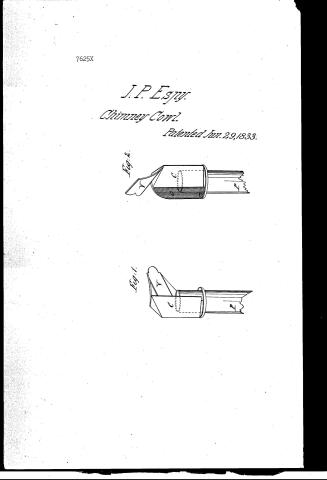
James P. Espy's Patent Drawing for a Chimney Cap fot Steamboats, Locomotives, and Chimneys for Houses

National Archives, Restored Patent Drawings (Record Group 241) · Full-size scan at the National Archives · Catalog record
Show the text on the drawing Hide (63 words)
Words on the drawing as machine-read by the National Archives; not checked. Useful mainly for searching.
/1- 93 PNEUMATICS. Calorific- Kimmine / signe V / M The / ROTARY. / Chimneys and Cowls. / James P.Espy / Chimney bap for Steamboat, Locomotives Chimmiesfor Houses. / CLASSIFICATION / 29th / 7625.x / DIVISION. / Fig.2. / colo / Aig 1. bap for chimries. Jjg.2. Capitor Ne: / P Top of chimney. C chimney bap. V. vane O'wire gauze.-
USPTO scan
The patent as scanned by the USPTO
-
 Page 1
-
 Page 2
-
 Page 3


U.S. Patent and Trademark Office · Google Patents
Show the transcription Hide (749 words)
Machine transcription (LightOnOCR) of the pages as scanned by the USPTO, most of them the handwritten copies made when the records were restored after the 1836 fire. Not checked; it can misread handwriting, so compare it with the scan.
Page 1.
7625X
J.P. Esny.
Chimney Cowl.
Patented Jun. 29, 1833.
Fig. 2.
Fig. 1.
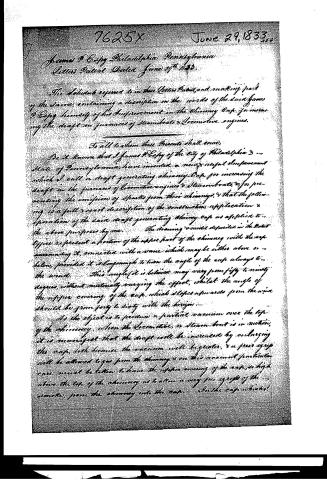
Page 2.
7625X June 29, 1833
James P. Esey Philadelphia Pennsylvania
Letters Patent Dated June 29th 1833
The Schedule referred to in these Letters Patent, and making part of the same, containing a description in the words of the said James P. Esey himself of his improvement in the Chimney Cap, for increasing the draft in furnaces of Steamboats & Locomotive engines.
To all to whom these Presents shall come:
Be it known that I James P. Esey of the City of Philadelphia & State of Pennsylvania, have invented a new & useful Instrument which I call a draft generating chimney Cap, for increasing the draft in the furnaces of Locomotive engines & Steamboats, & for preventing the emission of Sparks from their chimneys, & that the following is a full & exact description of the construction, application & operation of the said draft generating chimney cap as applied to the above purposes by me. The drawing & model deposited in the Patent Office represent a portion of the upper part of the chimney with the cap surrounding it, connected with a vane which may be either above or below, provided it is long enough to turn the angle of the cap always to the wind. This angle it is believed may vary from fifty to ninety degrees, without materially varying the effect, whilst the angle of the upper covering of the cap, which slopes upwards from the wind should be from forty to sixty with the horizon.
As the object is to produce a partial vacuum over the top of the chimney, when the Locomotive, or Steam boat is in motion, it is manifest that the draft will be increased by enlarging the cap, both because the vacuum will be greater, & a free escape will be allowed to gas from the chimney, & on this account particular care must be taken to have the upper covering of the cap, so high above the top of the chimney as to allow a very free escape of the smoke, from the chimney into the cap. In the cap which
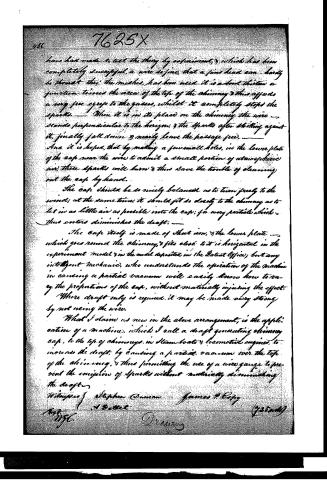
Page 3.
have had made to test the thing by experiment, which has been completely successful, a wire so fine, that a pin's head can hardly be thrust through the meshes, has been used. It is about thirteen or fourteen times the area of the top of the chimney, and thus affords a very free escape to the gases, whilst it completely stops the sparks. When it is in its place on the chimney, the wire stands perpendicular to the horizon, and the sparks after striking against it, finally fall down and nearly leave the passage free. And it is hoped, that by making a few small holes, in the lower plate of the cap near the wire to admit a small portion of atmospheric air, these sparks will burn and thus save the trouble of cleaning out the cap by hand.
The cap should be so nicely balanced as to turn freely to the wind; at the same time, it should fit so closely to the chimney as to let in as little air as possible into the cap; for every particle which thus enters diminishes the draft.
The cap itself is made of sheet iron, and the lower plate, which goes round the chimney, and fits close to it is horizontal in the experiment model and in the model deposited in the Patent Office; but any intelligent mechanic, who understands the operation of the machine in causing a partial vacuum will easily know how to vary the proportions of the cap, without materially injuring the effect. Where draft only is required, it may be made very strong by not using the wire.
What I claim as new in the above arrangement, is the application of a machine, which I call a draft generating chimney cap, to the top of chimneys in steam boats and locomotive engines, to increase the draft, by causing a partial vacuum over the top of the chimney, and thus permitting the use of a wire gauze to prevent the emission of sparks without materially diminishing the draft.
Witnesses: Stephen O'connor James P. Carey
J. Dallet
N. J. C.
Published accounts: journal notice
Notice in the monthly list of patents, with remarks
Journal of the Franklin Institute, new ser., vol. 12 (1833), p. 402 · View the page
22. For a Chimney Cap for increasing the draft in furnaces of steam-boats and locomotive engines; James P. Espy, city of Philadelphia, June 29.
Remarks. (See the specification.)
Published accounts: journal notice
Notice in the monthly list of patents, with remarks
Journal of the Franklin Institute, new ser., vol. 12 (1833), p. 418 · View the page
Where there is much travelling upon a road so improved, I lay two sets, or four continuous lines, of tracks, one set for the going, and one for the returning carriages. This will be found most convenient; although to turn out of the tracks, when carriages meet, will not be attended with difficulty, as one side only of the turning out carriage would have to be raised over a small obstacle. I am aware that some of the advantages of such a track road may be gained by laying timber, &c. as above, and by furrowing, guttering, or rebating, both tracks to guide the wheels, but I prefer to gutter, or groove, one only. What I claim as my invention or improvement, is the laying of tracks of wood, or other suitable material, one of which shall be furrowed, grooved, or guttered, in the manner, and for the purpose, hereinbefore set forth. JOHN S. WILLIAMS. Specification of a patent for an improvement in the Chimney Cap for increasing the draft in the Furnaces of Steam-boats, and Locomotive Engines. Granted to JAMES P. ESPY, city of Philadelphia, June 29, 1833.
Remarks. To all to whom these presents shall come, be it known, that I, James P. Espy, of the city of Philadelphia, and state of Pennsylvania, have invented a new and useful improvement, which I call a draft generating chimney cap. for increasing the draft in the furnaces of locomotive engines and steam-boats, and for preventing the emission of sparks from their chimnies, and that the following is a full and exact description of the construction, application, and operation, of the said draft generating chimney cap, as applied to the above purposes by me. The drawing and model deposited in the patent office, represent a portion of the upper part of the chimney with the cap surrounding it, connected with a vane which may be either above or below, provided it is long enough to turn the angle of the cap always to the wind. This angle, it is believed, may vary from fifty to ninety degrees without materially varying the effect, whilst the angle of the upper covering of the cap, which slopes upwards from the wind, should be from forty to sixty with the horizon. As the object is to produce a partial vacuum over the top of the ESPY'S Improved Chimney Cap. chimney, when the locomotive, or steam-boat, is in motion, it is manifest that the draft will be increased by enlarging the cap, both because the vacuum will be greater, and a freer egress will be allowed to gas from the chimney; and on this account particular care must be taken to have the upper covering of the cap so high above the top of the chimney as to allow a very free egress of the smoke from the chimney into the cap. In the cap which I have had made to test the theory by experiment, and which has been completely successful, a wire gauze so fine that a pin's head can hardly be thrust through the meshes, has been used, it is about thirteen or fourteen times the area of the top of the chimney, and thus affords a very free egress to the gases, whilst it completely stops the sparks. When it is in its place on the chimney the wire gauze stands perpendicular to the horizon, and the sparks after striking against it, finally fall down, and nearly leave the passage free. And it is hoped that, by making a few small holes in the lower plate of the cap, near the wire, to admit a small portion of atmospheric air, these sparks will burn, and thus save the trouble of cleaning out the cap by hand. The cap should be so nicely balanced as to turn freely to the wind; at the same time it should fit so closely to the chimney as to let in as little air as possible into the cap, for every particle which thus enters diminishes the draft. The cap itself is made of sheet iron, and the lower plate which goes round the chimney, and fits close to it, is horizontal, in the experiment model, and in the model deposited in the patent office; but any intelligent mechanic, who understands the operation of the machine in causing a partial vacuum, will easily know how to vary the proportions of the cap, without materially injuring the effect. Where draft only is required, it may be made very strong by not using the wire. What I claim as new in the above arrangement, is the application of a machine, which I call a draft generating chimney cap, to the top of chimnies in steam-boats and locomotive engines, to increase the draft by causing a partial vacuum over the top of the chimney, and thus permitting the use of a wire gauze to prevent the emission of sparks without materially diminishing the draft. JAMES P. ESPY. t B A D A, The chimney. B, Neck of the cap. C, Opening of the cap, D, Vane, ESPY'S Improved Chimney Cap. Mr. Espy has received the following certificates of the entire success of his invention, and he feels satisfied that the most decided advantage will result from the adoption of it, not only by locomotives, but by steam-boats incommoded by ordinary sparks, and not having draft enough to bear a wire gauze at the top of the smoke pipe; for the draft cap and its wire gauze the draft will be much greater than their present smoke pipes afford. Mr. Espy will receive communications on the subject (post paid) at Philadelphia.
About this record
- Patentee
- DATAMP
- Date
- the Name and Date index of patents, DATAMP, USPTO records
- Invention
- DATAMP
- Listed in
- the Name and Date index of patents, DATAMP, USPTO records, Jim Shaw's X-patent list, the Journal of the Franklin Institute, Burke's List of Patents (1847)
- Burke's 1847 Patent Office list gives the same patent.